How to Add Random Delays Between Actions to Mimic Humans
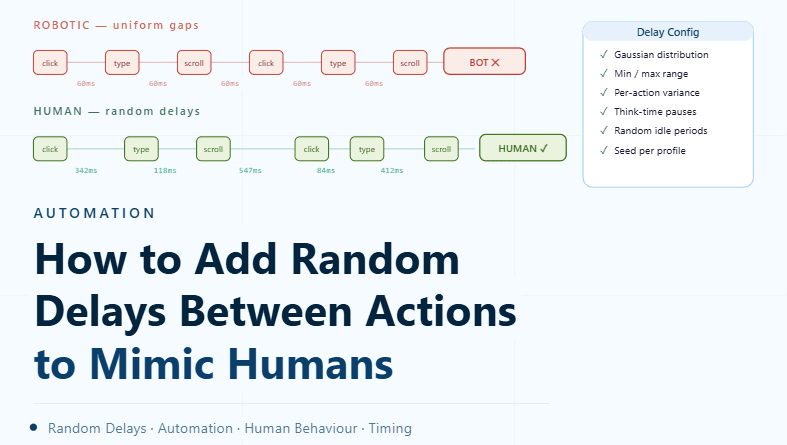
By the end of this tutorial, you will understand how to introduce timing variation between actions so your automation flows feel natural instead of rigid and repetitive. Systems that execute steps instantly or at perfectly fixed intervals can behave unnaturally, which reduces stability and predictability over time. To follow along, you only need a basic understanding of how automated actions are triggered. The focus here is on designing realistic timing patterns rather than writing code. This setup typically takes less than an hour to structure properly, but it has a strong impact on overall behavior. If you manage multiple workflows, Appilot can help orchestrate execution while your timing system ensures consistent and natural pacing. You will build a system that varies delays intelligently, maintains flow consistency, and avoids predictable patterns.
Why Fixed Timing Looks Unnatural
When actions occur at identical intervals every time, the behavior becomes predictable and mechanical. Real interactions rarely follow exact timing patterns, and small variations naturally occur between actions. Introducing variability removes rigid timing and creates smoother flow.
Understanding Natural Human Timing
Human behavior includes pauses, hesitations, and differences in reaction time depending on context. Some actions happen quickly, while others take longer due to reading, thinking, or adjusting. Replicating this variation helps create more realistic interaction pacing.
Using Ranges Instead of Fixed Delays
Instead of defining a single delay value, it is better to use a range of possible delays. Each action can then select a value within that range, ensuring that timing is never identical. This approach creates natural variability without losing control.
Varying Delays Based on Action Type
Different actions should have different delay characteristics. For example, simple clicks may have shorter delays, while actions that involve reading or decision-making may require longer pauses. Matching delay length to action type improves realism.
Introducing Occasional Longer Pauses
Humans sometimes pause for longer periods between actions. Adding occasional longer delays prevents the system from appearing too consistent and introduces natural breaks in activity. These pauses help create a more organic flow.
Avoiding Uniform Randomness
Purely random timing without structure can create unrealistic patterns. Delays should vary within controlled ranges and follow logical patterns based on context. This ensures that timing remains believable and consistent.
Aligning Delays with Workflow Complexity
More complex workflows naturally involve longer and more varied delays. Simpler workflows can operate with shorter intervals. Adjusting delay patterns based on complexity keeps interactions aligned with expected behavior.
Preventing Pattern Repetition
Even with variation, patterns can form if delays follow the same sequence repeatedly. Introducing slight randomness in both timing and sequence helps avoid this issue and maintains unpredictability.
Testing Timing Behavior
After configuring delays, it is important to observe how actions flow in real scenarios. Testing ensures that timing feels natural and does not slow down or disrupt workflows unnecessarily.
Monitoring and Adjusting Over Time
Timing requirements may change as workflows evolve. Monitoring behavior helps identify whether delays are too short, too long, or too consistent. Continuous adjustment ensures long-term effectiveness.
Integrating Delay Logic into Automation Systems
Delay configuration should be part of your overall automation design rather than an isolated feature. Integrating it ensures that all actions follow consistent timing principles across workflows.
Scaling Timing Control with Appilot
At this stage, your delay system works locally and improves interaction pacing. As the number of workflows increases, maintaining consistent timing manually becomes more complex. This is where Appilot becomes useful because it helps orchestrate workflows while your configuration ensures that all actions follow natural timing patterns.
FAQ
Q1: What are random delays in automation?
They are variable pauses between actions to mimic natural timing.
Q2: Why not use fixed delays?
Because fixed timing creates predictable and mechanical behavior.
Q3: How do I choose delay ranges?
Based on the type and complexity of each action.
Q4: Can delays be too random?
Yes, uncontrolled randomness can look unrealistic, so structure is important.
Q5: Do I need Appilot for this setup?
No, you can configure it locally. Appilot becomes useful when scaling workflows.
Conclusion
Adding random delays between actions is essential for creating natural and consistent automation behavior. By using controlled ranges, varying delays based on context, and avoiding repetitive patterns, you can build a system that feels more realistic. Start by defining delay rules, test their impact, and refine over time. Once this system is in place, your automation becomes smoother and more predictable.