How to Automate Etsy Listing Renewals

Etsy listing renewals seem simple when you have only a few products. A listing expires, you renew it, and the store keeps moving. But once your catalog grows, products begin expiring at different times, seasonal items need to come back at the right moment, and manual renewal becomes another repetitive task sitting in the middle of your daily store operations.
The real issue is not only the time required to renew listings. It is the inconsistency that appears when renewal depends entirely on memory. One listing gets renewed immediately because someone notices it. Another stays expired for days because nobody checked. Seasonal products disappear during important selling periods, and older listings stop getting visibility simply because they were forgotten.
That is why more Etsy sellers want to automate listing renewals. Instead of relying on manual checks, automation turns renewals into a structured workflow. With the right setup, products can be reviewed, renewed, prioritized, and tracked automatically without requiring someone to constantly monitor expiring listings.
For this guide, I will use Appilot as the workflow automation layer because it fits naturally into repeated browser-based ecommerce tasks like this one. That does not mean renewal strategy should be left entirely to automation. It should not. The smart approach is to keep product priorities, seasonal timing, and budget decisions human-led while using automation to handle the repetitive browser-side execution. That is where the biggest efficiency gain appears.
In this guide, you will learn why Etsy listing renewal automation matters, what you need before getting started, how to structure the workflow step by step, what safety practices matter most, and what realistic outcomes you can expect once the process is stable.
Why Etsy Listing Renewal Automation Matters in 2026
On Etsy, expired listings do not just stop selling. They also stop appearing in search, stop collecting engagement, and stop benefiting from the momentum they built while active. For sellers with a growing catalog, this can quietly reduce store performance without being obvious at first.
For a small store with a handful of products, manual renewals may still be manageable. But once you are dealing with dozens or hundreds of listings, keeping track of which products are expiring becomes repetitive and easy to neglect. One week you may renew everything properly. The next week several products stay inactive simply because the store was busy with something else.
The real cost is not just missed sales. It is operational inconsistency. One product may stay active because it is popular. Another equally important product may expire and remain hidden for days. Seasonal items may disappear at the exact time they should be visible. Over time, this weakens store performance and creates unnecessary manual work.
Automation matters because it creates structure. Instead of asking whether someone remembered to renew expiring listings, the business can define which listings should be renewed, when they should be renewed, and which products should be excluded. That makes the renewal process more consistent and easier to scale.
The Manual Approach vs. the Automated Approach
The manual approach to Etsy listing renewals usually depends on periodic checking. A seller reviews expired or soon-to-expire listings, decides which ones are worth renewing, renews them one by one, and then repeats the same process again later. This works when the store is small, but it becomes inefficient as product volume grows.
The biggest weakness of the manual approach is that it depends on memory and available time. If the store owner is busy with fulfillment, customer messages, or marketing, renewals often become an afterthought. Listings stay expired longer than they should, and products lose visibility.
The automated approach changes that structure. Instead of manually checking each listing every time, the business defines the renewal logic in advance. That may include automatically renewing all listings, prioritizing only high-performing products, excluding low-stock items, or bringing back seasonal listings at specific times.
This does not remove human control. The seller still decides which products deserve renewal and which ones should stay inactive. Automation simply removes the repetitive admin work involved in keeping the right listings live.
What You Need to Get Started
Before you automate Etsy listing renewals, you need a clear renewal strategy. Decide which products should always renew automatically, which ones should renew only under certain conditions, and which ones should not renew at all.
For example, some stores may want to renew only bestsellers and seasonal products. Others may want to renew everything except low-stock or discontinued items. The exact approach depends on the business, but the important thing is that the rules are intentional.
The second requirement is a reliable tracking system for listing status. You need a way to know which listings are active, which are expiring soon, and which have already expired. This may be handled through Etsy’s own listing status view, an internal spreadsheet, or another structured tracking layer.
The third requirement is a stable browser environment. If you manage multiple Etsy shops, each should have its own browser profile so renewals happen in the correct store environment every time.
This is where Appilot becomes useful in a practical way. It helps turn repeated browser-side listing renewal tasks into a more manageable workflow without forcing the business into a large custom build for what is essentially repeated store maintenance.
Finally, you need a logging system. Renewal actions should be visible so the team can review which listings were renewed, when they were renewed, and whether any products were skipped.
Step-by-Step: Setting Up Etsy Listing Renewal Automation
The first step is deciding which listings qualify for renewal. Not every expired listing should necessarily come back automatically. Some products may be seasonal. Others may be out of stock, outdated, or no longer relevant. Define those rules before building the workflow.
The second step is deciding when renewals should happen. Some stores may want listings renewed as soon as they expire. Others may want renewals to happen once per day, once per week, or only during specific campaign periods.
The third step is identifying priority products. Bestsellers, seasonal products, and evergreen products may deserve different treatment from slow-moving items. Strong renewal automation often includes a simple prioritization layer.
The fourth step is organizing the Etsy admin environment. If you manage one store, a stable browser setup is usually enough. If you manage multiple stores, each should have its own browser profile so the workflow always operates in the correct account.
Next, connect that environment to your workflow system. In this example, Appilot acts as the operational layer that helps execute repeated browser-side renewal actions once your rules are already defined. That makes sense because the challenge is not understanding which products matter. The challenge is consistently applying those renewal decisions without turning the process into repetitive daily admin work.
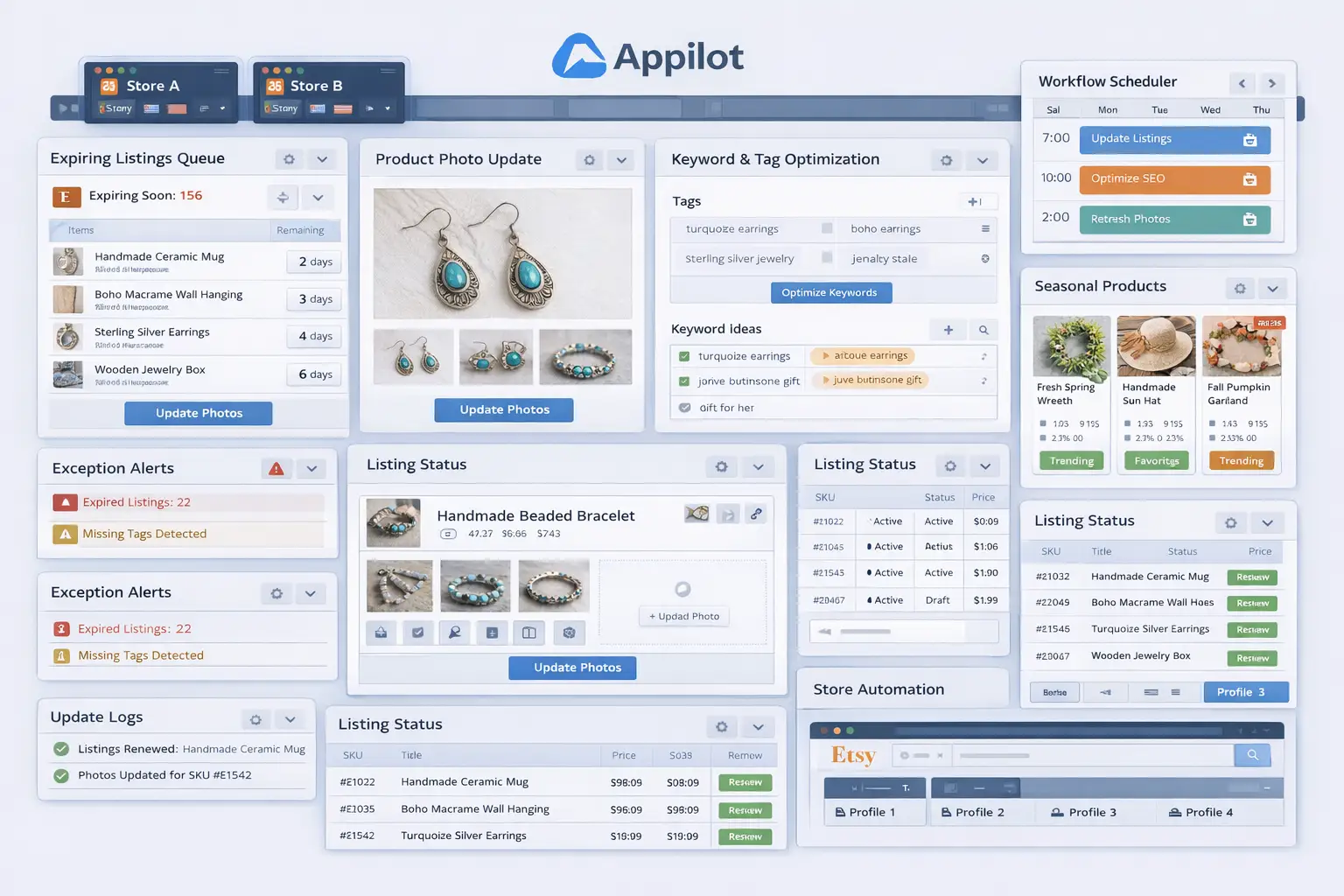
Now define the workflow sequence clearly. A typical setup begins by opening the correct Etsy store profile, reviewing listings that are expiring or already expired, filtering them based on the approved renewal rules, renewing the selected listings, saving the changes, and then logging the result. That logging step matters because it helps the team track which products were renewed and which ones still need attention.
The safest rollout begins with a small group of listings. Test the workflow on a handful of products first. Review whether the right listings were renewed, whether any low-priority items were included by mistake, and whether the action log recorded everything correctly.
After the first batch works, refine the rules. You may discover that certain product types need different renewal timing, or that some listings should be excluded entirely because they no longer convert well. That is normal. Good renewal automation becomes stronger as the business learns which listings deserve continued visibility.
Once the workflow proves stable, expand gradually. Add more listings, more renewal conditions, and more stores if needed. Some businesses may automate renewals only for core evergreen products, while others may automate most of the store once the rules prove reliable.
A practical implementation usually works like this. First, the business defines which listings should renew. Second, renewal timing and exclusions are mapped clearly. Third, the workflow launches the correct Etsy admin environment. Fourth, the system renews the approved listings. Fifth, the actions are logged. Sixth, the team reviews exceptions and refines the rules over time.
That is how Etsy listing renewals stop being a repetitive maintenance task and become a structured store workflow.
Safety and Best Practices for Listing Renewal Automation
The first rule is to keep renewal strategy human-led. Automation should apply the renewal rules, but the business should decide which products deserve continued visibility before anything goes live.
The second rule is to avoid renewing everything blindly. Some products may be outdated, low-performing, or out of stock. Strong renewal workflows focus on the listings that still matter.
The third rule is to separate evergreen listings from seasonal ones. Seasonal products often need different renewal timing and should not always follow the same logic as year-round products.
The fourth rule is to log every renewal action. This makes it easier to review which products were renewed and helps prevent duplicate or unnecessary renewals.
The fifth rule is to start small. Test the workflow on a small number of listings first, then expand only when the process proves reliable.
Real Results: What to Expect
During the first week, expect more setup and validation than dramatic gains. You will spend time defining which listings should renew, checking renewal timing, and making sure the workflow only touches the right products.
By the second and third weeks, the operational benefit becomes clearer. Listings that once expired unnoticed begin staying active more consistently. The team spends less time manually checking which products need attention and more time reviewing only the exceptions.
By the second month, the biggest win is usually consistency. Bestsellers stay visible, seasonal products return at the right time, and the store spends less time losing visibility because listings were forgotten.
The realistic result is not that every listing should always renew forever. The realistic result is a more disciplined and scalable renewal process that reduces repetitive admin work and keeps the right products active.
Common Problems and Solutions
One common problem is renewing too many listings. This usually happens when the workflow treats every product equally. The fix is to prioritize bestsellers, evergreen products, and seasonal items while excluding weak performers.
Another issue is poor timing. Renewing seasonal listings too early or too late reduces their value. The solution is to build timing rules into the workflow.
A third issue is weak logging. Without clear renewal logs, it becomes hard to know which listings were renewed and which were skipped. The fix is to make logging part of the core workflow.
The last major issue is relying on automation without review. Even good workflows need periodic checks to make sure the renewal logic still matches the business goals.
Choosing the Right Tools for Etsy Listing Renewal Automation
The right setup depends on store size, catalog size, and how frequently listings expire. A very small store with only a few listings may still manage renewals manually for a while. A growing store with dozens or hundreds of products benefits much more from a workflow that combines clear renewal rules with repeatable browser-side execution.
For this use case, a stable browser environment combined with a workflow layer is often the most practical option. Appilot fits naturally because it helps transform repeated renewal tasks into a manageable process without forcing the business into a large custom build.
This is also a natural place in your final publishing version to connect related resources such as Etsy listing optimization, browser integration guides, product visibility workflows, and broader marketplace automation content, because stores struggling with renewals often face other catalog maintenance challenges too.
Scaling Beyond Basic Renewal Workflows
At a small scale, teams can still review most expiring listings manually without too much difficulty. As the store grows, renewals become a systems problem. The challenge is no longer whether one listing can be renewed correctly. The challenge becomes whether many listings can stay active without creating a constant maintenance burden.
That is where automation becomes especially valuable. It creates a repeatable visibility-maintenance layer. Instead of waiting for someone to notice that a product expired, the store can operate with a more dependable renewal process.
The stores that benefit most are usually the ones already losing visibility because expired listings are being missed. For them, automation is not just a convenience. It is part of keeping the store operationally organized as the catalog grows.
Frequently Asked Questions
Q1: Can Etsy listing renewals really be automated?
Yes. If you define clear rules for which products should renew and when, much of the repetitive renewal process can be automated in a practical way.
Q2: What should I automate first?
Start with a small group of evergreen or bestselling products. A narrow rollout is easier to validate than trying to automate your full store immediately.
Q3: Why is Appilot relevant for this use case?
Because this is a repeated browser workflow problem after the renewal rules are already defined. Appilot fits naturally as the operational layer that helps apply those renewals consistently.
Q4: Do I still need manual review?
Yes. Renewal automation reduces repetitive work, but the team should still review exceptions, seasonal timing, and product performance regularly.
Q5: What is the biggest requirement for success?
A clear renewal strategy. Strong prioritization and timing rules matter much more than just turning automation on.
Q6: How much time can this save?
That depends on catalog size, but stores with many listings usually save significant time once renewals stop depending on daily manual checking.
Conclusion
If you want to automate Etsy listing renewals, the biggest opportunity is not just saving time. It is creating consistency in how your store keeps products visible. Manual renewals lead to missed listings, inconsistent timing, and too much dependence on repetitive admin work. A structured workflow replaces that with a more reliable system.
The best path is to define which listings matter most, build clear timing and exclusion rules, start with a narrow rollout, and use a workflow layer like Appilot where it naturally helps with repeated browser execution. Then test the results carefully, review product visibility regularly, and expand only when the workflow proves stable.
When done properly, listing renewal automation does not reduce control over your store. It strengthens control by making it easier to keep the right products active as the catalog grows.