How to Avoid eBay Account Suspensions When Dropshipping
You start dropshipping on eBay, list products, get your first sales, and everything seems to be working.
Then suddenly the account gets restricted.
Listings disappear. Selling limits drop. Payments are held. In more serious cases, the account may be suspended completely.
For many sellers, this happens without much warning.
You may think the issue came from the product supplier, the shipping delays, the tracking numbers, or the account age.
The reality is that eBay tracks much more than just the products you sell.
The platform also watches seller performance, delivery times, account behavior, linked accounts, IP addresses, browser fingerprints, buyer complaints, and how your listings compare to normal seller behavior.
If too many of these signals look risky, eBay may suspend the account.
The good news is that most eBay dropshipping suspensions can be prevented.
Once you understand what eBay is actually looking for, you can build a safer setup, reduce risk, and keep your account active much longer.
In this guide, you will learn why eBay dropshipping accounts get suspended, what the biggest warning signs are, how to recover safely, and how to prevent future restrictions.
Time to stabilize: Usually between 3 and 14 days depending on the severity of the restriction. Success rate: High if seller metrics and account quality improve quickly. Cost: Usually low if you already have the right browser, proxy, and account setup.
Why eBay Suspends Dropshipping Accounts
One of the biggest reasons eBay suspends dropshipping accounts is poor seller performance.
If buyers receive late shipments, invalid tracking numbers, cancelled orders, wrong products, or poor communication, the account quickly loses trust.
Another common issue is supplier quality.
Many sellers rely on slow suppliers with inconsistent stock levels. If a product sells out after it is listed, the seller may need to cancel the order.
Too many cancelled orders can damage seller metrics very quickly.
Tracking quality also matters.
If the account uploads fake tracking numbers, reused tracking numbers, or delayed tracking updates, eBay may see the account as suspicious.
Linked accounts are another major problem.
If multiple eBay accounts share the same browser profile, cookies, IP address, device fingerprint, payment method, or business information, eBay may connect them together.
If one account gets suspended, the others may be restricted too.
This is exactly why I built Appilot. The goal was to create safer browser environments, better account separation, and more stable seller behavior instead of connecting everything together in one place.
Warning Signs Before eBay Suspends an Account
In many cases, eBay gives warning signs before a full suspension happens.
You may notice lower selling limits, more payment holds, delayed payouts, listing removals, buyer complaints, account review warnings, or requests for more verification.
Some sellers also see lower visibility in search results, reduced traffic, or more tracking-related alerts.
These are usually signs that eBay is starting to lose trust in the account.
The earlier you react, the easier it is to avoid a full suspension.
The Most Common Reasons eBay Dropshipping Accounts Get Restricted
One major reason is shipping delays.
If too many orders arrive late, buyers may leave negative feedback and eBay may lower the account's seller rating.
Another common issue is out-of-stock products.
If products are no longer available after buyers place orders, repeated cancellations can quickly damage account trust.
Using poor suppliers is another major risk.
Cheap suppliers may send the wrong items, use low-quality packaging, or provide poor tracking information.
Dropshipping directly from large retail stores can also create problems.
If buyers receive invoices, gift receipts, or branded packaging from another retailer, they may complain to eBay.
Repeated buyer complaints can lead to suspensions.
How to Recover a Restricted eBay Account
Step 1: Review Seller Metrics
The first step is checking your seller performance metrics.
Look at late shipment rates, cancellation rates, buyer complaints, tracking issues, and negative feedback.
This helps identify what may have caused the restriction.
Step 2: Fix Supplier Problems
If the supplier is slow, unreliable, or frequently out of stock, replace them.
Use suppliers with faster shipping, better inventory control, and stronger tracking quality.
The more reliable the supplier becomes, the safer the account will be.
Step 3: Improve Order Handling
Ship faster, upload valid tracking numbers quickly, and respond to buyer messages faster.
The better your customer service looks, the easier it becomes to improve account trust.
Step 4: Stabilize the Account Environment
Keep the account on one browser profile, one device, one IP address, and one location whenever possible.
eBay is much more likely to trust an account that behaves consistently.
Switching between multiple browsers, proxies, devices, and countries creates more suspicious signals.
Step 5: Separate Multiple Accounts Properly
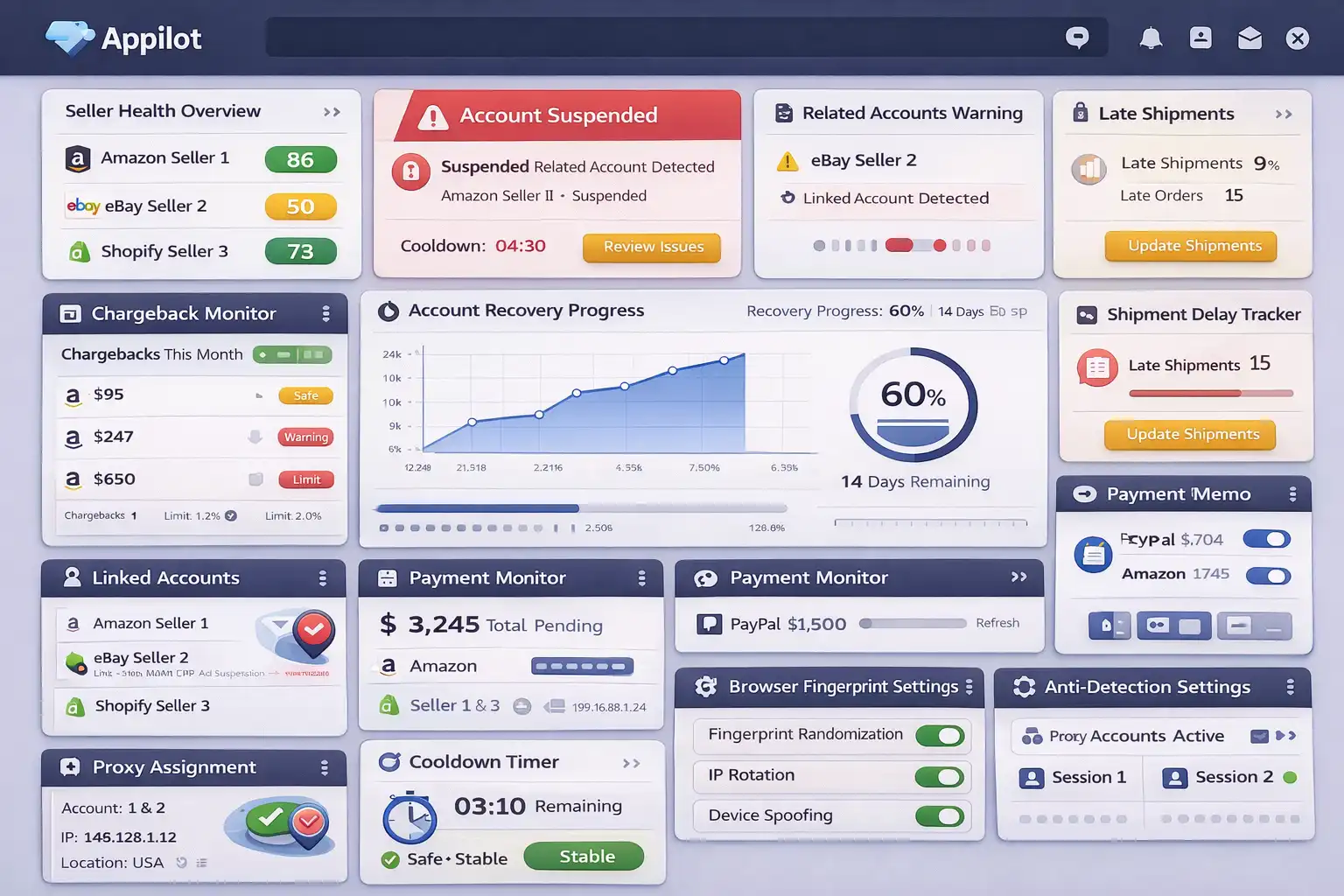
If you manage multiple eBay accounts, each one should have its own browser profile, cookies, proxy, IP address, device fingerprint, and payment environment.
This makes every account appear more independent.
If one account has issues, the others are less likely to be affected.
Appilot is useful here because it helps create safer browser environments and more stable account separation instead of connecting everything together in one place.
Step 6: Scale Slowly
Many sellers get suspended because they grow too quickly.
If a new account suddenly lists hundreds of products, processes many orders, or increases revenue sharply, eBay may see it as suspicious.
The safer approach is gradual growth.
Increase listings, sales volume, and order activity slowly over time.
How to Prevent Future eBay Dropshipping Suspensions
The best way to avoid future suspensions is creating a more stable seller environment.
Use reliable suppliers, fast shipping, strong tracking, and better customer service.
Avoid listing products that are frequently out of stock. Avoid cheap suppliers with poor tracking.
If you manage multiple accounts, separate them properly with different browser profiles, cookies, proxies, and device fingerprints.
Use high-quality residential proxies instead of cheap VPNs. Keep login locations stable.
The more trustworthy and stable the account looks, the easier it becomes to stay active long term.
Common Mistakes That Make eBay Suspensions Worse
One major mistake is continuing to use the same bad suppliers after restrictions begin.
Another mistake is creating a new eBay account immediately after one gets suspended.
If the original setup is still broken, the new account may get restricted too.
People also make the mistake of logging into multiple eBay accounts from the same browser profile or IP address.
Another common mistake is listing too many products too quickly on a brand new account.
If the account grows too fast, eBay may see it as suspicious.
Frequently Asked Questions
Q1: Why did eBay suspend my dropshipping account?
eBay usually suspends dropshipping accounts because of poor seller metrics, shipping delays, tracking issues, buyer complaints, or linked account signals.
Q2: Can a suspended eBay account be recovered?
Yes. Many suspended accounts can be recovered if the underlying issues are fixed.
Q3: Do linked accounts increase suspension risk?
Yes. eBay may connect accounts if they share the same browser, IP address, payment method, or device fingerprint.
Q4: Should I create a new eBay account after a suspension?
It is usually safer to first understand what caused the original suspension before creating a new account.
Q5: Does Appilot help reduce eBay suspension risk?
Appilot helps create safer browser environments, account separation, and more stable seller behavior.
Conclusion
eBay dropshipping suspensions usually happen because of poor seller performance, weak suppliers, tracking issues, or linked account signals.
The safest approach is improving shipping quality, separating accounts properly, and building a more stable seller environment.
The goal is not to scale as aggressively as possible.
The goal is to build long-term trust so seller accounts can stay active and stable over time.