How to Gradually Warm Up New Accounts Without Detection
By the end of this tutorial, you will understand how to introduce new accounts into your system in a controlled and natural way so they do not get flagged or restricted early. New accounts are highly sensitive because they have no history, and sudden or aggressive activity can quickly trigger platform defenses.
To follow along, you only need a basic understanding of how accounts behave within automation systems. The focus here is on designing a gradual and realistic activity pattern rather than writing code.
This setup typically takes about an hour to define, but it is one of the most important steps for long-term success. If you manage many accounts across workflows, Appilot can help manage execution while your warm-up strategy ensures safe onboarding.
You will build a system that introduces activity gradually, builds account trust over time, and minimizes early-stage risk.
Why New Accounts Are High Risk
New accounts lack history, which makes them more closely monitored by platforms. Any sudden spike in activity can appear unnatural because there is no baseline behavior to support it.
This is why gradual introduction is important. Building activity slowly helps create a natural pattern that reduces suspicion.
What a Proper Warm-Up Process Looks Like
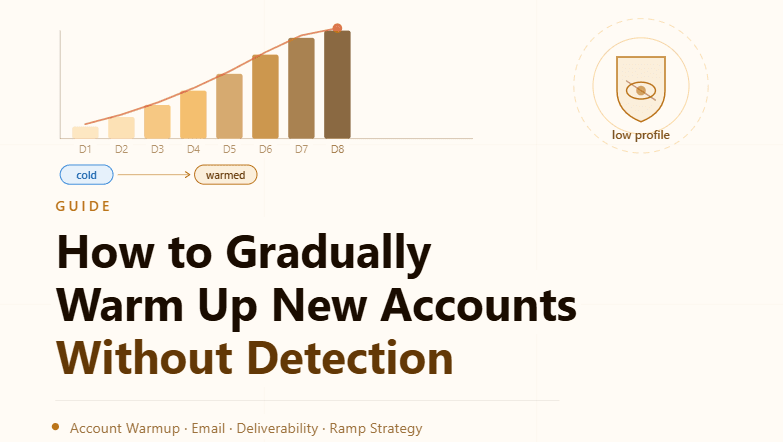
A proper warm-up process starts with minimal activity and increases gradually over time. Instead of performing many actions immediately, the account begins with light usage and slowly ramps up.
This progression allows the account to establish a normal behavior pattern before handling heavier workloads.
Starting with Low-Intensity Activity
In the early stage, activity should be minimal and simple. This helps the account appear natural and avoids triggering early restrictions.
Low-intensity actions provide a safe starting point while the account begins to build history.
Gradually Increasing Activity Levels
As the account becomes more stable, activity can be increased step by step. The increase should be controlled and measured rather than sudden.
This gradual progression helps maintain a consistent and believable usage pattern.
Introducing Variation in Behavior
Repetitive actions can create detectable patterns, especially for new accounts. Introducing variation in timing, sequence, and type of activity helps make behavior appear more natural.
Variation is an important part of avoiding detection during the warm-up phase.
Monitoring Account Response During Warm-Up
Not all accounts behave the same way during warm-up. Some may handle increased activity well, while others may show signs of stress.
Monitoring responses such as performance, errors, or verification prompts helps you adjust the process for each account.
Slowing Down When Risk Signals Appear
If an account shows signs of restriction or unusual behavior, the best approach is to slow down. Continuing to increase activity under these conditions can lead to escalation.
Reducing activity allows the account to stabilize before continuing the warm-up process.
Avoiding Immediate Full Utilization
One of the most common mistakes is treating new accounts like fully established ones. Immediate heavy usage often leads to restrictions.
Allowing time for gradual development ensures that accounts can handle higher workloads later.
Integrating Warm-Up into Account Lifecycle
Warm-up should be a defined phase in the lifecycle of every account. New accounts start in this phase and only move to full usage after meeting stability criteria.
This structured approach ensures consistency across all accounts.
Tracking Progress and Readiness
To know when an account is ready for full usage, you need to track its progress. Indicators such as stable performance, consistent task success, and absence of warnings signal readiness.
Tracking ensures that accounts are not pushed too quickly.
Scaling Warm-Up with Appilot
At this stage, your warm-up process works locally and helps onboard accounts safely. As the number of accounts increases, managing warm-up schedules manually becomes more complex.
This is where Appilot becomes useful because it helps orchestrate workflows across accounts while your warm-up strategy ensures safe progression.
FAQ
Q1: What is account warm-up?
It is the process of gradually increasing activity on new accounts to build trust and reduce detection risk.
Q2: Why is warm-up necessary?
Because new accounts are more sensitive and can be flagged easily if used aggressively.
Q3: How long should warm-up take?
It depends on the platform, but gradual progression over time is key.
Q4: What happens if I skip warm-up?
Accounts are more likely to face restrictions or bans early.
Q5: Do I need Appilot for warm-up?
No, you can manage it locally. Appilot becomes useful when scaling workflows.
Conclusion
Gradually warming up new accounts is essential for building stable and long-lasting automation systems. By starting with low activity, increasing usage carefully, and monitoring responses, you can reduce risk and improve account reliability.
Start by defining a clear warm-up phase, track progress, and adjust based on account behavior. Once this system is in place, onboarding new accounts becomes much safer and more predictable.