How to Prevent Facebook Marketplace Account Suspensions
You list a product on Facebook Marketplace, start getting messages, and everything seems to be working normally.
Then suddenly your listings disappear.
Your Marketplace access is restricted. Your account can no longer post new products. Buyers stop seeing your listings. In more serious cases, Facebook may suspend the account completely.
For many sellers, this does not happen only once.
You recover one Marketplace account, then another one gets restricted. You create a new account, post the same listings again, and the same problem comes back.
The frustrating part is that Facebook rarely explains exactly what caused the suspension.
You are left guessing whether the problem came from the product category, the pricing, the browser setup, the IP address, the listing style, the account age, or something else entirely.
The good news is that most Facebook Marketplace suspensions can be prevented.
Once you understand what Facebook is actually tracking, you can create safer selling patterns, build more trustworthy accounts, and keep Marketplace access active much longer.
In this guide, you will learn why Facebook Marketplace accounts get suspended, what the most common mistakes are, how to recover safely, and how to prevent future restrictions.
Time to stabilize: Usually between 2 and 14 days depending on the severity of the restriction. Success rate: High if suspicious activity is reduced early. Cost: Usually low if you already have the right browser, proxy, and account setup.
Why Facebook Marketplace Accounts Get Suspended
Facebook suspends Marketplace accounts when it believes there is too much risk associated with the account.
The platform tracks listing quality, pricing patterns, account age, browser fingerprints, device fingerprints, IP addresses, login locations, payment behavior, messaging activity, and how accounts are connected.
If too many of these signals look suspicious, Facebook may suspend Marketplace access.
One of the biggest reasons this happens is because the account moves too fast.
Brand new accounts that suddenly post many listings, send large numbers of replies, join many groups, or change locations too often often get flagged.
Facebook expects Marketplace sellers to behave naturally.
Another common issue is low-quality listings.
If listings use copied images, misleading titles, unrealistic pricing, restricted products, or repetitive descriptions, Facebook may see them as spam.
This is exactly why I built Appilot. The goal was to create safer account environments, more stable browser setups, and more natural listing behavior instead of repeatedly triggering Marketplace restrictions.
The Most Common Reasons Marketplace Accounts Get Restricted
One major reason is posting too many listings too quickly.
If a new account suddenly uploads dozens of products in one day, Facebook may see the behavior as suspicious.
Another common issue is selling restricted products.
Facebook Marketplace has strict rules around counterfeit items, digital goods, event tickets, financial products, animals, weapons, and certain health products.
Listings that fall into restricted categories are much more likely to trigger suspensions.
Poor account quality is another major problem.
Accounts with no profile picture, no friends, no posts, and no normal activity are much more likely to get flagged.
Using the same browser profile, IP address, or phone number across multiple Marketplace accounts can also create problems.
If one account gets suspended, the others may get restricted too.
Repeated changes in login location are another common trigger.
If the account appears to move between different countries or cities constantly, Facebook may think the account has been compromised.
Warning Signs Before Marketplace Access Gets Suspended
In many cases, Facebook gives smaller warning signs before a full suspension happens.
You may notice listings getting rejected, products taking longer to appear, messages failing to send, more identity verification requests, or warnings about unusual activity.
Some people also see reduced visibility, lower listing reach, or temporary posting limits.
These are usually signs that Facebook is starting to lose trust in the account.
The earlier you react, the easier it is to avoid a full suspension.
How to Recover a Suspended Marketplace Account
Step 1: Stop Posting New Listings
One of the biggest mistakes people make is continuing to upload more listings after warnings start appearing.
If Facebook is already reviewing the account, more activity can make the suspension worse.
The first step is slowing everything down.
Step 2: Review Listing Quality
Go through your listings carefully.
Look for copied descriptions, misleading titles, unrealistic pricing, repeated text, low-quality images, or products that may violate Marketplace rules.
Even small improvements in listing quality can help rebuild trust.
Step 3: Stabilize Login Activity
Keep the account on one browser profile, one device, one IP address, and one location whenever possible.
Facebook is much more likely to trust a Marketplace account that behaves consistently.
Switching between multiple browsers, proxies, devices, and countries creates more suspicious signals.
Step 4: Improve Account Quality
Add a profile picture, make a few normal posts, interact with content naturally, and build a more complete profile.
Accounts that look empty or incomplete are much more likely to get suspended.
Step 5: Separate Marketplace Accounts Properly
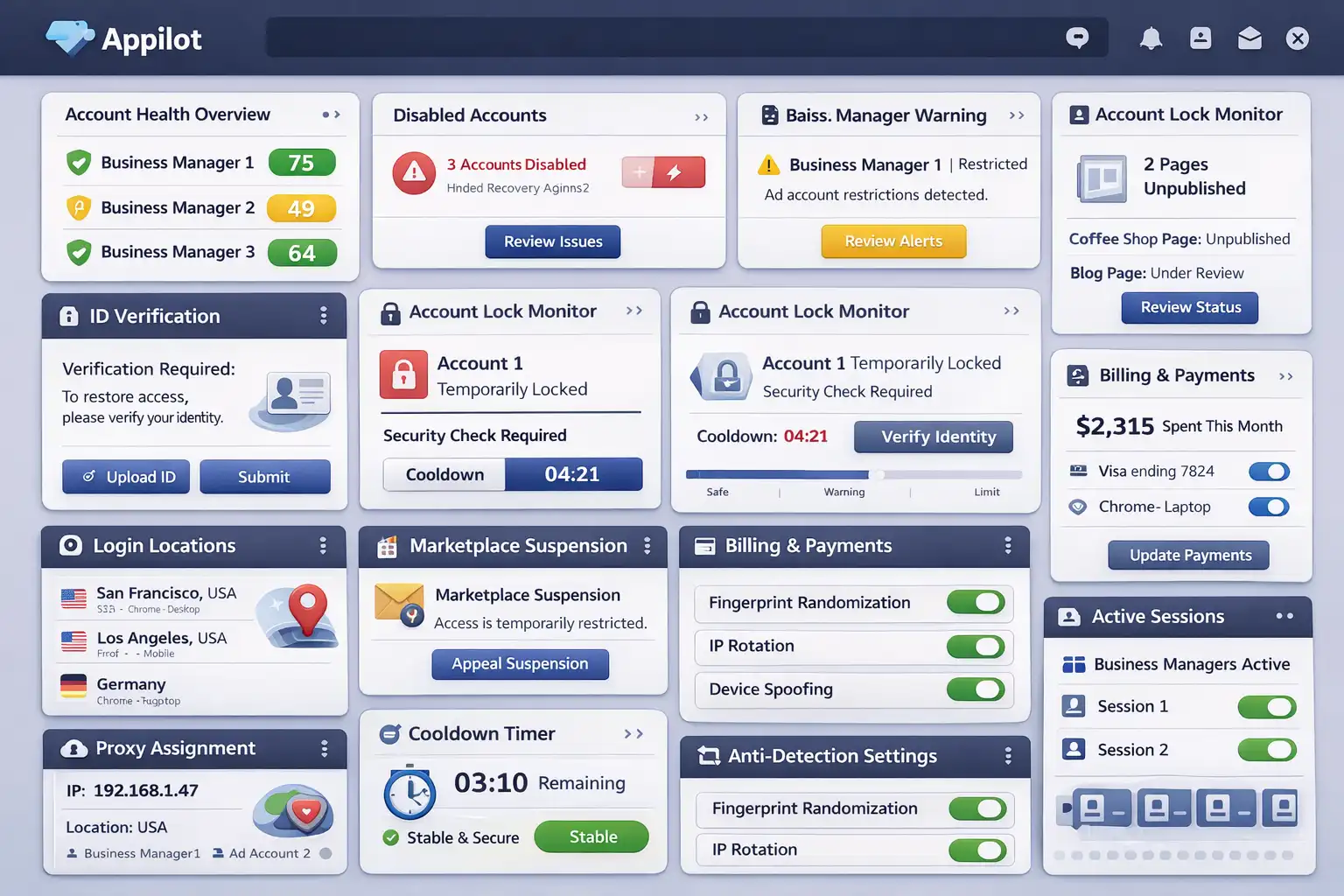
If you manage multiple Marketplace accounts, each one should have its own browser profile, cookies, proxy, device fingerprint, and session history.
This makes every account appear more independent.
If one account gets suspended, the others are less likely to be affected.
Appilot is useful here because it helps create safer browser environments and more stable account separation instead of connecting everything together in one place.
Step 6: Warm New Accounts Slowly
New Marketplace accounts should be warmed slowly over one to two weeks.
Start with a few normal actions such as browsing listings, messaging a few sellers, adding a profile picture, and posting one or two products.
Gradually increase activity over time.
The slower and more natural the account looks, the safer it becomes.
How to Prevent Facebook Marketplace Suspensions in the Future
The best way to avoid future suspensions is creating a more stable account environment.
Use high-quality residential proxies instead of cheap VPNs. Keep login locations consistent. Separate accounts properly with different browser profiles and device fingerprints.
Avoid posting too many listings too quickly.
Do not upload repetitive products, use copied text, or list restricted items.
Focus on making the account look like a real seller first.
The more trustworthy and stable the account looks, the easier it becomes to avoid future restrictions.
Common Mistakes That Make Marketplace Suspensions Worse
One major mistake is constantly retrying listings after they get rejected.
Another mistake is changing browsers, devices, proxies, and locations repeatedly.
People also make the mistake of creating multiple Marketplace accounts from the same browser profile or using the same phone number across many accounts.
Another common mistake is creating empty accounts with no friends, no posts, and no normal activity.
If the account does not look real, Facebook is much more likely to restrict it.
Frequently Asked Questions
Q1: Why did Facebook suspend my Marketplace account?
Facebook usually suspends Marketplace accounts because of suspicious activity, poor listing quality, restricted products, or unstable browser and IP signals.
Q2: How long do Marketplace suspensions last?
Most temporary suspensions last between a few days and two weeks. More serious restrictions may take longer.
Q3: Do proxies help keep Marketplace accounts safe?
Yes. High-quality residential proxies can help if they are used consistently.
Q4: Can multiple Marketplace accounts use the same browser profile?
It is much safer to separate every account with its own browser profile and cookies.
Q5: Does Appilot help reduce Marketplace suspension risk?
Appilot helps create safer browser environments, account separation, and more stable login behavior.
Conclusion
Facebook Marketplace accounts usually get suspended because they move too quickly, look suspicious, or share unstable browser and IP signals.
The safest approach is slowing down, improving listing quality, separating accounts properly, and creating more natural seller behavior.
The goal is not to scale as fast as possible.
The goal is to build long-term trust so Marketplace accounts can stay active and stable over time.