How to Survive When Your Browser Provider Raises Prices 3x
Everything Was Profitable—Until Your Browser Costs Exploded
At first, your browser setup feels affordable. You are paying for a few profiles, maybe a few team seats, and everything seems reasonable.
Then your browser provider raises prices.
Maybe profile limits get reduced. Maybe team features move behind a higher plan. Maybe proxy integrations, API access, or automation features suddenly become premium-only.
Now the exact same workflow that used to be profitable costs two or three times more than before.
This is one of the biggest risks in browser automation. Many people build their entire operation around one browser provider without thinking about what happens if pricing changes.
The problem is not just the extra cost. The real problem is becoming too dependent on one tool.
Why Browser Price Increases Hurt So Much
Most people do not just use their browser provider for profiles.
They also use it for proxies, team access, API connections, storage, automation integrations, session syncing, and account organization.
Over time, the browser becomes the center of the entire workflow.
That means when the provider raises prices, it affects everything.
This is especially common with antidetect browsers and tools built around Selenium, Playwright, and large browser profile systems where you may be running dozens or hundreds of accounts.
The bigger your profile count, the worse it gets
A small pricing increase might not matter if you only have ten profiles.
But if you are managing fifty, one hundred, or several hundred browser profiles, even a small increase becomes expensive very quickly.
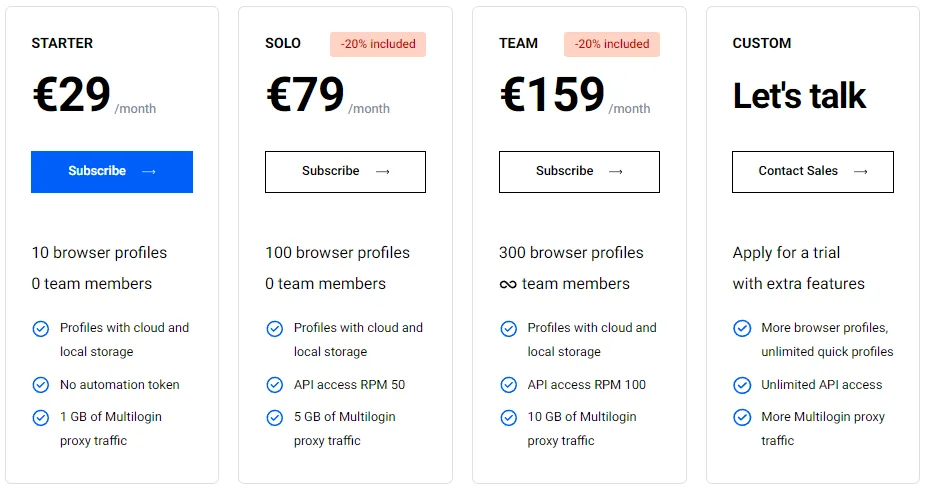
A browser provider that raises profile pricing by a few dollars per profile can suddenly add thousands of dollars per year to your operating costs.
Most people are paying for things they do not use
One of the biggest problems is that browser providers often bundle features together.
You may be paying for storage limits, collaboration tools, fingerprint customization, cloud syncing, or premium integrations that you do not actually need.
Once the pricing increases, you realize a large part of your bill is tied to features that are not even important to your workflows.
The Hidden Cost of Staying Too Long
When prices increase, many people keep paying because migrating feels difficult.
They assume it will take too long to move profiles, rebuild schedules, reconnect proxies, and reorganize tasks.
So they stay.
The problem is that this creates long-term cost pressure.
Every month, more money goes toward the browser platform instead of the workflows themselves. Profit margins shrink. Tool costs become harder to justify. You start paying more just to keep the same system alive.
Eventually, the browser provider becomes one of the biggest expenses in the entire automation stack.
The Complete Fix: Reduce Dependency Before It Gets Worse
The best way to survive a major price increase is to separate what you actually need from what the browser provider is charging for.
You should identify:
Which profiles are still active
Which features are actually used
Which workflows generate the most value
Which browser profiles can be archived
Which team seats are unnecessary
Which integrations can be replaced
In many cases, you can reduce costs immediately just by cleaning up unused profiles, removing old accounts, and downgrading unnecessary features.
Separate browser profiles from workflow logic
One of the biggest mistakes is tying all your workflow logic directly to one browser provider.
Your real asset is not the browser platform itself.
Your real asset is the workflow logic, account structure, schedule system, and proxy assignments.
If you separate those things from the browser provider, migration becomes much easier.
That means if prices increase again later, you are not trapped.
Keep browser providers interchangeable
The best long-term strategy is to treat browser providers as replaceable.
You should be able to move between providers without rebuilding your entire operation from scratch.
That means documenting which profiles belong to which workflows, which proxies are assigned where, and which schedules matter most.
Once everything is documented properly, moving to another browser platform becomes much easier.
Why Centralization Makes Cost Control Easier
One of the biggest reasons browser costs spiral out of control is because everything is scattered across too many places.
You may have browser profiles in one platform, schedules in another tool, proxies managed elsewhere, and account assignments inside spreadsheets.
That makes it difficult to see which profiles are actually being used and which workflows still matter.
A centralized dashboard makes it much easier to understand where money is being spent.
This is one of the reasons Appilot becomes useful as automation grows.
Instead of relying entirely on one browser provider for everything, you can centralize schedules, workflows, Android tasks, profile assignments, and task history in one place.
That means browser providers become just one part of the stack instead of the center of the entire system.
If one provider raises prices too much, it becomes much easier to move without losing everything.
How to Prevent This Problem in the Future
The best way to avoid getting trapped by browser pricing is to avoid building your entire operation around one provider.
You should always document your profiles, schedules, proxies, and workflow logic separately from the browser itself.
You should also regularly audit which profiles are still active and which subscriptions are actually necessary.
Most importantly, you should design your system so that browser providers are interchangeable.
That way, when pricing changes, you can negotiate, downgrade, or migrate without disrupting the rest of the workflow.
Common Mistakes That Make This Worse
One of the biggest mistakes is keeping too many inactive browser profiles.
Another mistake is paying for premium features that are rarely used.
There is also a tendency to stay with an expensive provider simply because migration feels difficult.
In reality, staying too long can cost far more than moving.
Conclusion: Browser Providers Should Support Your System—Not Control It
When a browser provider raises prices, it can feel like your entire system is under pressure.
But the most valuable part of your operation is not the browser itself.
It is the workflow logic, account structure, schedules, proxies, and automation knowledge behind everything.
If those things are documented and organized properly, you can reduce costs, switch providers, and keep your system profitable without losing control.