How to Test Proxy Speed and Quality Before Using
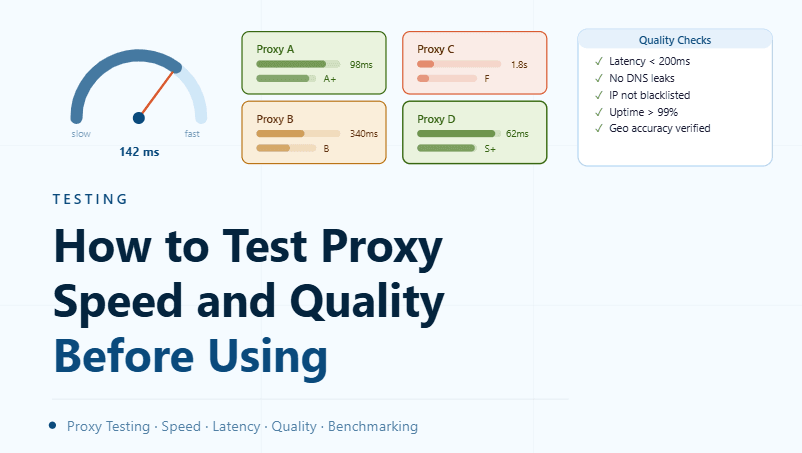
By the end of this tutorial, you will understand how to evaluate proxies before using them in your workflows so you avoid slow, unstable, or unreliable connections. Using untested proxies is one of the biggest causes of failed tasks, timeouts, and inconsistent behavior.
To follow along, you only need a basic understanding of how proxies connect your profiles to the internet. The focus here is on building a testing process rather than writing code.
This setup typically takes less than an hour to define, but it saves significant time later by preventing issues. If you manage multiple workflows, Appilot can help orchestrate execution while your testing system ensures only high-quality proxies are used.
You will build a system that checks proxy speed, reliability, and consistency before assigning them to profiles.

Why Testing Proxies Before Use Is Critical
Not all proxies perform the same. Some may have high latency, slow response times, or unstable connections. Using such proxies without testing can cause workflows to fail or behave unpredictably.
Testing ensures that only reliable proxies are used, which improves overall system performance and stability.
Understanding What “Good Proxy Quality” Means
A high-quality proxy is not just fast. It should also be stable, consistent, and responsive over time. Speed alone is not enough if the connection drops frequently or behaves inconsistently.
Quality is a combination of multiple factors, including response time, reliability, and overall performance.
Measuring Proxy Speed and Latency
One of the first things to evaluate is how quickly a proxy responds. Latency measures the time it takes for a request to travel through the proxy and return a response.
Lower latency generally indicates a faster connection, which is important for smooth workflow execution.
Checking Connection Stability
A proxy may appear fast in a single test but still be unreliable over time. Stability testing involves making multiple requests to see whether the proxy consistently performs well.
Consistent performance is more important than occasional speed.
Evaluating Success Rates
A good proxy should successfully handle requests without frequent failures. Testing multiple requests helps determine how often the proxy responds correctly.
High success rates indicate that the proxy can be trusted for regular use.
Identifying Slow or Unreliable Proxies
During testing, some proxies will show poor performance. These may have high latency, frequent timeouts, or inconsistent responses.
Identifying and removing these proxies ensures that they do not affect your workflows.
Comparing Proxies Within a Pool
When working with multiple proxies, comparing them helps determine which ones perform best. This allows you to prioritize high-quality proxies and use weaker ones less frequently.
Comparison improves overall efficiency.
Testing Proxies Under Real Conditions
Proxies should be tested in conditions similar to actual usage. This ensures that the results reflect real performance rather than ideal scenarios.
Real-world testing provides more accurate insights.
Creating a Proxy Scoring System
Assigning scores based on performance metrics helps rank proxies. Factors such as speed, stability, and success rate can be combined into a simple scoring system.
This makes it easier to select the best proxies quickly.
Retesting Proxies Regularly
Proxy performance can change over time. A proxy that works well today may degrade later. Regular testing ensures that your system adapts to these changes.
Continuous evaluation keeps your proxy pool reliable.
Integrating Testing into Workflow Systems
Testing should be part of your overall workflow process. Instead of assigning proxies directly, the system should select only those that meet quality standards.
This integration ensures consistent performance across all tasks.
Scaling Proxy Testing with Appilot
At this stage, your testing system works locally and helps filter out low-quality proxies. As the number of proxies and workflows increases, managing testing manually becomes more complex.
This is where Appilot becomes useful because it helps orchestrate workflows while your testing system ensures that only reliable proxies are used.
FAQ
Q1: What is proxy testing?
It is the process of evaluating proxies for speed, stability, and reliability before using them.
Q2: Why is latency important?
Because it affects how quickly tasks can be completed through the proxy.
Q3: Can a proxy be fast but unreliable?
Yes, which is why stability testing is also important.
Q4: How often should I test proxies?
Regularly, as performance can change over time.
Q5: Do I need Appilot for testing?
No, you can test proxies locally. Appilot becomes useful when scaling workflows.
Conclusion
Testing proxy speed and quality before use is essential for building a stable and efficient system. By evaluating latency, stability, and success rates, you can ensure that only reliable proxies are used in your workflows.
Start by creating a simple testing process, compare proxies, and refine your selection over time. Once this system is in place, your workflows become faster, more stable, and more predictable.