What Are HTTP Headers? (And How They Fingerprint You)

Most users never see HTTP headers, but they are one of the most important parts of how the web works. Every time your browser makes a request to a website, it sends a set of headers that describe your device, browser, and preferences. While these headers are necessary for functionality, they also play a major role in tracking and fingerprinting.
Understanding HTTP header fingerprinting is important because it reveals how basic communication between your browser and a website can expose identifying information. It also explains why many detection systems rely on subtle inconsistencies in headers to identify automation or suspicious behavior. This guide explains what HTTP headers are, how they work, and how they are used for fingerprinting.
What Are HTTP Headers?
HTTP headers are pieces of information sent between a client, such as your browser, and a server when a request is made. They provide context about the request and help the server respond appropriately.
Headers include details such as the type of browser being used, supported content formats, language preferences, and connection information. These values are automatically included in every request and are essential for delivering the correct content.
Because headers are sent with every interaction, they provide a consistent and reliable source of data that can be used for identification.
The Core Principle Behind HTTP Header Fingerprinting
The core principle behind HTTP header fingerprinting is that the combination of header values varies across users. While individual headers may be common, the specific combination and formatting can create a unique profile.
For example, differences in browser versions, operating systems, language settings, and supported encodings can all affect header values. Even small variations in how headers are ordered or formatted can contribute to uniqueness.
This means that HTTP headers act as a baseline fingerprint that can be used to identify and differentiate users.
Common HTTP Headers Used in Fingerprinting
Several HTTP headers are particularly important for fingerprinting because they reveal key information about the browser and device.
The User-Agent header identifies the browser, operating system, and sometimes device type. The Accept and Accept-Encoding headers indicate what content formats and compression methods the browser supports. The Accept-Language header reveals language preferences, which can provide regional context.
Together, these headers create a profile that helps websites understand the client environment and, in many cases, identify returning users.
Why HTTP Header Fingerprinting Matters
HTTP header fingerprinting matters because it provides a simple yet powerful way to identify users without relying on cookies or stored data. Since headers are included in every request, they offer a consistent signal that can be used across sessions.
In fraud detection systems, header data helps identify unusual patterns. For example, if a request claims to come from a mobile device but includes headers typical of a desktop browser, this inconsistency can indicate suspicious activity.
From a privacy perspective, HTTP headers are significant because they are unavoidable. Users cannot easily prevent their browser from sending headers, and modifying them incorrectly can lead to detection.
For developers building automation systems, header consistency is critical. If the headers do not match the rest of the environment, such as the browser behavior or device characteristics, detection systems can flag the activity.
How HTTP Header Fingerprinting Works in Practice
HTTP header fingerprinting works by collecting header data, analyzing it, and comparing it across requests.
Capturing Header Information
When a browser sends a request to a server, the headers are captured and logged. This includes all relevant fields such as User-Agent, Accept-Language, and others.
This data provides an initial snapshot of the client environment and can be used immediately for analysis.
Analyzing Patterns and Consistency
The collected headers are analyzed to identify patterns and check for consistency with other signals. Detection systems look for mismatches or unusual combinations that may indicate automation.
For example, a mismatch between the User-Agent and actual browser behavior can be a strong indicator of a synthetic environment.
Building the Fingerprint
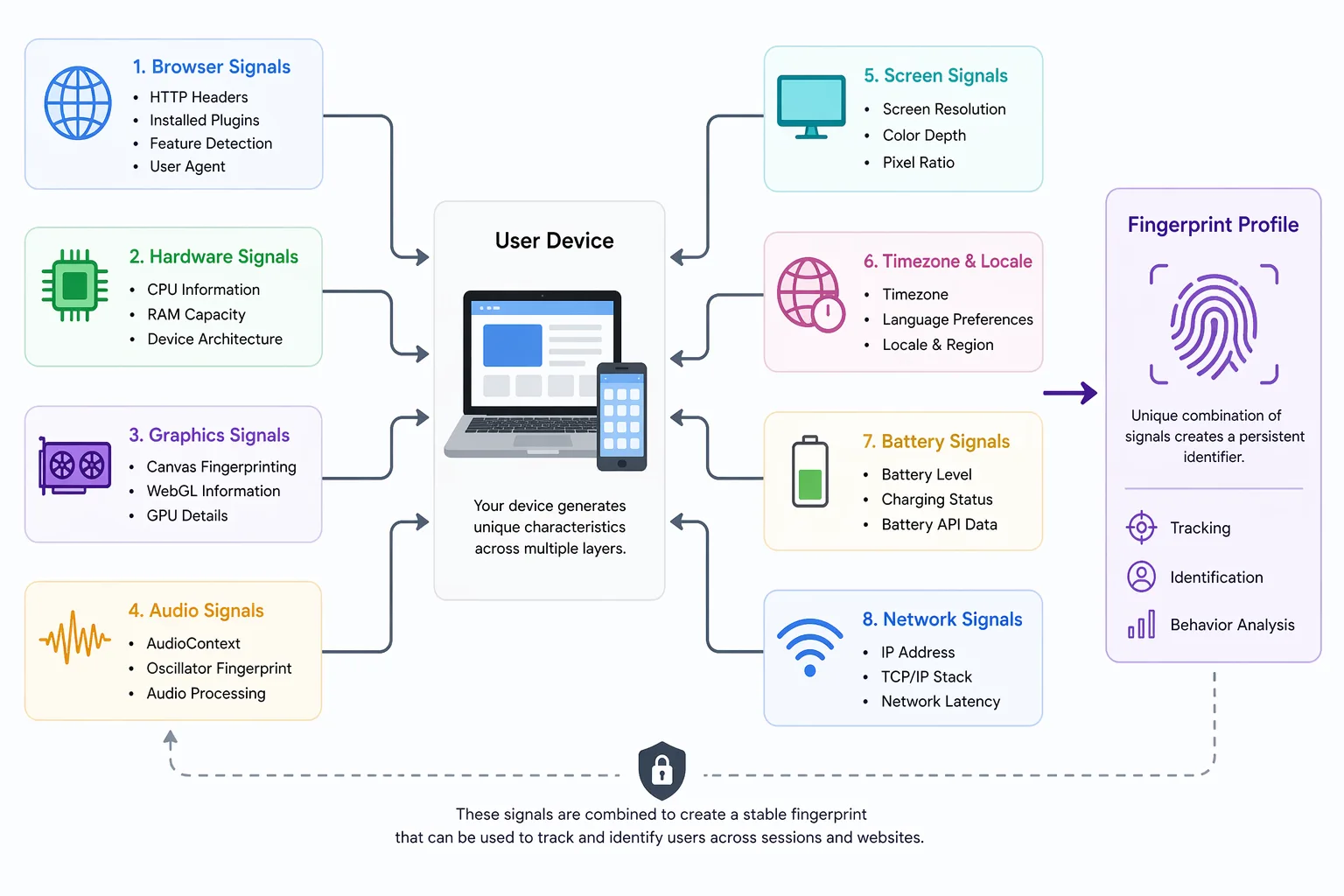
The header data is combined with other signals to form a fingerprint. While headers alone may not uniquely identify a user, they provide a strong foundation for identification when combined with other attributes.
Because headers are consistent across requests, they help maintain continuity in tracking.
Common Misconceptions About HTTP Header Fingerprinting
There are several misconceptions about HTTP header fingerprinting that can lead to misunderstandings about its role in tracking.
One common belief is that changing the User-Agent prevents tracking, but while this alters one header, other headers and signals can still reveal inconsistencies.
Another misconception is that headers are too generic to be useful, but the combination of multiple headers and their formatting can create a distinctive profile.
There is also a belief that header fingerprinting alone can uniquely identify users, but it is typically used in combination with other fingerprinting methods. Its strength lies in supporting broader detection systems.
Real-World Examples of HTTP Header Fingerprinting
HTTP header fingerprinting is widely used in systems that require accurate identification and detection.
In financial platforms, it helps detect fraudulent behavior by identifying requests with inconsistent or suspicious header patterns. This allows systems to flag potential threats even when other signals appear normal.
In social media environments, header fingerprinting contributes to detecting automated activity. Platforms analyze header data alongside other attributes to identify bots. Tools like Appilot help address this challenge by running automation on real Android devices, where headers naturally align with actual device behavior instead of synthetic configurations.
In analytics and tracking systems, header data helps identify returning users and maintain continuity across sessions.
The Technical Side of HTTP Header Fingerprinting
From a technical perspective, HTTP header fingerprinting relies on low to moderate entropy. While individual headers are not highly unique, their combination and structure increase identifying power.
The process involves collecting header data, normalizing it, and integrating it into a broader fingerprint. This allows systems to efficiently compare and track users across requests.
Understanding these technical details helps explain why HTTP headers remain a foundational component of fingerprinting systems.
When HTTP Header Fingerprinting Applies
HTTP header fingerprinting becomes especially relevant in scenarios where consistent communication between client and server is critical.
It is important in fraud detection systems, where identifying mismatched or unusual requests can help detect suspicious activity. It is also critical in automation systems, where maintaining realistic and consistent headers is necessary to avoid detection. In privacy-sensitive applications, understanding this technique helps developers design systems that account for tracking risks.
Frequently Asked Questions
Q: How do HTTP headers fingerprint users?
They fingerprint users by analyzing header values and combinations to create a profile of the browser and device.
Q: What are HTTP headers used for?
They are used to provide context about requests, deliver content correctly, and support tracking and detection systems.
Q: Can you block HTTP header fingerprinting?
You cannot fully block headers, but you can reduce fingerprinting by maintaining consistent and realistic values.
Q: Is HTTP header fingerprinting accurate?
It is moderately effective and becomes more powerful when combined with other fingerprinting methods.
Q: Does changing User-Agent stop tracking?
No, changing one header does not prevent tracking and can create inconsistencies that increase detection risk.
Q: How does HTTP header fingerprinting affect automation tools?
It can expose automation systems if header values do not align with other signals. Tools that use real-device environments, such as Appilot, tend to produce more reliable results because they maintain consistent and natural configurations.
Key Takeaways
HTTP headers are a fundamental part of how browsers communicate with servers, and they also serve as a key signal in fingerprinting systems. By analyzing header values and their consistency, websites can identify users and detect suspicious behavior. While headers alone may not uniquely identify a user, they provide a strong foundation for tracking when combined with other signals, making them an essential concept for understanding modern web tracking and detection systems.