Human-Like Behavior Simulation: The Key to Undetectable Bots
Human-Like Behavior Simulation: The Key to Undetectable Bots
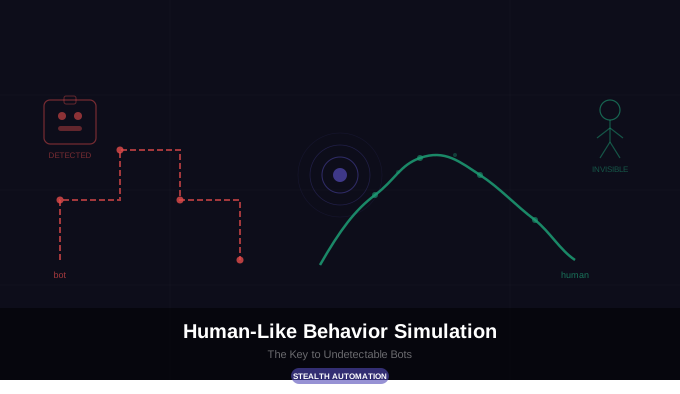
Fast execution and random delays are no longer enough to avoid detection. Modern websites analyze how users behave, not just what actions they perform. Automation that moves too precisely or too consistently stands out immediately.
Human-like behavior simulation focuses on aligning automated interaction patterns with realistic user behavior. It improves reliability by reducing behavioral anomalies rather than attempting to hide automation entirely.
What Is Human-Like Behavior Simulation?
Human-like behavior simulation is the practice of designing automation flows that resemble real user interaction patterns.
Instead of only scripting actions, it models timing, hesitation, scrolling patterns, and session variability. The goal is plausibility, not perfection.
In simple terms, it is automation that behaves like a person rather than a script.
Why Behavior Matters in Modern Detection
Detection systems increasingly rely on behavioral analysis.
Scripts that click instantly, scroll in perfect linear patterns, or execute identical flows across sessions generate detectable signals. Humans do not operate with millisecond precision or identical repetition.
Modern systems evaluate:
Time between actions
Scroll depth and velocity
Navigation sequence
Dwell time
Session continuity
Behavioral realism is now a core component of stable automation.
Core Components of Human-Like Simulation
Variable Timing
Real users pause unpredictably. Effective simulation introduces structured variability rather than fixed sleep intervals.
Non-Linear Scrolling
Humans scroll in bursts, stop mid-page, and occasionally scroll back. Perfect straight-line scrolling is a common automation signal.
Micro-Adjustments
Hovering before clicking, minor corrections, and slight hesitation improve plausibility.
Session Diversity
Users do not repeat identical action sequences across sessions. Automation should adapt flows based on context rather than replaying fixed paths.
The objective is consistency with realistic patterns, not chaotic randomness.
Where Behavior Simulation Is Essential
Account Automation
Logged-in account workflows are highly sensitive to unnatural behavior. Realistic pacing reduces restriction risk.
Web Scraping on Protected Sites
Interacting with pages in a believable way before extracting data improves long-term access stability.
Long-Running Automation
Automation that runs continuously must avoid repetitive patterns that accumulate detection signals.
Implementing Human-Like Behavior Correctly
Study real interaction flows before modeling automation.
Avoid fixed timing, identical sequences, and uniform scroll logic.
Match behavior to context. A content-reading session differs from a checkout process.
Monitor detection indicators such as captchas, degraded success rates, or unexplained failures.
Subtle realism is more effective than complex randomization.
Supporting Behavior Simulation at Scale
As automation scales, maintaining realistic behavior across sessions becomes operationally complex.
Appilot supports behavior-aware automation workflows designed for production environments. It emphasizes session consistency, detection-aware execution, and long-term reliability.
Appilot is relevant when automation success depends on realistic behavior patterns and operational stability.
Common Mistakes
Randomizing everything creates unnatural patterns.
Repeating identical workflows across sessions increases long-term detection risk.
Focusing only on proxies or fingerprints while ignoring behavior reduces effectiveness.
Behavior is as important as environment configuration.
Final Thoughts
Automation fails when it behaves too perfectly. Real users are inconsistent, variable, and context-driven.
Human-like behavior simulation aligns automation with realistic usage patterns, improving stability and reducing detection risk.
No technique guarantees invisibility. However, behavior realism significantly strengthens long-term automation performance.
If implementing structured behavior simulation becomes difficult at scale, Appilot helps manage detection-aware automation workflows effectively.
Frequently Asked Questions
Q: What is human-like behavior simulation?
It is designing automation flows that mimic realistic user interaction patterns.
Q: Why is behavior more important than simple delays?
Because detection systems analyze patterns, not just timing gaps.
Q: Does adding randomness solve detection?
No. Randomness must be structured and realistic.
Q: Can behavior simulation guarantee zero detection?
No. It reduces risk but cannot eliminate detection completely.
Q: Does realistic behavior slow automation?
Yes, but it improves reliability.
Q: Can Appilot support behavior-aware automation?
Yes. Appilot is built to support detection-aware, production-grade workflows.