Imperva Bot Protection: How It Works

As automation continues to evolve, enterprises rely on advanced security systems to protect their platforms from unwanted traffic. One of the key players in this space is Imperva Bot Protection, a system designed to identify and manage automated activity across websites and applications.
Understanding Imperva Bot Protection is important because it is widely used in high-security environments where accuracy and reliability are critical. It combines multiple detection techniques to classify traffic and respond accordingly. This guide explains how Imperva works and the signals it uses to detect bots.
What Is Imperva Bot Protection?
Imperva Bot Protection is a security solution that detects and mitigates automated traffic by analyzing requests in real time. It evaluates each interaction to determine whether it originates from a human user or a bot.
Based on this evaluation, Imperva can allow, challenge, rate-limit, or block traffic.
The system is designed to protect against a wide range of automated activities, including scraping, account abuse, and fraud.
The Core Principle Behind Imperva Detection
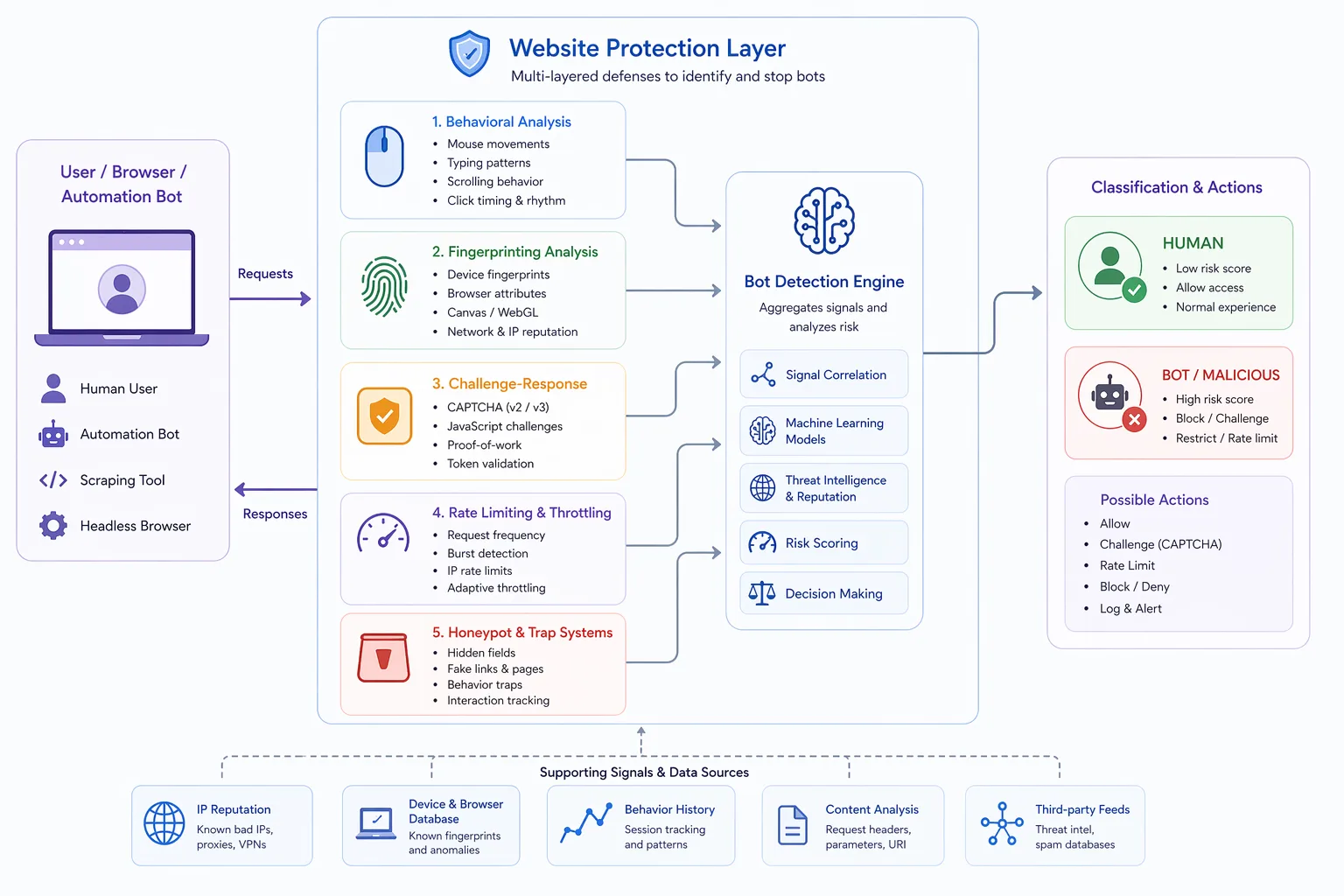
The core principle behind Imperva Bot Protection is multi-signal correlation. Instead of relying on a single indicator, it analyzes multiple layers of data and evaluates how they align.
This includes browser fingerprints, behavioral patterns, and network characteristics. By correlating these signals, Imperva can detect inconsistencies that indicate automation.
This approach increases accuracy and reduces reliance on any one factor.
How Imperva Bot Protection Works
Imperva processes incoming traffic through several layers of analysis.
Device Fingerprinting
Imperva collects detailed information about the browser and device to create a unique fingerprint.
This includes hardware characteristics, rendering behavior, and API outputs. Unusual or inconsistent fingerprints can indicate automation.
Fingerprinting helps track and identify repeated interactions.
Behavioral Analysis
The system monitors how users interact with the website, including navigation flow, timing, and input patterns.
Human behavior tends to be irregular, while bots often follow structured and predictable sequences.
Behavioral analysis is a key component of detection.
JavaScript Challenges
Imperva uses JavaScript-based challenges to evaluate the browser environment.
These challenges test how the browser executes code and whether it behaves like a real user environment. Automated setups may fail or produce inconsistent results.
Network and IP Intelligence
Imperva analyzes IP reputation, geolocation consistency, and request frequency.
IPs associated with suspicious activity or known proxy networks may receive lower trust scores.
Network data is combined with other signals to build a complete profile.
Why Imperva Bot Protection Matters
Imperva is widely used in enterprise environments where security and performance are critical.
Its ability to analyze multiple layers of data allows it to detect both basic and advanced automation.
For businesses, it helps prevent abuse and protect resources. For automation systems, it presents a complex challenge.
Understanding how it works helps explain why certain requests are flagged.
Common Detection Signals Used by Imperva
Imperva relies on a combination of signals to identify bots.
Consistency across signals is essential. Mismatches between browser data, IP location, and behavior can raise suspicion.
Timing patterns are closely monitored. Extremely fast or perfectly timed actions can indicate automation.
Fingerprint stability is evaluated over time to detect anomalies.
These signals are analyzed together to form a comprehensive assessment.
Imperva Response Mechanisms
Imperva responds to detected bots based on risk level.
Low-risk traffic is allowed without interruption. Medium-risk traffic may be challenged with captchas or verification steps.
High-risk traffic can be rate-limited or blocked entirely.
This flexible response system allows for effective traffic management.
Limitations of Imperva Bot Protection
Despite its advanced capabilities, Imperva has limitations.
False positives can occur, where legitimate users are flagged as bots.
There is also the challenge of evolving automation techniques, which require continuous updates to detection methods.
These limitations reflect the complexity of bot detection.
Imperva vs Other Bot Detection Systems
Imperva is often compared to systems like Cloudflare, Akamai, and DataDome.
While all use multi-layered detection, Imperva combines fingerprinting, behavior, and network analysis with enterprise-grade infrastructure.
Each system has its own strengths, but all aim to identify automation.
Imperva vs Anti-Detection Techniques
Imperva is designed to detect environments that attempt to mask or spoof signals.
It looks for inconsistencies that arise when signals are artificially modified.
Even well-configured setups can produce subtle differences that are detected.
This makes bypassing such systems increasingly difficult.
Imperva vs Real-Device Environments
A key distinction in modern detection is the difference between simulated environments and real-device environments.
Imperva analyzes multiple layers of signals, and inconsistencies in simulated setups can be detected even if individual signals appear correct.
Real-device approaches operate on actual hardware where signals naturally align. Tools like Appilot follow this approach by running automation on real Android devices, where browser behavior, network patterns, and device characteristics reflect real-world usage.
This reduces reliance on masking techniques.
When Imperva Detection Is Most Strict
Imperva applies stricter detection in environments with high security requirements or sensitive operations.
This includes financial services, enterprise applications, and platforms with high-value transactions.
In these scenarios, detection thresholds are higher and responses are more aggressive.
Understanding this helps in adapting to different contexts.
Frequently Asked Questions
Q: What is Imperva Bot Protection?
It is a system that detects and manages automated traffic using multiple signals.
Q: How does Imperva detect bots?
By analyzing fingerprints, behavior, JavaScript execution, and network data.
Q: What happens when a bot is detected?
The request may be challenged, rate-limited, or blocked.
Q: Is Imperva similar to other systems?
Yes, it uses a multi-layered approach similar to other advanced platforms.
Q: Can Imperva block legitimate users?
Yes, false positives can occur.
Q: How do real-device solutions compare?
Real-device solutions like Appilot align signals naturally, reducing inconsistencies compared to simulated environments.
Key Takeaways
Imperva Bot Protection is an advanced detection system that uses multi-layered analysis to identify automated traffic. It evaluates device fingerprints, behavior patterns, JavaScript execution, and network data to classify requests. Based on this analysis, it can allow, challenge, rate-limit, or block traffic. While highly effective, it is not perfect and must continuously evolve to keep up with new automation techniques. Understanding how Imperva works is essential for navigating modern bot detection systems.