Instagram Growth Service vs DIY Automation Bot: Which Gives Better ROI?
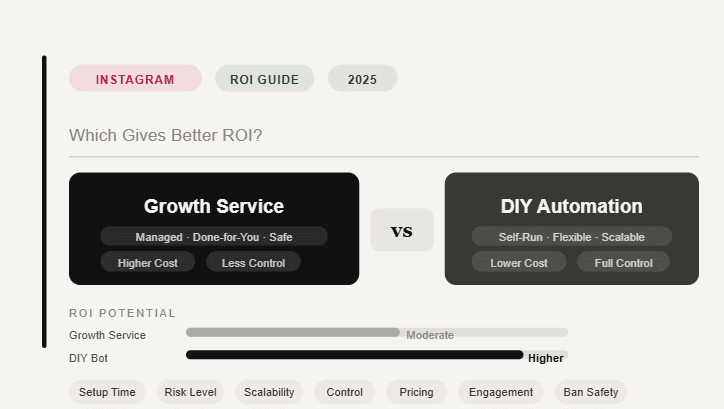
Instagram growth can be handled in two main ways. You can hire an Instagram growth service that manages strategy, content support, engagement, outreach, reporting, and account growth on your behalf. Or you can use a DIY automation bot to run repetitive tasks yourself, such as engagement workflows, DMs, posting support, account checks, or multi-account operations.
Both options can produce value. Both can also waste money if used the wrong way.
An Instagram growth service usually costs more, but it can bring human judgment, strategy, reporting, and hands-on execution. A DIY automation bot usually costs less, but it requires setup, monitoring, workflow design, and a clear understanding of account safety. The ROI depends on your goals, budget, time, skill level, risk tolerance, and whether you need real followers, leads, sales, or simply less manual work.
The honest answer is that a growth service gives better ROI when you need strategy and execution done for you, while a DIY automation bot gives better ROI when you already know your workflow and need to reduce repetitive manual work. For serious teams, the best setup is often a hybrid: use human strategy for content and audience decisions, then use automation carefully for workflow support.
What Is an Instagram Growth Service?
An Instagram growth service is usually a done-for-you or managed service that helps an account grow through content planning, engagement, outreach, analytics, profile optimization, influencer coordination, or manual account activity. Some services focus on organic strategy, while others focus on engagement, audience targeting, or follower growth.
The advantage of a service is that someone else handles the work. A good service can help define the audience, improve profile positioning, suggest content ideas, engage with relevant users, track performance, and provide recommendations. This can be useful for business owners, creators, coaches, ecommerce brands, agencies, and local businesses that do not have time to manage Instagram every day.
The problem is that not all growth services are equal. Some rely on weak automation, fake followers, engagement pods, or low-quality outreach. Those services may make numbers look better temporarily, but they rarely create strong ROI. A real growth service should focus on relevant audience growth, better engagement quality, real conversations, and measurable outcomes like leads, sales, bookings, or qualified DMs.
What Is a DIY Instagram Automation Bot?
A DIY Instagram automation bot is a tool that helps users automate parts of their Instagram workflow. This can include scheduling, comment-to-DM flows, direct message automation, account checks, profile actions, engagement support, real-device workflows, or multi-account management.
The main benefit is control. Instead of paying someone else to manage growth, you build and manage the system yourself. This can be much cheaper over time, especially if you understand your audience and already have a working content strategy.
But DIY automation also creates responsibility. You need to know what to automate, what not to automate, how often actions should run, how to avoid unnatural patterns, how to monitor accounts, and how to handle issues. Instagram can restrict accounts when it detects activity that violates its terms around automated access, so automation should be used carefully and responsibly.
A DIY bot is not a magic growth engine. It is a workflow tool. It can improve efficiency, but it cannot fix weak content, poor offers, unclear positioning, or irrelevant targeting.
The Main Difference Between Growth Services and DIY Bots
The biggest difference is who owns the strategy.
With a growth service, the provider usually owns part of the strategy and execution. They decide what actions to take, what audience to target, how to engage, what to report, and how to improve the account. You pay for expertise and labor.
With a DIY automation bot, you own the strategy. The tool only executes the workflows you design. If the workflow is smart, the bot can save time and improve consistency. If the workflow is weak, the bot can amplify mistakes.
That is why ROI depends heavily on your skill level. A beginner may get better ROI from a strong growth service because they need guidance. An experienced operator may get better ROI from a DIY bot because they already know what to do and only need execution support.
Cost Comparison
An Instagram growth service usually has a higher monthly cost because you are paying for people, strategy, communication, account work, reporting, and sometimes content support. A good service may cost significantly more than a software tool, but the extra cost can make sense if it saves time and produces qualified leads or sales.
A DIY automation bot usually has a lower monthly cost, but the hidden cost is your time. You need to set up workflows, monitor results, adjust actions, check account health, review DMs, manage proxies or devices if needed, and improve the system.
The cheapest option is not always the best ROI. A low-cost bot that creates account issues or brings low-quality engagement is expensive in the long run. A higher-cost growth service that brings real customers can be worth it. Likewise, a DIY bot that saves dozens of hours per month can create excellent ROI if used correctly.
Time Investment Comparison
A growth service saves more time because the provider handles most of the work. You may still need to approve strategy, provide content, review reports, and answer high-value leads, but the day-to-day execution is usually outsourced.
A DIY automation bot saves time only after the system is set up properly. At first, it may require testing, adjustments, account mapping, message writing, limits, monitoring, and workflow cleanup. Once the system is stable, it can reduce repetitive manual work significantly.
For a busy founder or creator, a growth service may produce better ROI because time is the limiting factor. For an agency or operator managing many accounts, a DIY automation bot may produce better ROI because the same system can support multiple workflows.
Control Comparison
DIY automation gives more control. You decide the workflow, pacing, targeting, messaging, device setup, and account rules. This is useful when you have a clear strategy and want full visibility.
Growth services give less control because you are trusting someone else to manage execution. This can be good if the service is experienced, but risky if they use unclear methods. Before hiring a service, you should understand exactly what they do, whether they use automation, whether they send DMs, how they target users, and what metrics they report.
For brands that care deeply about voice and reputation, control matters. A poorly written DM or generic engagement action can damage trust. DIY tools allow more precision, but they also require more responsibility.
Risk Comparison
A growth service can be risky if it uses aggressive tactics behind the scenes. Some services promise fast follower growth but rely on fake followers, engagement pods, mass actions, or low-quality automation. That may increase numbers but hurt account quality.
A DIY automation bot can also be risky if the user runs it aggressively. Mass following, repetitive comments, cold DM spam, unstable proxy rotation, and unnatural activity can create account friction. Instagram’s official guidance also emphasizes growing by creating engaging content that resonates with the audience, which shows why real content and audience relevance remain central to growth.
The safest option is not service or bot by default. The safest option is the one that uses realistic workflows, relevant targeting, conservative activity, strong content, and transparent reporting.
ROI Comparison for Beginners
Beginners often get better ROI from a good Instagram growth service because they may not know what to automate yet. If the profile is weak, the offer is unclear, or the content strategy is random, a bot will not solve the problem.
A growth service can help identify the audience, improve profile structure, suggest better content, and create a repeatable engagement plan. This guidance can be valuable early on.
However, beginners should avoid services that promise instant followers or guaranteed viral growth. Those promises usually lead to low-quality tactics. The best service for beginners is one that focuses on strategy, content, audience quality, and real engagement.
ROI Comparison for Agencies
Agencies often get better ROI from DIY automation bots because they manage multiple accounts and need operational leverage. A manual process that works for one account becomes difficult when repeated across 20 or 50 accounts.
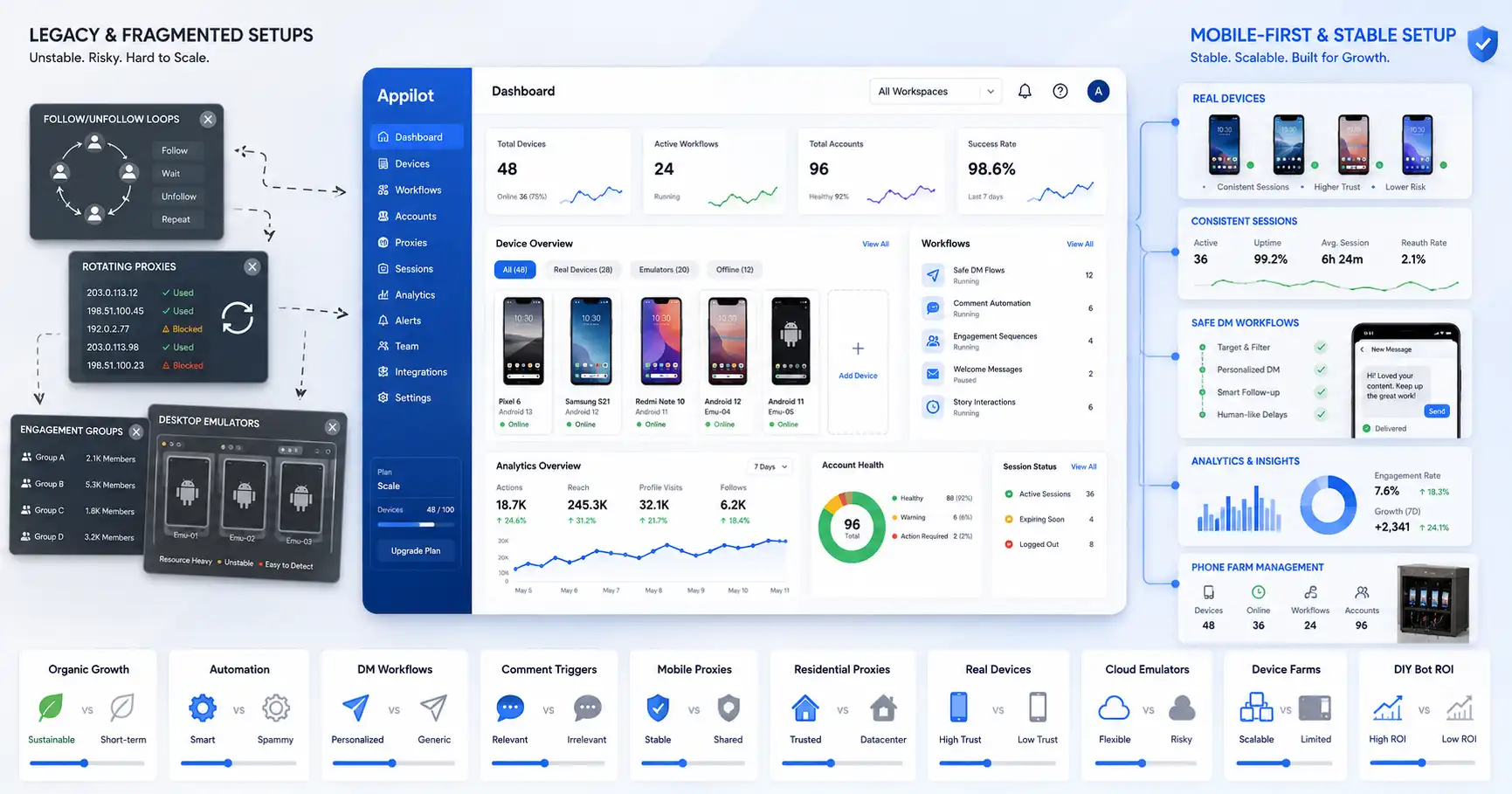
For agencies, automation can reduce manual switching, repetitive checks, inbox handling, basic workflows, and mobile app tasks. This is where tools like Appilot become valuable because they help manage Android devices, emulators, and mobile workflows from a web dashboard.
A growth service is less practical for agencies unless the agency is outsourcing fulfillment. If the agency already has strategy and client management in-house, a DIY automation system usually gives better margins and more control.
ROI Comparison for Ecommerce Brands
Ecommerce brands usually get the best ROI from a hybrid setup. A growth service can help with content strategy, influencer partnerships, creative testing, and campaign planning. A DIY automation tool can help with DMs, comment-to-DM flows, product links, discount delivery, and customer support workflows.
For ecommerce, conversions matter more than followers. A bot that sends requested product links quickly can create direct ROI. A service that improves content and influencer reach can also create ROI. The best choice depends on whether the brand’s main bottleneck is strategy or execution.
If the brand has strong content but slow response times, automation may produce better ROI. If the brand has weak content and unclear positioning, a service may help more.
ROI Comparison for Creators and Coaches
Creators and coaches often benefit from a growth service when they need positioning, content direction, and offer clarity. A good service can help turn expertise into content themes and engagement strategies.
But DIY automation can be powerful once the creator has an audience and offer. For example, comment-to-DM automation can deliver guides, templates, booking links, course pages, or lead magnets to users who request them.
The best ROI usually comes from using automation after the audience has shown intent. Cold automation can feel spammy, but user-triggered automation can feel helpful.
ROI Comparison for Phone Farm Operators
Phone farm operators usually get better ROI from DIY automation because their entire model depends on controlling devices, accounts, workflows, and infrastructure. Paying a growth service to manage each account would often be too expensive and too limiting.
For phone farm workflows, the key is real-device control, account separation, session stability, and workflow visibility. Appilot is useful here because it supports mobile-first automation across Android devices and emulators, helping operators manage workflows more centrally.
A growth service may help with strategy, but the operational ROI usually comes from owning the automation system.
When a Growth Service Gives Better ROI
A growth service gives better ROI when you lack time, lack strategy, need human judgment, or want someone to manage growth for you. It is also useful when your account needs content direction, profile optimization, audience research, campaign planning, or reporting.
A good growth service is especially valuable when the business owner’s time is more expensive than the monthly fee. If outsourcing Instagram frees you to focus on sales, product, clients, or operations, the ROI may be strong.
The service gives better ROI when it produces real business outcomes, not just follower growth. Leads, sales, bookings, qualified DMs, email signups, and community engagement matter more than vanity metrics.
When a DIY Automation Bot Gives Better ROI
A DIY automation bot gives better ROI when you already understand your audience and need operational leverage. If you know what actions should happen, what messages should be sent, what accounts should be monitored, and what workflows should repeat, automation can save a lot of time.
It is also better when you manage multiple accounts. The more accounts you manage, the more valuable automation becomes, as long as it is controlled and responsible.
DIY automation is strongest when it supports real workflows: scheduling, requested DMs, comment triggers, mobile account checks, inbox support, and multi-account operations. It is weakest when used for spammy mass actions.
Why Appilot Fits the DIY Automation Side
Appilot fits the DIY automation side because it helps teams manage real-device and emulator-based social media workflows from one dashboard. Instead of manually operating every Android device or emulator, teams can use Appilot as a mobile-first workflow layer.
This matters because Instagram is mobile-first. Many important workflows happen inside the app, not only through web dashboards. Appilot helps agencies, operators, growth teams, and phone farm users manage mobile workflows more efficiently.
For ROI, Appilot is valuable when manual device work is eating too much time. If a team spends hours switching between accounts, checking apps, managing devices, or repeating the same mobile actions, Appilot can reduce operational cost.
The strongest Appilot use case is not careless automation. It is controlled workflow support, real-device execution, and better multi-account management.
The Best ROI Strategy: Hybrid Growth
The best ROI often comes from combining human strategy with automation. A human should decide the audience, positioning, offer, content themes, engagement style, and conversion path. Automation should handle repetitive support tasks.
A hybrid setup might look like this: a strategist plans content, a creator publishes strong Reels and carousels, a DM automation flow delivers requested resources, Appilot manages mobile workflows across devices, and analytics guide future decisions.
This creates a better ROI model because the human work focuses on judgment and creativity, while automation handles repetition and scale.
Common ROI Mistakes
The first mistake is judging ROI only by follower count. Followers are not ROI unless they become engagement, leads, sales, bookings, or brand value.
The second mistake is using a growth service without knowing its methods. If the provider uses risky tactics, the account may suffer even if the numbers rise temporarily.
The third mistake is buying a bot without a workflow. A bot needs strategy. Without clear targeting, messaging, and limits, it can create more problems than value.
The fourth mistake is ignoring content quality. Instagram itself recommends growth through engaging content that resonates with the audience, so automation should support content, not replace it.
The fifth mistake is automating high-value conversations too early. Automation can qualify and route leads, but serious prospects often need a human response.
Final Verdict
An Instagram growth service gives better ROI when you need strategy, content guidance, human execution, and done-for-you management. A DIY automation bot gives better ROI when you already know your workflow and need to save time, manage multiple accounts, or support mobile app operations.
For beginners, a good growth service may be better. For agencies, phone farm operators, and experienced marketers, a DIY automation bot can produce stronger ROI because it gives more control and lower operating cost over time.
The best approach is usually hybrid. Use human strategy to build real growth, then use automation to support repetitive workflows. Appilot fits this model by helping teams manage real-device Instagram and social media workflows across Android devices and emulators.
The highest ROI does not come from the cheapest tool or the fastest follower promise. It comes from a system that creates real audience quality, saves meaningful time, protects account health, and turns attention into measurable business results.
FAQs
Q1: Is an Instagram growth service better than a DIY automation bot?
A growth service is better if you need strategy and done-for-you execution. A DIY automation bot is better if you already know your workflow and need to save time.
Q2: Which option gives better ROI for agencies?
DIY automation bots usually give better ROI for agencies because they reduce repetitive work across multiple accounts and give more control over workflows.
Q3: Are Instagram automation bots risky?
They can be risky if used for aggressive follows, spam DMs, repetitive comments, or unnatural activity. They are safer when used for controlled workflow support.
Q4: When should I hire an Instagram growth service?
Hire a growth service when you need help with strategy, content direction, audience targeting, reporting, and daily execution.
Q5: How does Appilot improve DIY automation ROI?
Appilot helps teams manage Android devices, emulators, and mobile social media workflows from one dashboard, reducing manual device work and improving multi-account control.