Instagram Product Catalog Sync Automation for E-commerce
Managing a small Instagram product catalog is simple. You upload a few products, update a few prices, and occasionally change product images or descriptions. But once your store grows to dozens or hundreds of products, the process becomes much harder to manage manually.
Many ecommerce brands update products constantly. New items are added, old items are removed, seasonal collections appear, prices change, stock levels move, and product descriptions are updated. If your Instagram catalog is not synced properly, customers may see outdated products, incorrect prices, sold-out items, or broken links.
The larger the store becomes, the more difficult it becomes to keep Instagram synchronized with the actual ecommerce catalog.
This becomes even more complicated when brands operate multiple Instagram accounts. One account may focus on beauty products, another on fashion, and another on limited-time offers. Each account may require different product collections and different product visibility rules.
This is where product catalog sync automation becomes valuable. Instead of manually updating products every day, you can build workflows that automatically keep Instagram catalogs aligned with your ecommerce platform.
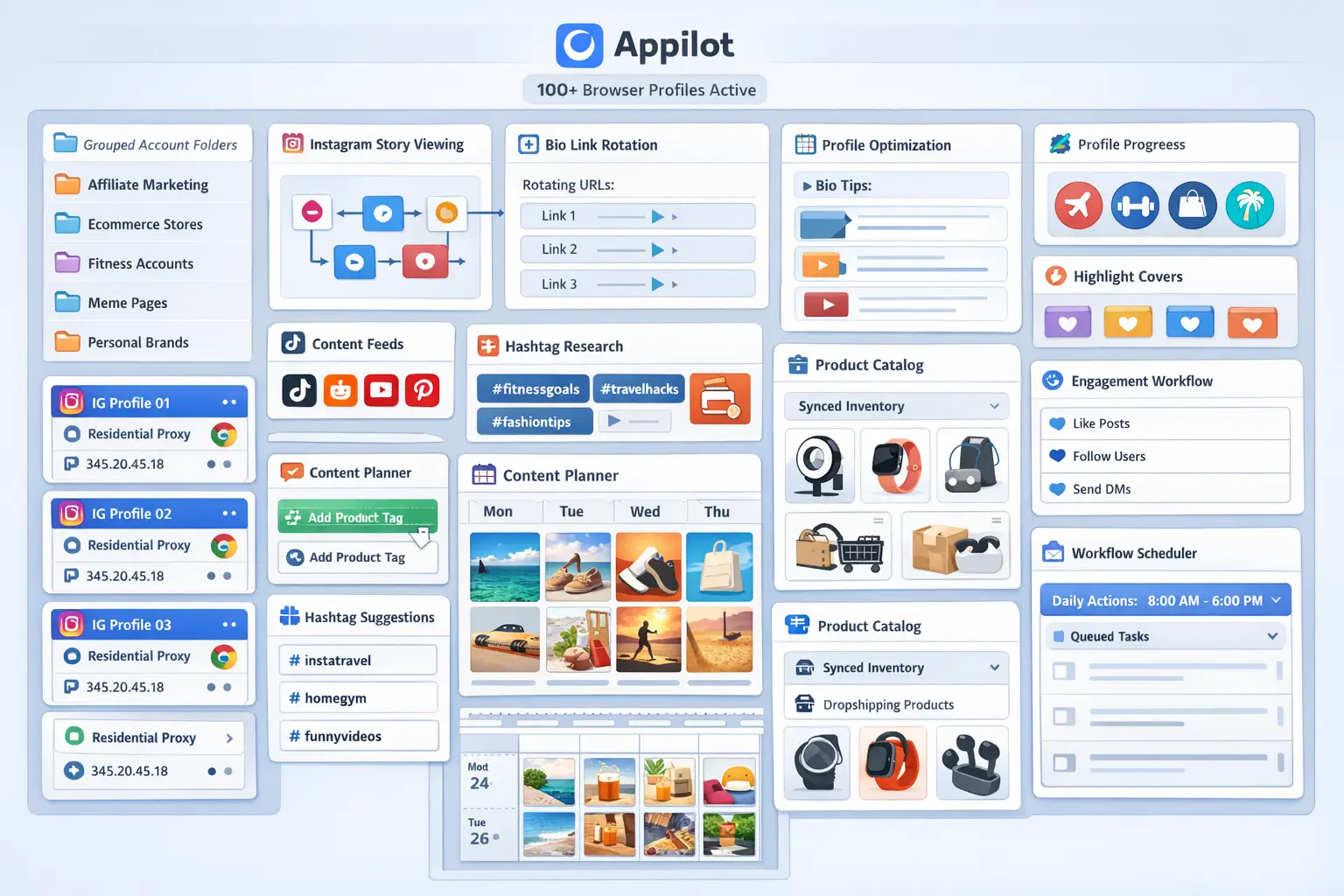
For this guide, I will use Appilot as the main workflow platform. Appilot helps automate browser workflows and Android actions from one dashboard, making it easier to sync Instagram catalogs, manage browser profiles, and organize ecommerce operations across multiple accounts.
In this guide, you will learn why catalog syncing matters, how to organize product collections, how to connect Instagram accounts with Appilot, and how to automate product updates safely across multiple product groups.
Setup Time: Around 60 minutes
Difficulty: Intermediate
Estimated Time Saved: 10 to 25 hours weekly
Why Product Catalog Sync Matters
An outdated product catalog creates friction for customers and extra work for ecommerce teams.
For example, a customer may tap a tagged product on Instagram only to discover that:
The price is outdated
The product is sold out
The link no longer works
The image is incorrect
The wrong description is shown
The product has already been removed from the store
These issues reduce trust and often lead to lost sales.
For stores with a large product range, manual syncing becomes difficult because product data changes frequently.
For example, a fashion brand may update:
Seasonal collections
Product variants
Discount pricing
Limited edition releases
Country-specific inventory
New arrivals
Product availability
If the Instagram catalog is not updated at the same pace, the shopping experience quickly becomes inconsistent.
Automation solves this problem by creating a system that regularly checks the store catalog and syncs updates automatically.
The manual approach may work for very small stores, but it becomes difficult once product counts grow.
With automation, you can connect your store catalog to Instagram workflows, group products into collections, and sync updates automatically.
The biggest advantage is not only saving time. It is maintaining accurate product information across every Instagram account and product group.
What You Need to Get Started
To automate Instagram product catalog syncing, you need a few tools working together.
The first requirement is an ecommerce platform such as Shopify, WooCommerce, BigCommerce, Magento, CSV product feeds, Airtable, or Google Sheets.
The second requirement is an antidetect browser such as GoLogin, AdsPower, Multilogin, or Dolphin Anty. These browsers help manage multiple Instagram accounts while keeping cookies, fingerprints, and proxies separated.
The third requirement is residential or mobile proxies. Proxies help make account activity look more natural and reduce the risk of multiple accounts appearing from the same IP address.
The fourth requirement is Appilot. Appilot helps connect browser profiles, organize product collections, automate sync workflows, and manage Instagram catalog updates from one dashboard.
A typical setup for catalog sync automation usually costs between $150 and $500 per month depending on the number of browser profiles, products, and workflows involved.
Step-by-Step: Setting Up Product Catalog Sync Automation
Step 1: Organize Products Into Collections
Before creating any workflow, you should organize products into categories.
For example, you may have:
New arrivals
Best sellers
Seasonal products
Sale items
Limited edition products
Country-specific collections
Category-based collections
A fashion brand may separate jackets, shoes, shirts, and accessories. A beauty brand may separate skincare, makeup, hair products, and wellness products.
The more organized the product catalog becomes, the easier it becomes to automate syncing later.
Step 2: Group Instagram Accounts by Campaign Type
If you manage multiple Instagram accounts, you should organize them into account groups.
For example:
beauty-products-account
fitness-products-account
us-fashion-account
uk-fashion-account
holiday-sales-account
This makes it easier to sync specific product collections with the correct account group.
For example, a UK-based account may need a different catalog than a US-based account.
Step 3: Connect Browser Profiles to Appilot
Once your browser profiles are ready, connect them to Appilot using your browser API key.
Inside Appilot, you can create profile groups such as:
beauty-brands
fashion-brands
fitness-products
ecommerce-sales-pages
seasonal-offers
This makes it easier to assign catalog sync workflows to the correct account group.
Step 4: Create a Catalog Sync Workflow
Once everything is connected, you can create a workflow that checks for product changes and updates Instagram automatically.
For example, you may want to:
Add new arrivals automatically
Remove sold-out products
Update product prices
Change product images
Sync discount pricing
Refresh product descriptions
Update seasonal collections
const workflow = {
  name: "Instagram Product Catalog Sync",
  accounts: "beauty-brands",
  actions: [
    "Check product feed",
    "Detect changes",
    "Update Instagram catalog",
    "Remove unavailable products",
    "Sync prices and descriptions"
  ],
  schedule: "Daily"
};
The strongest workflows are usually simple and reliable. The goal is to create a repeatable process that keeps Instagram catalogs accurate without constant manual work.
Step 5: Test With a Small Product Collection First
Before syncing hundreds of products, start with a small test group first.
Choose a few products and confirm that:
Prices update correctly
Product images match
Links work properly
Sold-out products disappear
New products appear correctly
Product descriptions sync properly
Once everything works correctly, you can gradually expand to larger product collections and more Instagram accounts.
This helps reduce errors and gives you time to improve the workflow before scaling.
Best Practices for Product Catalog Sync Automation
The best sync systems focus on accuracy rather than speed.
It is better to update fewer products correctly than to sync large catalogs with mistakes.
You should also review product collections regularly. Even if the sync process is automated, you still need to confirm that prices, links, descriptions, and product images remain accurate.
Another important practice is separating collections by region and audience. A US-based audience may require different pricing and products than a UK-based audience.
It is also useful to keep backup copies of product feeds. If something goes wrong, you can quickly restore the previous version of the catalog.
Real Example: Scaling Catalog Sync Across 800 Products
One ecommerce brand managed more than 800 products across multiple Instagram accounts for fashion, beauty, and seasonal sales.
At first, catalog updates were handled manually. Every new product, price change, and seasonal launch required team members to update the Instagram catalog by hand.
As the catalog grew, problems started appearing. Some products showed outdated prices, some links stopped working, and some sold-out products were still visible.
The brand eventually switched to a workflow using GoLogin, residential proxies, and Appilot. Products were organized into collections, and sync workflows were created for each account group.
After 90 days, the brand reduced manual catalog management work by more than 75 percent while improving product accuracy across all Instagram accounts.
The biggest improvement was not just saving time. It was having a much more reliable system for keeping product data updated.
Common Mistakes to Avoid
One common mistake is syncing every product across every account. Different accounts often require different product collections.
Another mistake is forgetting to remove sold-out items. Products that are unavailable can create frustration for customers and reduce trust.
Some teams also forget to review synced data regularly. Automation helps reduce work, but final checks are still important.
It is also important not to update every account at the exact same time. Staggered workflows usually look more natural and are easier to monitor.
FAQ
Q1: How many products can I manage with automated catalog syncing?
Most ecommerce brands can comfortably manage hundreds of products with structured workflows. Larger stores can support even bigger catalogs by organizing products into collections.
Q2: Can I use different product collections for different Instagram accounts?
Yes. Most brands create separate collections for different regions, audiences, and campaign types.
Q3: How often should product catalogs be synced?
Most stores benefit from daily syncing, although larger stores with frequent changes may prefer multiple syncs per day.
Q4: Will Instagram detect automated catalog syncing?
The risk stays low when you use separate browser profiles, realistic activity timing, good proxies, and gradual workflows.
Q5: Which browser is best for Instagram ecommerce automation?
GoLogin is usually best for smaller operations, AdsPower works well for larger account groups, and Multilogin is useful for enterprise teams.
Conclusion
Instagram product catalog sync automation helps ecommerce brands save time, reduce mistakes, and keep product information accurate across multiple accounts.
Instead of manually updating prices, images, descriptions, and product availability every day, you can create workflows that keep everything synchronized automatically.
The key is to organize product collections carefully, test workflows gradually, review synced data regularly, and focus on accuracy rather than speed.
For ecommerce brands, agencies, and affiliate marketers, product catalog sync automation can become one of the most useful systems for managing Instagram shopping campaigns at scale.