Instagram Restricting Your Reach? Here's Why and How to Fix It
You are posting regularly, creating reels, using hashtags, replying to comments, and staying active.
Then suddenly your reach drops.
Your reels stop getting views. Your posts stop appearing in hashtags. Story views fall. Follower growth slows down. Content that used to perform well suddenly struggles.
Most people notice the problem slowly.
At first, they think it is just a weak post.
Then it keeps happening.
Soon almost every piece of content starts getting lower engagement than before.
This is when many people start asking the same question.
Is Instagram restricting my reach?
In many cases, the answer is yes.
Instagram may reduce the visibility of content when it believes an account is behaving suspiciously, posting low-quality content, using repetitive engagement tactics, or violating platform guidelines.
The good news is that reduced reach is usually fixable.
Once you understand why Instagram limits visibility, you can rebuild trust, improve performance, and make your content more visible again.
In this guide, you will learn why Instagram restricts reach, what the warning signs are, how to recover, and how to prevent the problem in the future.
Time to recover: Usually between 3 and 14 days depending on the severity of the restriction. Success rate: High if the account reduces suspicious behavior early. Cost: Usually free unless you need better account management tools, browser separation, or proxies.
Why Instagram Restricts Reach
Instagram wants to promote content that keeps users engaged on the platform.
If an account looks suspicious, spammy, repetitive, or low quality, Instagram may reduce how many people see the content.
The platform tracks much more than likes and comments. It also tracks session history, account age, device fingerprints, browser fingerprints, IP addresses, content quality, action frequency, login patterns, hashtag behavior, and how users react to your posts.
If too many of these signals look unusual, Instagram may reduce your visibility.
One of the most common reasons is repetitive behavior. If you use the same hashtags on every post, send the same DM repeatedly, leave identical comments, or follow and unfollow aggressively, Instagram may start limiting reach.
Another common issue is low-quality content. If people skip your reels quickly, ignore your posts, hide your content, or report your account, reach may start falling.
Accounts that use low-quality automation tools, fake engagement, or large batches of fake followers can also lose visibility very quickly.
This is exactly why I built Appilot. The goal was to help create more natural account behavior and safer automation instead of repetitive actions that reduce reach over time.
Signs Instagram Is Restricting Your Reach
One of the biggest signs is a sudden drop in engagement across all content types.
Your reels may stop reaching non-followers. Story views may decline sharply. Posts may stop appearing in hashtags. Profile visits may fall.
You may also notice that most of your views are suddenly coming only from existing followers instead of new users.
Another warning sign is that content stops getting recommended. Reels no longer appear in explore pages, hashtag pages, or suggested content sections.
Some people also notice more login challenges, action blocks, repeated verification requests, or suspicious activity warnings at the same time.
These are usually signs that Instagram no longer fully trusts the account.
How to Fix Low Instagram Reach
Step 1: Reduce Aggressive Activity
If your reach has dropped suddenly, reduce aggressive activity for a few days.
Do not keep following large numbers of users, sending bulk DMs, leaving repetitive comments, or posting too aggressively.
The goal is to make the account look calmer and more natural again.
Many people panic when reach drops and try to increase activity to force better performance.
This usually makes the problem worse.
Step 2: Improve Content Quality
Instagram rewards content that keeps people watching, clicking, sharing, and engaging.
If your content gets skipped quickly or ignored, reach may continue falling.
Focus on stronger hooks, better captions, more engaging reels, more useful content, and better storytelling.
The more people interact with your content, the easier it becomes to recover reach.
Step 3: Stop Using Repetitive Hashtags
Using the same group of hashtags on every post can make the account look repetitive.
Instead, vary hashtags based on the content and use smaller, more targeted keywords.
Avoid spammy hashtags and avoid adding large blocks of irrelevant hashtags to every post.
Step 4: Disconnect Low-Quality Automation Tools
Cheap Instagram bots often repeat the same timing patterns, messages, and action sequences.
Instagram can detect this very easily.
If you are using low-quality automation tools, disconnect them immediately.
The problem is not automation itself. The problem is repetitive automation that looks unnatural.
Step 5: Separate Accounts Properly
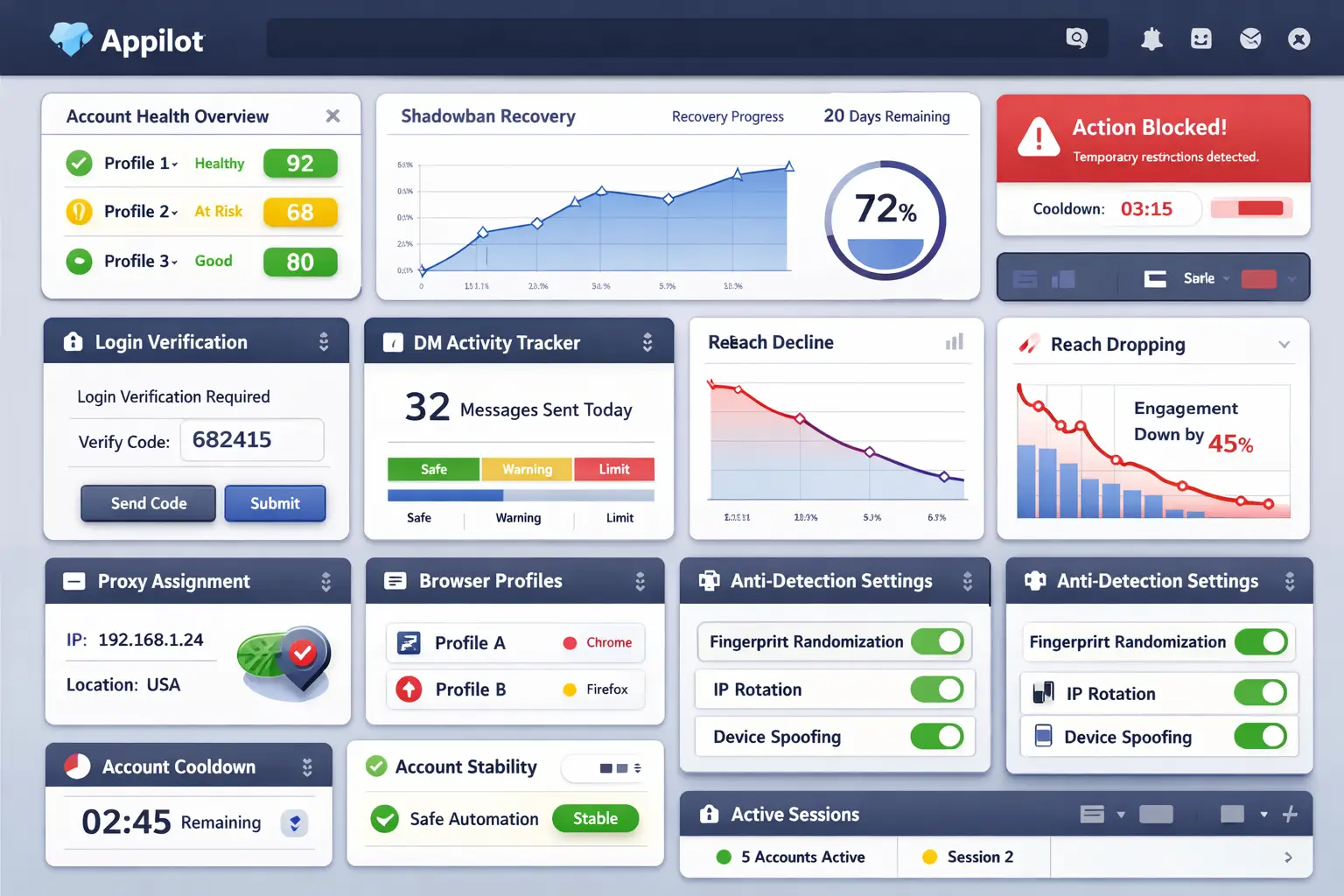
If you manage multiple Instagram accounts, separate them with different browser profiles, proxies, cookies, and device fingerprints.
Instagram can connect accounts together through shared browser data and IP addresses.
If one account loses trust, the others may lose reach too.
Appilot is useful here because it helps create safer account environments and more natural behavior patterns instead of repetitive workflows that get flagged.
Step 6: Warm the Account Back Up Slowly
Once reach starts recovering, do not go back to full activity immediately.
Increase posting, engagement, and outreach slowly.
The goal is to rebuild trust gradually.
The slower and more natural the account looks, the more stable reach becomes over time.
How to Prevent Reach Restrictions in the Future
The best way to protect reach is creating more natural activity patterns.
Avoid sending identical DMs, using the same hashtags repeatedly, or following too many people too quickly.
Use high-quality proxies if you manage multiple accounts. Keep account locations stable. Separate browser environments properly.
Focus on content quality instead of trying to force growth through spammy tactics.
If you automate any part of Instagram activity, make sure it behaves more like a real person.
Randomize delays, vary action sequences, and avoid repetitive patterns.
The more natural the account looks, the easier it becomes to maintain strong reach long term.
Common Mistakes That Make Reach Restrictions Worse
One major mistake is posting more aggressively after reach drops.
Many people think more content will fix the issue quickly, but if the account is already restricted, more activity can make the problem worse.
Another mistake is buying fake followers or engagement.
This usually damages account trust even more.
People also make the mistake of continuing to use repetitive hashtags, spammy comments, or low-quality automation tools.
If the same behavior caused the problem in the first place, repeating it will only make recovery harder.
Frequently Asked Questions
Q1: How long does Instagram restrict reach?
Most reach restrictions last between 3 and 14 days. More serious cases may take longer if suspicious behavior continues.
Q2: Can hashtags reduce my reach?
Yes. Repetitive, spammy, or irrelevant hashtags can make the account look suspicious.
Q3: Will deleting posts fix low reach?
Usually not. Improving content quality and reducing suspicious behavior is more effective.
Q4: Does automation always reduce reach?
No. Low-quality automation is risky, but safer and more natural automation can work well.
Q5: Why are my reels suddenly getting fewer views?
This can happen because of lower watch time, repetitive content, suspicious activity, or reduced account trust.
Conclusion
Instagram reach restrictions are frustrating, but they are usually temporary.
The key is reducing suspicious behavior, improving content quality, separating accounts properly, and creating more natural activity patterns.
The goal is not to force more activity.
The goal is to make the account look safer, stronger, and more trustworthy over time.