The IP Reputation Problem: When Clean Proxies Go Bad
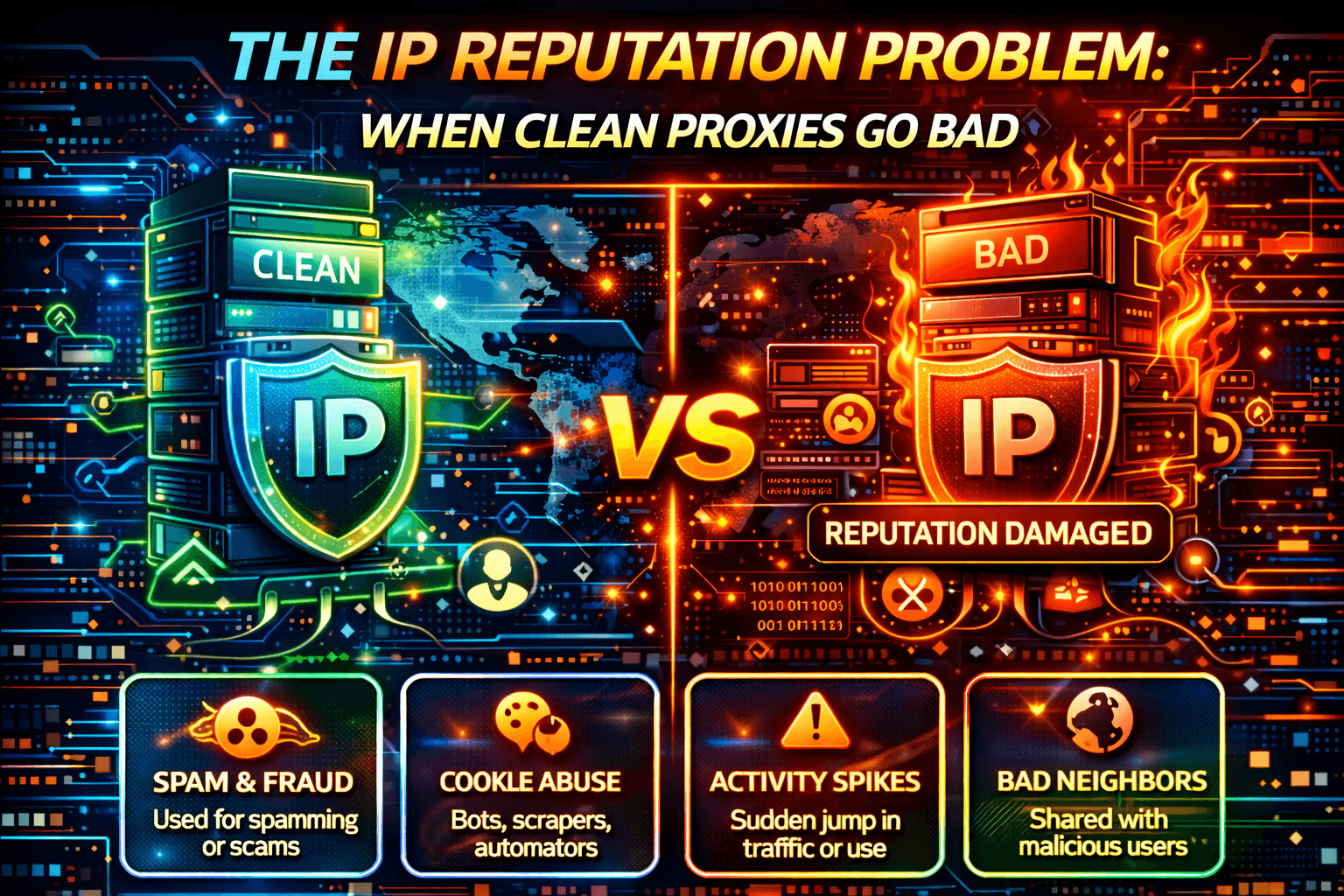
You configured proxy rotation correctly. You paid for reputable proxies. Requests are spaced out properly and stay within safe limits.
Then the problems begin.
You start seeing blocks, CAPTCHAs, throttling, and silent degradation. This is the IP reputation problem.
Even clean proxies eventually go bad, and once reputation drops, rotating faster usually does not solve the issue.
This guide explains why rotating IPs stop working, how reputation actually forms in modern systems, and what a durable IP rotation strategy looks like at scale.
Why This Keeps Getting Worse
The frustrating part is that many teams do everything correctly at the beginning. They choose a reputable proxy provider, implement automatic rotation, avoid aggressive scraping, and keep concurrency low.
Even then, the proxy pool eventually degrades.
Instead of obvious “Access Denied” errors, the warning signs usually appear as slower response times, missing data fields, rising CAPTCHA frequency, and silent throttling.
The automation still appears to run, but trust quietly collapses underneath it.
The Hidden Operational Impact
When IP reputation drops, the damage compounds quickly.
Teams end up spending more money on additional proxies, only to watch those burn out as well. IPs that once lasted for months may now survive only for days or even hours. Reliability becomes unpredictable, and engineering teams spend more time debugging proxy behavior than building features.
Modern systems no longer evaluate IPs in isolation. They evaluate patterns, environments, session continuity, and infrastructure fingerprints.
Before fixing IP rotation, it is important to understand how reputation actually forms.
Why IP Rotation Is No Longer a Silver Bullet
The old model was simple. Rotate the IP address, avoid rate limits, and keep moving.
That model no longer works the same way.
Today, IP rotation exists inside a larger trust system that includes ASN-level reputation, subnet scoring, behavioral correlation, session stability, and historical traffic fingerprints.
You can rotate perfectly and still fail because modern defenses track patterns rather than individual addresses.
How IP Reputation Actually Forms
1. Reputation Is Network-Scoped, Not Just IP-Scoped
Modern defense systems score entire proxy networks, ASN clusters, subnets, and historical usage patterns.
If one IP behaves badly, nearby IPs often inherit suspicion as well. That is why a proxy pool can degrade quickly even if yesterday’s IPs looked completely clean.
2. Rotation Without Context Looks Suspicious
Frequent IP switching creates broken sessions, token invalidation, geo inconsistencies, and fragmented identities.
Detection systems interpret this behavior as evasion.
Automatic rotation without session awareness often increases detection rather than reducing it.
3. Behavior Reuse Burns IPs Faster
If every IP sends identical requests, follows the same timing, hits the same endpoints, and uses identical headers, reputation collapses across the entire pool.
Modern correlation systems score patterns, not just addresses. Uniform behavior across multiple IPs is one of the fastest ways to burn through a proxy network.
4. Shared Pools Inherit Shared History
In residential or shared proxy networks, another customer may have already abused the IPs before you received them.
Someone may have scraped aggressively, triggered fraud rules, or abused login endpoints.
That means your IP inherits some of that reputation history. In practice, “clean” often only means “not burned yet.”
Common IP Rotation Myths
“Rotate Faster”
Rotating more frequently usually increases session breaks, geo inconsistencies, and correlation flags rather than reducing them.
“Buy More Proxies”
Scaling bad behavior across a larger proxy pool only spreads bad reputation faster.
“Switch Providers”
Many proxy providers source IPs from overlapping ASN pools, which means reputation often follows across providers.
“Use a VPN”
VPN networks are widely abused, heavily fingerprinted, and often already distrusted by modern platforms.
These myths fail because they treat IPs as disposable. Modern systems treat IPs as trust carriers.
The Real Cost of Bad IP Strategy
When reputation drops, the cost shows up through more retries, more compute usage, higher proxy spend, partial data loss, and increased maintenance work.
The automation may still technically run, but the quality of the outcomes continues to degrade.
What Durable IP Rotation Looks Like
1. Session-Aware Rotation
Good proxy rotation keeps an IP stable during an active session and rotates only between sessions rather than between every request.
It also preserves cookies and tokens so that the platform sees continuity instead of fragmentation.
This dramatically reduces flags and trust loss.
2. Behavioral Diversity Per IP
Each IP should use slightly different timing, follow different navigation paths, and hit endpoints in different sequences.
Uniformity destroys IP reputation much faster than raw volume.
3. Fewer IPs, Used Better
One of the most counterintuitive truths is that ten well-managed IPs often outperform a thousand burned ones.
Quality almost always beats quantity.
4. Align Environment With Channel
Desktop browser traffic often faces the harshest IP scrutiny.
Some teams reduce IP pressure by avoiding stateless HTTP scraping, using persistent sessions, and running workflows in environments that naturally generate stronger trust signals.
In mobile-native workflows, IP reputation still matters, but it often carries less weight compared to device authenticity and behavioral signals.
This is where Appilot fits naturally into the discussion. Appilot uses real Android devices, Android Accessibility Services, and mobile-first execution instead of disposable browser sessions. Because the environment is more realistic, platforms rely less heavily on IP address alone when evaluating trust.
This does not remove the importance of IP reputation, but it reduces overreliance on IPs as the primary trust signal.
Step-by-Step: Stabilizing Your Rotation System
Step 1: Audit Reputation Signals
Track CAPTCHA frequency, throttling rates, partial responses, session invalidation, and other signs of trust degradation.
Status codes alone are not enough because silent degradation often happens before obvious blocking.
Step 2: Slow Down Rotation
Tie IP addresses to full sessions and avoid rotating in the middle of active workflows.
Stability increases trust.
Step 3: Reduce Pattern Reuse
Change timing windows, endpoint order, and navigation sequences for each IP.
Correlation is the real enemy, not simply rate limits.
Step 4: Shrink the Pool
Aggressively remove low-quality IPs.
A smaller, high-quality proxy pool usually performs much better than a huge low-quality one.
Step 5: Re-evaluate the Surface
If web traffic keeps burning through IPs, reconsider whether the workflow truly belongs on the web.
Reduce stateless execution, increase session realism, and explore alternative execution surfaces where trust is easier to maintain.
IP reputation tends to degrade fastest in synthetic, disposable environments.
Real Example
A team was using a premium rotating proxy service with thousands of IPs. Over time, they saw rising CAPTCHA frequency, shorter IP lifespans, and increasing proxy costs.
They fixed the problem by reducing their pool size by 70%, introducing session persistence, and adding more behavioral variance.
The result was lower costs, fewer blocks, and longer-lasting IPs.
The lesson was simple: rotation without strategy accelerates failure.
Common Mistakes That Ruin Reputation
Stateless requests destroy trust quickly because they create fragmented and unnatural activity.
Identical automation across IPs is also dangerous because modern correlation systems are extremely effective at spotting repeated patterns.
Constantly chasing “fresh” IPs is another mistake because freshness without trust has very little value.
Long-Term Strategy: Design Beyond IPs
IP rotation is a tactic, not a complete strategy.
Long-term stability comes from session realism, behavioral diversity, environment alignment, and gradual scaling.
If IPs are carrying all of the trust weight in your system, the automation is still fragile.
Frequently Asked Questions
Q1: How long do IPs stay clean?
It depends heavily on behavior. Poor patterns can burn through IPs very quickly.
Q2: Are residential proxies immune?
No. Residential proxies degrade more slowly than datacenter proxies, but they are not immune to reputation loss.
Q3: Does rotating per request help?
Usually not. In most cases, rotating on every request creates more problems than it solves.
Q4: Can IP reputation be reset?
Rarely. Reputation generally fades slowly over time if behavior improves, but it is difficult to reset completely.
Conclusion
The real problem with proxy rotation is not that proxies eventually go bad. The problem is that reputation spreads, patterns correlate, and aggressive rotation often amplifies mistakes.
Clean IPs do not stay clean without the right context.
The best approach is to stabilize sessions, reduce behavioral uniformity, and rotate with intent rather than panic.
Once IPs stop being your only layer of defense, they stop being your biggest liability.