IPv4 vs IPv6 Proxies for Social Media Automation: Which Should You Use?
Proxy choice is one of the biggest factors in social media automation safety. A bot can run on a real Android device, use realistic timing, and follow conservative limits, but if the proxy environment looks suspicious or unsupported, the account can still face challenges, blocks, or trust issues. That is why bot operators often ask whether IPv4 or IPv6 proxies are better for Instagram, TikTok, LinkedIn, Reddit, Telegram, Snapchat, YouTube, Threads, and other social platforms.
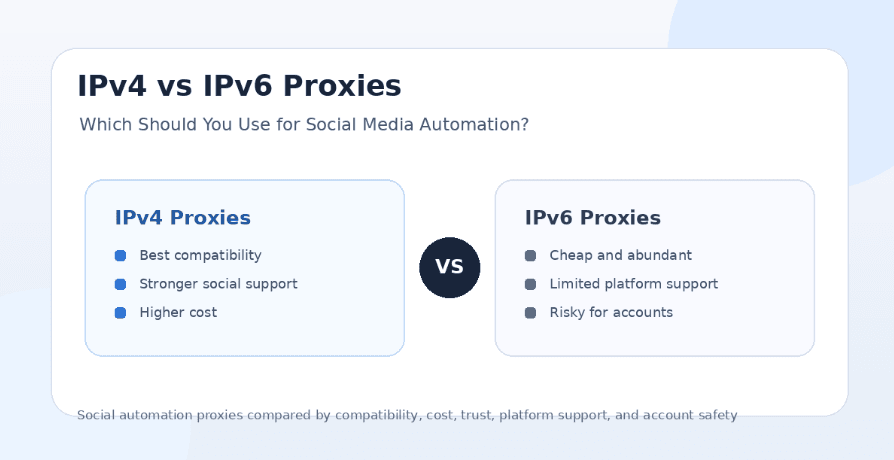
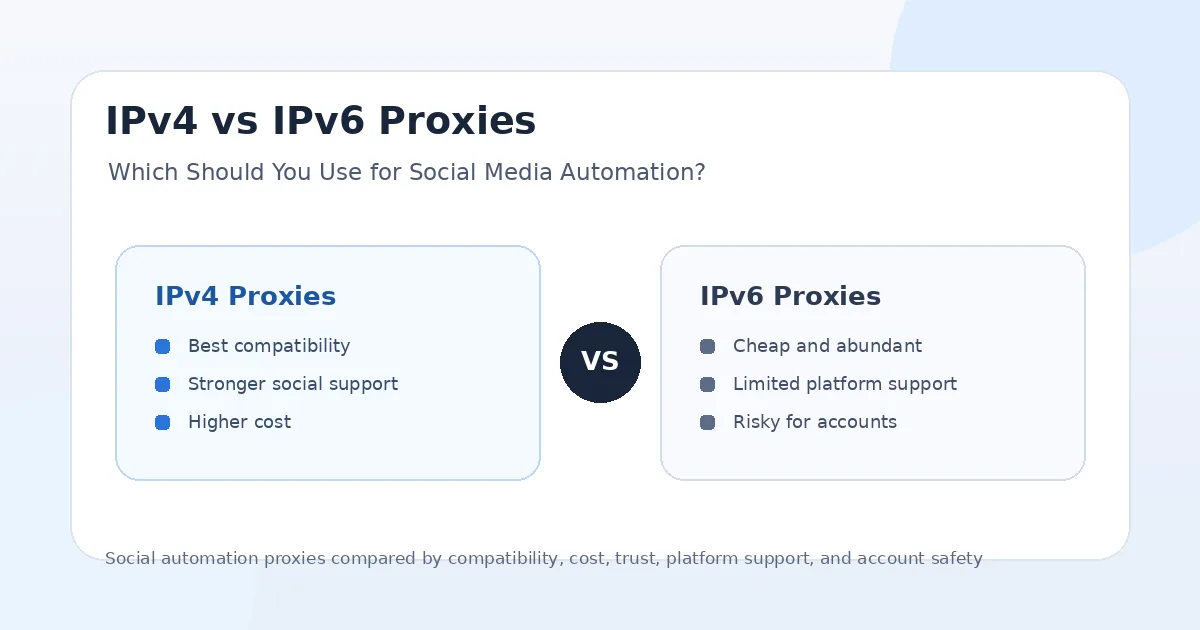
The short answer is simple: IPv4 proxies are usually the safer and more compatible choice for social media automation. IPv6 proxies can be cheap, abundant, and useful for certain technical workflows, but they are not always supported equally across social platforms, proxy providers, apps, anti-abuse systems, and account environments. For valuable social accounts, IPv4 is still the practical default.
That does not mean IPv6 is useless. It can work for some scraping, testing, low-risk browsing, infrastructure experiments, or platforms that fully support IPv6 traffic. But for serious multi-account social media automation, especially with logged-in accounts, mobile workflows, and real-device bots, IPv4 mobile or residential proxies are usually the stronger choice.
What Are IPv4 Proxies?
IPv4 proxies use the older and still widely adopted internet address format. Most websites, social platforms, apps, proxy providers, automation tools, and anti-abuse systems have long-standing support for IPv4 traffic. This makes IPv4 the safest default for most bot operators.
For social media automation, IPv4 proxies are useful because they are broadly compatible. Instagram, TikTok, LinkedIn, Reddit, Telegram, Snapchat, YouTube, Threads, Discord, and many other platforms are already used to seeing IPv4 traffic from residential networks, mobile carriers, and business connections.
The downside is cost. IPv4 addresses are limited, which makes clean IPv4 proxies more expensive than IPv6 proxies. High-quality IPv4 mobile and residential proxies can cost more, but they usually provide better reliability and account compatibility for serious automation workflows.
What Are IPv6 Proxies?
IPv6 proxies use the newer internet address format designed to provide a much larger pool of available IP addresses. Because IPv6 space is much larger than IPv4, IPv6 proxies are often cheaper, easier to generate in bulk, and attractive for operators who want large proxy volumes.
The main advantage is availability. IPv6 proxies can be useful for technical testing, large-scale networking experiments, crawling targets that accept IPv6 cleanly, and workflows where account trust is not the main concern.
The limitation is platform support and trust. Not every social platform, app environment, proxy workflow, or anti-abuse system treats IPv6 traffic the same way as IPv4. Some targets may support IPv6 technically but still behave differently when accounts log in or perform sensitive actions from IPv6 ranges. For valuable social accounts, that uncertainty creates risk.
IPv4 vs IPv6 Proxies: The Main Difference
The main difference is compatibility. IPv4 is older, more widely supported, and more proven for social media automation. IPv6 is newer, cheaper, and more abundant, but it can be less predictable depending on the platform and workflow.
For bot operators, this matters because social media automation is not only about sending traffic. It is about building a believable account environment. If an account normally behaves like a mobile user in one region, suddenly using a strange IPv6 range may create a mismatch.
IPv4 is usually the better choice when account safety matters. IPv6 is usually better when cost, scale, or testing matters more than account trust.
Which Is Safer for Social Media Bots?
IPv4 is usually safer for social media bots because it has broader support across platforms and proxy types. High-quality IPv4 mobile proxies and residential proxies are the standard choice for most serious operators because they look closer to normal consumer traffic.
IPv6 can be risky for logged-in accounts if the platform does not handle IPv6 traffic the same way, if the proxy pool is obviously server-based, or if the target platform rarely sees normal users from that type of network. Even when IPv6 technically works, it may not provide the same trust profile as clean IPv4 mobile or residential IPs.
For Appilot users running bots on real Android devices or emulators, IPv4 is usually the best match because the device layer already aims to look mobile and realistic. Pairing that with stable IPv4 mobile or residential proxies creates a cleaner account environment than using cheap IPv6 ranges that may not match normal social app behavior.
Why IPv4 Still Wins for Instagram Automation
Instagram automation depends heavily on trust signals. Device consistency, proxy location, app behavior, account age, action speed, login history, and network quality all matter. IPv4 mobile proxies and residential proxies usually fit that environment better than IPv6 proxies.
Most Instagram automation operators still prefer IPv4 because it is more predictable. A dedicated IPv4 mobile proxy paired with a real Android device creates a stronger baseline than an IPv6 proxy running through a questionable server range.
IPv6 may work for testing or low-value accounts, but it is not the best default for serious Instagram workflows. If an account is client-owned, revenue-generating, or long-term, IPv4 is the safer choice.
IPv4 vs IPv6 for TikTok Bots
TikTok is a mobile-first platform where device behavior, video performance, account history, and network quality matter. IPv4 mobile proxies are usually the strongest option because they fit the mobile app environment well.
IPv6 may be tempting because it is cheaper and easier to scale, but TikTok automation is not a place where cheap infrastructure should come before account trust. A TikTok account running through a clean IPv4 mobile proxy is usually more believable than one running through a low-cost IPv6 pool.
For testing, IPv6 may be acceptable if the workflow does not involve valuable accounts. For production TikTok automation, IPv4 mobile proxies are usually better.
IPv4 vs IPv6 for LinkedIn Bots
LinkedIn has strong desktop usage as well as mobile usage, so high-quality IPv4 residential proxies can work very well. A professional account logging in from a stable residential IPv4 address usually looks more natural than one coming from a strange or unsupported IPv6 range.
IPv6 can be especially uncertain for LinkedIn outreach because LinkedIn is sensitive to login environment, scraping, spam, and automation. If the account is valuable, uncertainty is not worth the small cost savings.
For LinkedIn auto-connect, message workflows, recruiter accounts, agency outreach, and sales automation, IPv4 residential or mobile proxies are usually the safer route.
IPv4 vs IPv6 for Reddit Bots
Reddit can be used from many network types, but account trust still matters. For posting, commenting, voting, and logged-in Reddit activity, IPv4 residential proxies are usually safer and more predictable than IPv6 proxies.
IPv6 may work for public browsing or low-risk scraping if the target setup supports it. But for account-based Reddit automation, IPv4 is usually better because it reduces compatibility uncertainty.
Reddit communities are also sensitive to suspicious behavior. Even if the proxy works technically, poor comments, fake upvotes, repeated posting, or spammy account patterns can still create bans. IPv4 helps with network compatibility, but behavior still decides long-term trust.
IPv4 vs IPv6 for Telegram Bots
Telegram workflows depend on whether the automation uses official Bot API, user accounts, mobile app sessions, or desktop clients. For most user-account automation, IPv4 mobile or residential proxies are easier to manage and more predictable.
IPv6 can work in some technical Telegram workflows, but it is not always the safest choice for accounts that need stable identity. If users are sending messages, joining groups, or managing communities, account trust and session consistency matter more than cheap proxy volume.
For Appilot-style Telegram workflows running through Android devices and emulators, IPv4 mobile or residential proxies usually make the most sense because they match real-user network behavior more naturally.
IPv4 vs IPv6 for YouTube Automation
YouTube supports a broad range of users and networks, but social automation still needs trust. For account management, comment workflows, app testing, and channel operations, IPv4 residential or mobile proxies are usually more predictable.
IPv6 may work for testing, crawling, or low-risk tasks, but it should not be treated as a shortcut for fake watch-time automation. Artificial engagement remains risky regardless of whether the proxy is IPv4 or IPv6.
For legitimate YouTube automation, the best setup is a stable device environment, realistic account behavior, and a high-quality IPv4 proxy when a proxy is needed.
IPv4 vs IPv6 for Snapchat and Threads
Snapchat and Threads are mobile-first environments where real-device behavior and network consistency matter. IPv4 mobile proxies are usually the safest choice because they match normal mobile usage more closely.
IPv6 may be less predictable for these apps, especially when used through cheap proxy pools or server-style environments. If the goal is testing, IPv6 may be acceptable. If the goal is production social automation, IPv4 mobile proxies are safer.
For Snapchat, especially, real mobile behavior matters because the app is camera-heavy and app-session focused. IPv4 mobile proxies paired with real Android devices are usually stronger than IPv6 proxies paired with virtual environments.
Cost Comparison
IPv6 proxies are usually cheaper because IPv6 address space is abundant. This makes them attractive for operators who want large proxy pools at low cost.
IPv4 proxies are more expensive because IPv4 space is limited and high-quality clean IPv4 addresses are in demand. Mobile and residential IPv4 proxies cost even more because they have stronger trust profiles.
The cost difference matters, but bot operators should not choose proxies only by price. A cheap IPv6 proxy that causes login issues, poor compatibility, or account restrictions can become more expensive than a cleaner IPv4 proxy.
Compatibility Comparison
IPv4 wins on compatibility. It works almost everywhere, and social platforms are highly familiar with IPv4 traffic. Most proxy tools, mobile apps, automation environments, and bot stacks are designed with IPv4 in mind.
IPv6 compatibility can vary. Some platforms support it well, some behave inconsistently, and some workflows may fail depending on provider routing, app behavior, or proxy configuration.
For serious automation, predictability is valuable. IPv4 is usually the more predictable choice, especially when accounts are logged in and performing sensitive actions.
Trust and Reputation
A proxy is not safe just because it is IPv4, and it is not unsafe just because it is IPv6. Reputation still matters. A bad IPv4 datacenter proxy can be worse than a clean IPv6 residential path for certain low-risk tasks.
However, in the real world of social media automation, high-quality IPv4 mobile and residential proxies usually have stronger trust and more proven performance. IPv6 proxy pools are often used because they are cheap and abundant, which can attract low-quality automation use cases.
For account-based workflows, choose the proxy type with the strongest reputation and most stable session behavior. In most cases, that means IPv4 mobile or residential.
IPv4 Mobile Proxies vs IPv6 Proxies
IPv4 mobile proxies are usually much stronger than IPv6 proxies for social media automation. Mobile carrier IPv4 traffic looks closer to real mobile app usage and is widely accepted across platforms.
IPv6 proxies may offer huge volume, but volume is not the main goal for social account safety. If the account matters, quality beats quantity.
For Instagram, TikTok, Snapchat, Threads, Telegram, and YouTube app workflows, IPv4 mobile proxies are usually the premium choice. They cost more, but they provide a better trust baseline.
IPv4 Residential Proxies vs IPv6 Proxies
IPv4 residential proxies are also usually safer than IPv6 proxies for logged-in account automation. They look like normal home internet traffic and are more broadly supported across platforms.
IPv6 proxies can work for some technical workflows, but they may not provide the same natural consumer network profile depending on the provider and platform.
For LinkedIn, Reddit, web-based social workflows, marketplace automation, and moderate account operations, IPv4 residential proxies are usually a good balance between cost and trust.
IPv4 Datacenter Proxies vs IPv6 Proxies
IPv4 datacenter proxies are fast and widely compatible, but they are still server IPs. They are not ideal for valuable social accounts because many platforms associate datacenter traffic with automation, scraping, and spam.
IPv6 proxies may be cheaper and more abundant than IPv4 datacenter proxies, but they can also suffer from compatibility and trust issues. For low-risk scraping or testing, either may work depending on the target.
For social media account automation, neither IPv4 datacenter nor cheap IPv6 proxies is ideal. IPv4 mobile or residential proxies are usually much safer.
Best Choice for Multi-Account Automation
For multi-account automation, IPv4 dedicated mobile or residential proxies are usually the best choice. Each account should have a stable proxy environment, consistent location, and clean account-to-proxy mapping.
IPv6 may look appealing when managing many accounts because it is cheap and abundant, but social media automation is not only about having many IPs. It is about having believable, stable, trusted IPs.
When using Appilot to manage multiple real Android devices or emulators, IPv4 proxies help keep the network layer consistent with the mobile device layer. That combination is better for long-term account stability than pairing real-device bots with cheap IPv6 infrastructure.
Best Choice for Testing
IPv6 proxies can be useful for testing. If you are checking basic connectivity, experimenting with scripts, crawling low-risk targets, or testing proxy routing, IPv6 can reduce cost.
IPv4 proxies are better for realistic testing. If the goal is to understand how a social media account will behave in production, test with the same kind of proxy you plan to use in production.
For Appilot users, a practical workflow is to test low-risk behavior with cheaper environments, then validate important account workflows with IPv4 mobile or residential proxies before scaling.
Best Choice for Agencies
Agencies should usually avoid IPv6 proxies for client social media accounts unless they have a very specific reason and have tested the platform thoroughly. Client accounts need stable, predictable environments.
IPv4 mobile proxies are the best choice for mobile-first social platforms. IPv4 residential proxies can work well for LinkedIn, Reddit, and some web-based workflows. IPv4 datacenter proxies should be reserved for low-risk testing and non-sensitive tasks.
For agencies running Appilot, IPv4 proxies pair better with real Android devices and emulators because they provide stronger platform compatibility and fewer unknowns.
Best Choice for Phone Farms
Phone farms should use IPv4 mobile proxies whenever possible. A real Android phone with a stable IPv4 mobile proxy creates one of the strongest environments for social media automation.
IPv6 proxies do not usually fit the phone farm model as well because the goal of a phone farm is realism. Cheap IPv6 traffic can weaken that realism if the platform does not treat it like normal mobile user traffic.
For valuable accounts, phone farms should prioritize dedicated IPv4 mobile proxies, stable sessions, and consistent account mapping.
Common Mistakes With IPv6 Proxies
One common mistake is assuming IPv6 is better because there are more IPs available. More IPs do not automatically mean safer accounts. Social platforms care about trust, not just IP quantity.
Another mistake is using IPv6 for logged-in accounts without testing platform compatibility. A workflow may work technically but still produce unusual login or session behavior.
A third mistake is choosing IPv6 only because it is cheap. For serious social media automation, cheap infrastructure can become expensive if it causes account restrictions or poor campaign performance.
Common Mistakes With IPv4 Proxies
One mistake is assuming all IPv4 proxies are safe. A low-quality IPv4 datacenter proxy can still be risky. The proxy type, provider quality, IP history, session stability, and location control all matter.
Another mistake is rotating IPv4 proxies too often on logged-in accounts. Even good IPv4 proxies can create risk if the account appears to jump locations too frequently.
A third mistake is using the same IPv4 proxy for too many accounts. Dedicated mapping is safer for important accounts, especially in multi-account Instagram, TikTok, LinkedIn, and Reddit workflows.
Final Verdict
For social media automation, IPv4 proxies are usually the best choice. They offer better compatibility, stronger platform support, more predictable behavior, and a more proven trust profile for logged-in accounts. IPv4 mobile proxies are best for mobile-first platforms like Instagram, TikTok, Snapchat, Threads, Telegram, and YouTube. IPv4 residential proxies are strong for LinkedIn, Reddit, web workflows, and moderate-risk account operations.
IPv6 proxies are useful for testing, low-risk tasks, infrastructure experiments, and some scraping workflows where the target supports IPv6 well. They are cheap and abundant, but they are not the best default for valuable social media accounts.
The safest setup is not only IPv4 or IPv6. It is a stable device, clean proxy, realistic limits, consistent account mapping, and a workflow that does not look spammy. Appilot fits naturally into that setup by letting operators run social media bots on real Android devices and emulators remotely, while IPv4 mobile or residential proxies provide a more reliable network layer. You can explore Appilot’s bot store and real-device workflows at appilot.app.
FAQs
Q1: Are IPv4 proxies better than IPv6 proxies for social media bots?
Yes, IPv4 proxies are usually better because they offer stronger compatibility, platform support, and account trust for social media automation.
Q2: Are IPv6 proxies safe for Instagram automation?
IPv6 proxies are not the best choice for serious Instagram automation. IPv4 mobile or residential proxies are usually safer for logged-in accounts.
Q3: Why are IPv6 proxies cheaper?
IPv6 proxies are cheaper because IPv6 address space is much larger and easier to allocate. Lower cost does not always mean better account safety.
Q4: Should agencies use IPv4 or IPv6 proxies?
Agencies should usually use IPv4 mobile or residential proxies for client accounts. IPv6 is better reserved for testing or low-risk workflows.
Q5: Does Appilot work better with IPv4 proxies?
For most social media workflows, yes. Appilot can run bots on Android devices and emulators, and IPv4 mobile or residential proxies usually provide the best network layer.