What Is IPv6 Leakage? (And How to Disable It)
As internet infrastructure evolves, IPv6 has become increasingly common alongside the traditional IPv4 system. While IPv6 improves scalability and performance, it also introduces a lesser-known privacy issue called IPv6 leakage. Even when using proxies or VPNs, IPv6 traffic can bypass configured routes and expose real network information.
Understanding IPv6 leakage is important because it can silently break the consistency of your network setup. This guide explains how IPv6 leaks occur and how to prevent them.
What Is IPv6 Leakage?
IPv6 leakage occurs when IPv6 traffic bypasses the intended secure or masked network path and is sent directly through your local network.
This happens when a proxy or VPN only routes IPv4 traffic while leaving IPv6 traffic unmanaged.
As a result, your real IPv6 address can be exposed even if your IPv4 address is masked.
The Core Difference Between IPv4 and IPv6
IPv4 and IPv6 are both internet protocols used to identify devices on a network.
IPv4 uses shorter addresses and is widely supported, while IPv6 uses longer addresses and provides a much larger address space.
Many systems support both protocols simultaneously, which can lead to routing inconsistencies if not properly configured.
How IPv6 Leakage Works
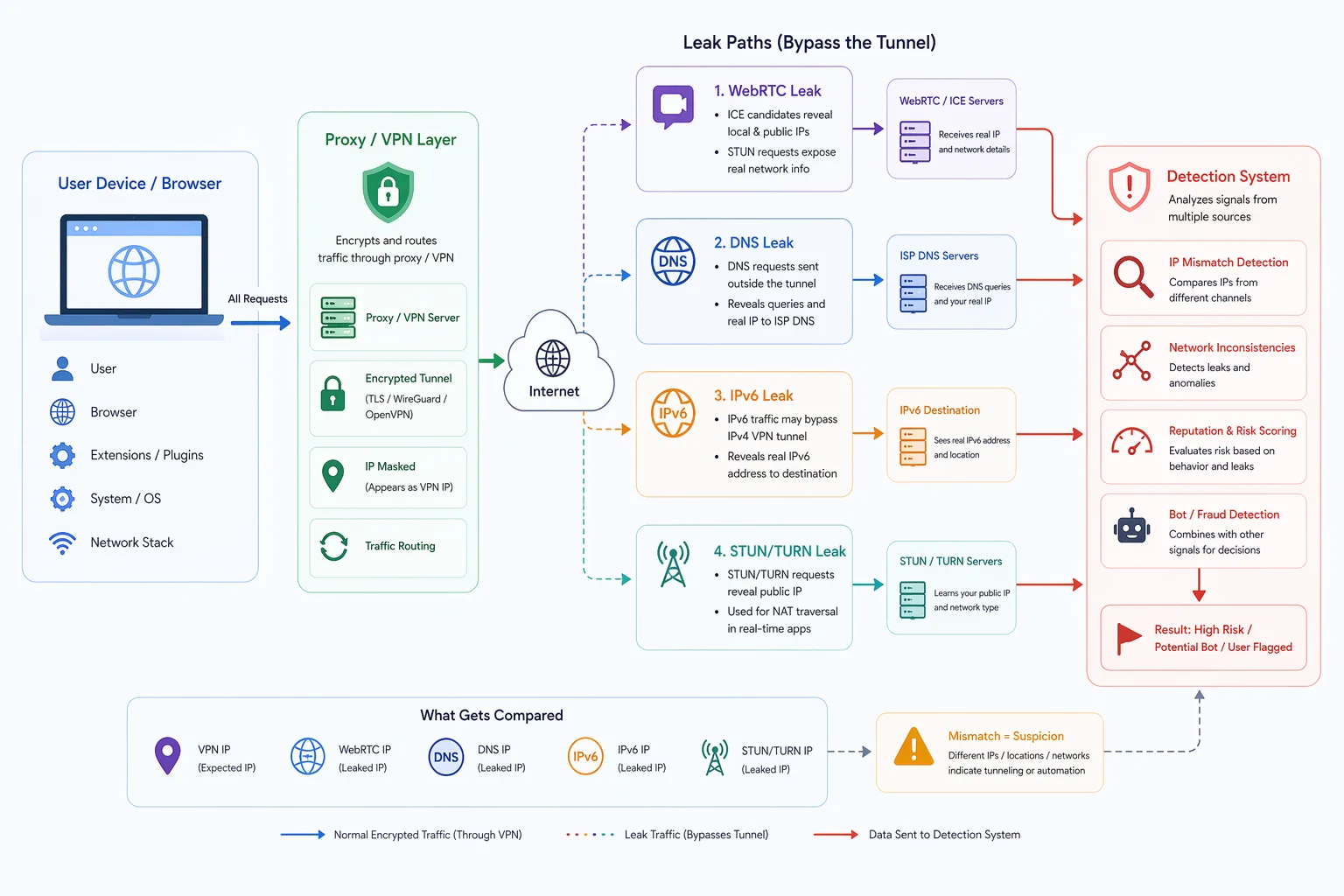
IPv6 leaks occur due to mismatched routing between IPv4 and IPv6 traffic.
Dual-Stack Environments
Most modern devices operate in dual-stack mode, meaning they use both IPv4 and IPv6.
If a proxy or VPN only handles IPv4, IPv6 traffic may still use the default network route.
Unmanaged IPv6 Traffic
When IPv6 is not explicitly configured, the system may send requests directly through the ISP.
This bypasses any masking applied to IPv4 traffic.
DNS and Connection Requests
DNS queries and connection attempts may prefer IPv6 when available.
If IPv6 is not properly routed, these requests can expose real network information.
Browser and System Behavior
Browsers and operating systems may prioritize IPv6 for faster connections.
This automatic behavior can lead to unintended exposure.
Why IPv6 Leakage Matters
IPv6 leakage matters because it exposes your real network identity.
Even if your IPv4 traffic is masked, an exposed IPv6 address creates inconsistency.
Detection systems can identify this mismatch and flag the session.
This is particularly important in environments where IP consistency is critical.
IPv6 Leakage and Bot Detection
Detection systems compare multiple network signals to identify anomalies.
If your visible IP differs from your IPv6 address, it creates a clear inconsistency.
This can indicate the use of proxies, VPNs, or modified environments.
IPv6 leaks are often used alongside other signals to detect automation.
IPv6 Leakage vs DNS and WebRTC Leaks
IPv6 leakage is similar to DNS and WebRTC leaks in that all expose real network information.
However, IPv6 leakage occurs at the protocol level, while DNS and WebRTC leaks occur during resolution and connection setup.
All three can create mismatches that detection systems analyze.
Managing all of them is important for maintaining consistency.
How to Detect IPv6 Leakage
Detecting IPv6 leaks involves checking whether your IPv6 address is exposed.
Online tools can display both IPv4 and IPv6 addresses.
If your IPv6 address matches your real network instead of your proxy or VPN, a leak is present.
Consistency between protocols is key.
How to Disable IPv6 Leakage
Preventing IPv6 leaks requires controlling how IPv6 traffic is handled.
Disable IPv6 on Your System
One of the simplest methods is to disable IPv6 entirely.
This prevents any IPv6 traffic from being sent outside the intended network path.
Use IPv6-Compatible VPN or Proxy
Some services support IPv6 routing.
Using such configurations ensures that both IPv4 and IPv6 traffic are handled consistently.
Configure Network Settings
Manual configuration can ensure that IPv6 traffic follows the same route as IPv4.
This reduces the risk of leaks.
Monitor Network Behavior
Regularly checking your network configuration helps identify potential issues.
This ensures that no unintended routing occurs.
IPv6 Leakage vs Detection Systems
Preventing IPv6 leaks reduces inconsistencies, but detection systems analyze multiple signals.
Even with proper IPv6 configuration, other factors such as behavior and fingerprinting are still evaluated.
IPv6 management is one part of a broader strategy.
Limitations of IPv6 Leak Prevention
Preventing IPv6 leaks can be challenging.
Disabling IPv6 may affect compatibility with certain services.
Not all proxies or VPNs support IPv6 routing.
Additionally, detection systems rely on multiple signals, so addressing IPv6 alone is not sufficient.
These limitations highlight the need for a comprehensive approach.
IPv6 Leakage vs Real-Device Environments
A key distinction in modern detection is the difference between simulated setups and real-device environments.
IPv6 leaks often occur in environments where network routing is artificially modified.
Real-device approaches operate on actual hardware and network configurations where IPv4 and IPv6 routing naturally align. Tools like Appilot follow this approach by running automation on real Android devices, where network behavior remains consistent across protocols.
This reduces mismatches that detection systems rely on.
When IPv6 Leakage Is Most Critical
IPv6 leakage is most critical in scenarios where IP consistency is required.
This includes authentication systems, geo-restricted platforms, and high-security environments.
In these contexts, mismatched network data can trigger detection or restrictions.
Understanding this helps in managing risk.
Frequently Asked Questions
Q: What is IPv6 leakage?
It is when IPv6 traffic bypasses a proxy or VPN and exposes your real IP.
Q: Why does IPv6 leakage happen?
Because IPv6 traffic is not routed through the secure connection.
Q: How can I detect IPv6 leaks?
By checking if your IPv6 address matches your real network.
Q: Can IPv6 be disabled?
Yes, it can be disabled in system settings.
Q: Is IPv6 leakage similar to DNS leaks?
Both expose real network data but occur at different levels.
Q: How do real-device solutions compare?
Real-device solutions like Appilot maintain consistent routing across protocols, reducing mismatches.
Key Takeaways
IPv6 leakage occurs when IPv6 traffic bypasses a proxy or VPN and exposes your real IP address. It is caused by mismatched routing in dual-stack environments where IPv4 is protected but IPv6 is not. This creates inconsistencies that can be detected by websites and security systems. Preventing IPv6 leaks involves disabling IPv6, using compatible configurations, and ensuring consistent routing. Managing IPv6 is an important part of maintaining network integrity.