What Are JavaScript Challenges? Anti-Bot Code Execution
Modern websites do not rely on a single signal to detect bots. Instead, they actively test the browser using JavaScript challenges, which are pieces of code executed on the client side to verify whether the environment behaves like a real user. These challenges are designed to analyze how the browser executes code, responds to conditions, and interacts with the page, making them a powerful tool in anti-bot systems.
Understanding JavaScript challenges is important because they operate dynamically and can adapt in real time. This guide explains how these challenges work and why they are effective in detecting automation.
What Are JavaScript Challenges?
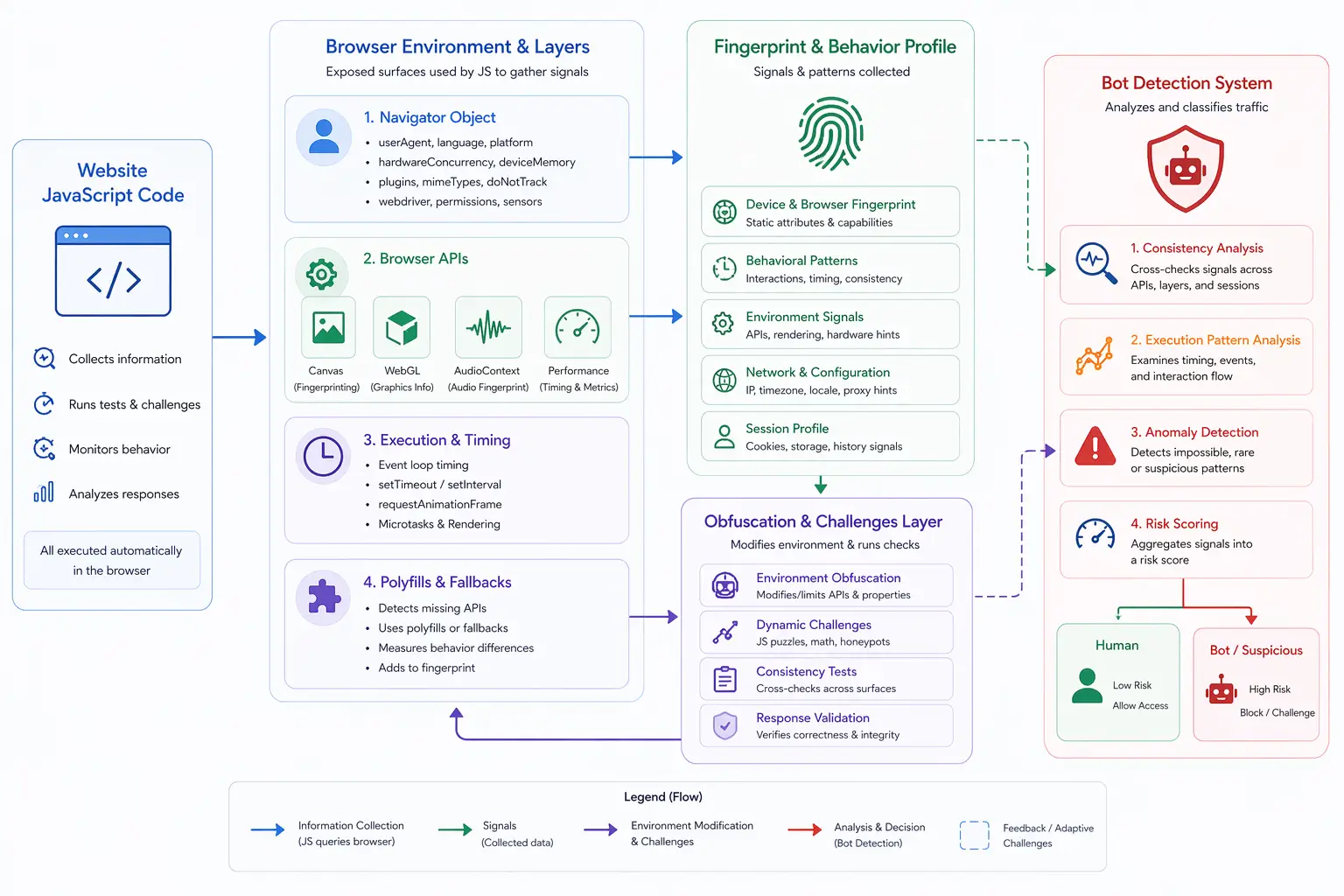
JavaScript challenges are scripts sent by a website to the browser that must be executed correctly in order to proceed, where these scripts perform checks on the environment and return results back to the server for evaluation. Unlike static fingerprinting, JavaScript challenges actively test the browser’s capabilities, behavior, and execution patterns, making them more difficult to bypass. They are commonly used in bot detection systems to verify that a request is coming from a real user.
The Core Idea Behind JavaScript Challenges
The core idea behind JavaScript challenges is validation through execution, where instead of relying only on reported data, the system observes how the browser actually performs tasks. By running code and analyzing the results, websites can detect inconsistencies that indicate automation or modification. This approach allows detection systems to move beyond static properties and focus on real-time behavior.
How JavaScript Challenges Work
JavaScript challenges work by delivering scripts to the browser that must be executed and evaluated, where the results are then sent back to the server for verification. These scripts can test a wide range of factors, including API availability, execution timing, and interaction behavior, and they often include obfuscated or dynamically generated code to prevent reverse engineering. The browser’s response is compared against expected patterns, and any deviation can indicate automation.
Types of JavaScript Challenges
JavaScript challenges come in different forms depending on what the system is trying to verify, where some challenges focus on checking browser APIs such as Canvas, WebGL, or Audio to confirm that they behave as expected, while others analyze execution timing to detect unnatural speed or delays. Some challenges test for the presence of automation frameworks by looking for known properties or behaviors, and others simulate user interactions to see if the browser responds naturally. These different types of challenges are often combined to create a more comprehensive test.
Why JavaScript Challenges Are Effective
JavaScript challenges are effective because they require the browser to actively demonstrate its behavior rather than just report static information, where this makes it harder for automated systems to fake responses. Since the challenges can be updated or randomized, they are also difficult to predict and bypass consistently. This dynamic nature allows detection systems to stay ahead of simple spoofing techniques.
JavaScript Challenges and Bot Detection
Bot detection systems rely heavily on JavaScript challenges to identify automation, where these challenges provide real-time data about how the browser operates. Automated environments often fail these tests because they lack full support for certain APIs, produce inconsistent outputs, or execute code in ways that differ from real devices. By analyzing these differences, detection systems can accurately classify traffic as human or bot.
JavaScript Challenges vs CAPTCHA
JavaScript challenges differ from CAPTCHA systems in that they operate silently in the background without requiring user interaction, while CAPTCHA presents a visible test that users must solve. JavaScript challenges are designed to be invisible and continuous, allowing websites to evaluate users without interrupting the experience. Both methods are often used together for stronger verification.
Limitations of JavaScript Challenges
Despite their effectiveness, JavaScript challenges have limitations because they depend on browser capabilities and can sometimes affect performance or user experience. Advanced automation systems may also attempt to mimic real browser behavior more closely, reducing the effectiveness of simple challenges. Additionally, false positives can occur if legitimate users have unusual configurations or restricted environments.
JavaScript Challenges vs Other Detection Methods
JavaScript challenges are one part of a broader detection strategy that includes fingerprinting, network analysis, and behavioral tracking, where each method provides a different perspective on user activity. While fingerprinting identifies the environment and network analysis evaluates routing, JavaScript challenges test execution behavior directly. Combining these methods creates a more robust detection system.
JavaScript Challenges vs Real-Device Environments
A key distinction in modern detection is the difference between simulated environments and real-device environments, where JavaScript challenges can reveal inconsistencies in setups that attempt to mimic real browsers through modification or spoofing. Real-device approaches operate on actual hardware where code execution, API behavior, and performance characteristics naturally align, and tools like Appilot follow this approach by running automation on real Android devices, ensuring that JavaScript challenges are handled in a way that reflects real-world conditions. This reduces the likelihood of detection due to mismatched execution behavior.
When JavaScript Challenges Are Most Critical
JavaScript challenges are most critical in scenarios where accurate verification of users is required, such as login systems, payment platforms, and high-security applications, where distinguishing between human users and automated traffic is essential. In these contexts, challenges provide a reliable way to test browser behavior without relying solely on static data.
Frequently Asked Questions
Q: What are JavaScript challenges?
They are scripts that test browser behavior to detect bots.
Q: How do they work?
They execute code in the browser and analyze the results.
Q: Are they visible to users?
Most operate silently in the background.
Q: How are they different from CAPTCHA?
They do not require user interaction.
Q: Can automation pass these challenges?
Some advanced systems can, but inconsistencies are often detected.
Q: How do real-device solutions compare?
Real-device solutions like Appilot execute JavaScript challenges naturally, reducing detection risk.
Key Takeaways
JavaScript challenges are dynamic scripts used by websites to test browser behavior and detect automation by analyzing how code is executed in real time. They go beyond static fingerprinting by actively validating environment consistency, making them a powerful tool in bot detection systems. While effective, they have limitations and are often combined with other detection methods. Understanding how JavaScript challenges work is essential for navigating modern anti-bot systems.