Understanding Keystroke Dynamics in Bot Detection

As bot detection systems become more advanced, they increasingly rely on subtle behavioral signals that are difficult to replicate. One of the most powerful of these signals is keystroke dynamics. Instead of focusing only on what users type, websites analyze how they type.
This approach is effective because human typing behavior is highly variable and influenced by factors such as speed, rhythm, and decision-making. Automated systems, even when designed to mimic typing, often fail to reproduce these natural patterns accurately. This guide explains how keystroke dynamics works and how it helps detect bots.
What Is Keystroke Dynamics?
Keystroke dynamics is the process of analyzing typing behavior to determine whether the input is generated by a human or an automated system. It focuses on timing and rhythm rather than the actual content being typed.
This includes how long keys are pressed, how quickly users move between keys, and how their typing patterns change over time.
Unlike static detection methods, keystroke dynamics captures real-time behavioral data.
The Core Principle Behind Keystroke Detection
The core principle behind keystroke dynamics is rhythm variability. Human typing is not perfectly consistent.
People pause, make corrections, change speed, and vary their rhythm depending on context. These variations create unique patterns.
Bots, on the other hand, often produce consistent or overly uniform typing behavior.
Detection systems use these differences to identify automation.
How Keystroke Dynamics Works
Keystroke dynamics systems collect and analyze typing data in real time.
Key Press Duration
This measures how long a key is held down before being released.
Humans naturally vary this duration, while bots may produce consistent timings.
Inter-Key Delay
This refers to the time between releasing one key and pressing the next.
Human typing includes irregular delays, while bots often follow predictable intervals.
Typing Speed Variation
Humans do not type at a constant speed. They may slow down when thinking or speed up when confident.
Bots often maintain a steady typing rate.
Error and Correction Patterns
Humans frequently make mistakes and correct them using backspace or edits.
Bots may type perfectly or follow predefined correction patterns.
Rhythm and Flow
The overall rhythm of typing is analyzed to detect natural variability.
Human typing includes bursts of activity and pauses, while bots may produce uniform patterns.
Why Keystroke Dynamics Matters
Keystroke dynamics is important because it captures behavior that is difficult to fake.
While bots can replicate text input, replicating the timing and rhythm of human typing is much more challenging.
This makes it a strong indicator of authenticity.
It is widely used in modern bot detection systems, especially in login and form interactions.
Common Typing Patterns That Indicate Bots
Detection systems look for patterns that differ from natural human typing.
Perfectly consistent key press durations can indicate automation.
Uniform delays between keystrokes are another signal.
Lack of typing errors or corrections may also raise suspicion.
Instant typing without hesitation can indicate a bot.
These patterns are evaluated together rather than individually.
Keystroke Dynamics vs Other Behavioral Signals
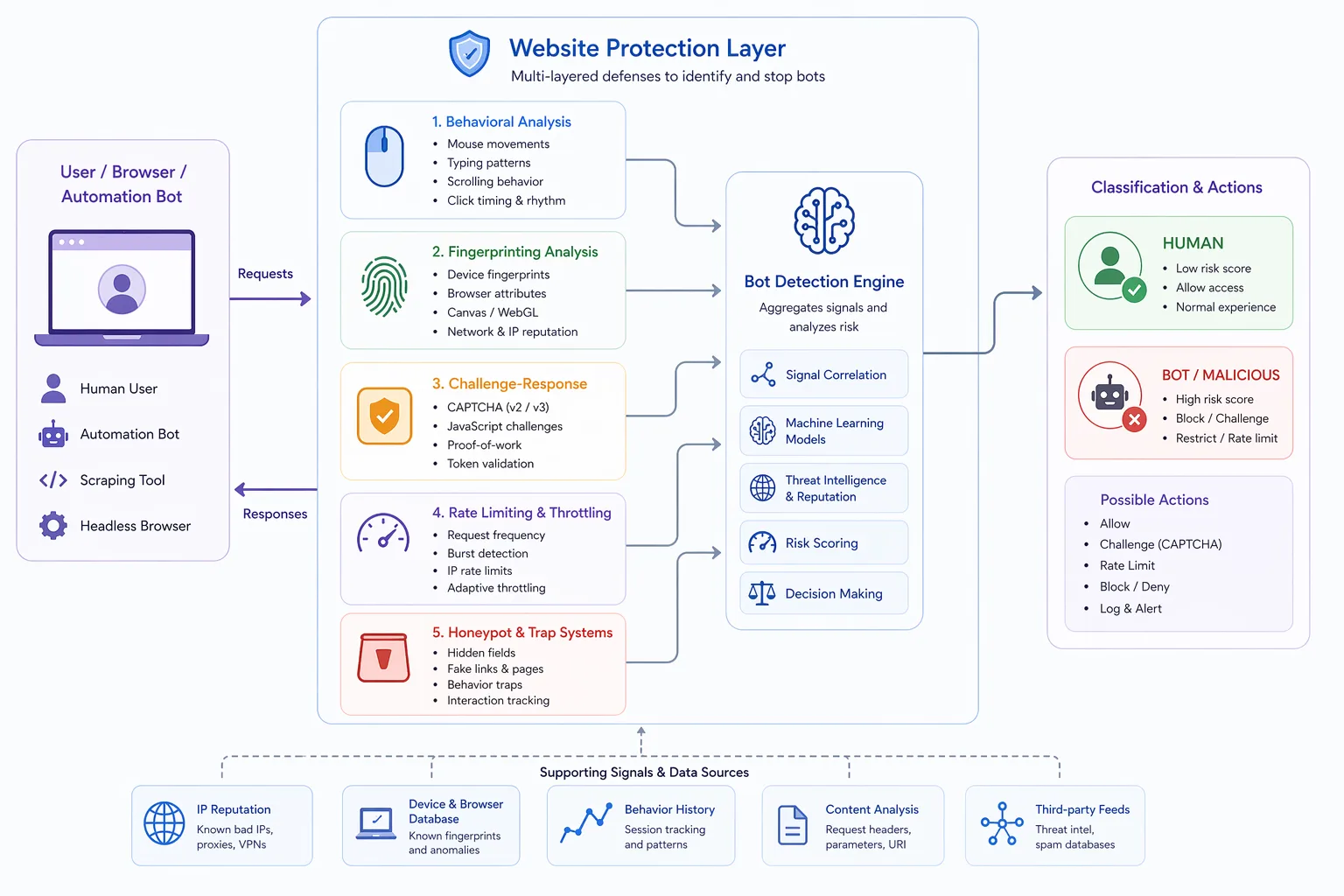
Keystroke dynamics is part of a broader behavioral analysis framework.
It is often combined with mouse movement tracking, scrolling behavior, and navigation patterns.
While each signal provides insight, combining them increases detection accuracy.
Keystroke dynamics is particularly useful because it reflects cognitive and motor behavior.
Limitations of Keystroke Dynamics
Despite its effectiveness, keystroke dynamics has limitations.
False positives can occur, especially for users with atypical typing patterns or assistive technologies.
There is also the challenge of advanced automation that attempts to simulate human typing behavior.
These limitations require detection systems to use multiple signals.
Keystroke Dynamics vs Scripted Input
Scripted input often produces deterministic timing patterns.
Even when randomness is added, it may not fully replicate human variability.
Detection systems can identify these differences by analyzing multiple aspects of typing behavior.
This makes simple simulation insufficient.
Keystroke Dynamics vs Real-Device Environments
A key distinction in modern detection is the difference between simulated behavior and natural behavior.
Keystroke dynamics can detect inconsistencies in simulated environments, even if technical signals appear correct.
Real-device approaches operate on actual hardware where typing behavior naturally reflects human interaction. Tools like Appilot follow this approach by running automation on real Android devices, where input patterns, timing, and system behavior align with real-world usage.
This reduces the need to artificially simulate typing.
When Keystroke Dynamics Is Most Effective
Keystroke dynamics is most effective in scenarios where users input text.
This includes login forms, registration pages, and search fields.
In these contexts, typing behavior provides strong indicators of authenticity.
Understanding this helps in designing systems that align with detection expectations.
Frequently Asked Questions
Q: What is keystroke dynamics?
It is the analysis of typing behavior to detect bots.
Q: Why is keystroke dynamics effective?
Because human typing patterns are variable and difficult to replicate.
Q: What signals are analyzed?
Key press duration, inter-key delay, speed variation, and corrections.
Q: Can bots mimic typing behavior?
They can try, but it is difficult to match human variability.
Q: Is keystroke dynamics used alone?
No, it is combined with other behavioral signals.
Q: How do real-device solutions compare?
Real-device solutions like Appilot naturally produce realistic typing behavior, reducing reliance on simulation.
Key Takeaways
Keystroke dynamics is a behavioral detection method that analyzes typing patterns, timing, and rhythm to distinguish humans from bots. It works because human typing is naturally variable and difficult to replicate accurately. By evaluating signals such as key press duration, inter-key delay, and typing speed variation, detection systems can identify automation. While it has limitations, it remains a key component of modern bot detection strategies.