Language and Locale Fingerprinting Explained
Most users think language settings only affect how content appears on a website, but they also play a significant role in tracking and detection systems. Even something as simple as your browser language or regional format settings can reveal important information about your device and location. This method is known as language and locale fingerprinting.
Understanding language and locale fingerprinting is important because it shows how subtle configuration details contribute to identification. It also explains why mismatched environments are often flagged in automation systems. This guide explains how language and locale fingerprinting works, why it matters, and how it is used in real-world scenarios.
What Is Language and Locale Fingerprinting?
Language and locale fingerprinting is a technique used to identify users based on their browser language preferences and regional settings. Websites collect this information through browser APIs and use it as part of a broader fingerprint.
Language settings typically include the preferred language of the browser, while locale settings define region-specific formats such as date, time, number formatting, and currency. Together, these settings provide insight into the user’s geographic and cultural context.
While many users share common language settings, variations in preferences, fallback languages, and regional configurations can create a distinctive profile when combined with other signals.
The Core Principle Behind Language and Locale Fingerprinting
The core principle behind language and locale fingerprinting is that users configure their devices differently based on region and preference. Even small differences, such as the order of preferred languages or specific regional formats, can contribute to uniqueness.
For example, a browser set to English (United States) with a secondary preference for Spanish will differ from one set to English (United Kingdom) with no fallback languages. These differences may seem minor, but they add valuable context to a fingerprint.
This technique focuses more on consistency and context rather than high uniqueness, making it an important supporting signal in detection systems.
How Language and Locale Fingerprinting Differs from Other Methods
Language and locale fingerprinting differs from other fingerprinting methods because it provides contextual information about the user’s environment rather than deep behavioral or hardware signals.
For example, canvas and WebGL fingerprinting analyze rendering behavior, hardware fingerprinting examines device performance, and plugin fingerprinting looks at installed tools. Language and locale fingerprinting complements these methods by adding regional context.
A helpful way to understand this is to think of it as describing where and how a user is configured, rather than how their system behaves internally.
Why Language and Locale Fingerprinting Matters
Language and locale fingerprinting matters because it plays a key role in validating consistency across a user’s profile. Even if other signals appear normal, mismatches in language or locale can raise suspicion.
In fraud detection systems, language data helps identify unusual patterns, such as accounts operating in regions that do not match their configured settings. This allows platforms to detect suspicious activity more effectively.
From a privacy perspective, language and locale fingerprinting contributes to narrowing down a user’s identity. While it may not uniquely identify a user, it provides valuable context that strengthens overall tracking.
For developers building automation systems, maintaining consistent language and locale settings is essential. If these settings do not align with other attributes such as IP address or timezone, detection systems can flag the activity. This is why coherent environments are critical.
How Language and Locale Fingerprinting Works in Practice
Language and locale fingerprinting works by collecting language data, analyzing it for consistency, and incorporating it into a broader fingerprint.
Collecting Language and Locale Data
When a user visits a website, scripts query the browser to retrieve language preferences and locale settings. This includes the primary language, fallback languages, and regional formatting information.
These values provide insight into how the device is configured and what region it is associated with.
Analyzing Consistency Across Signals
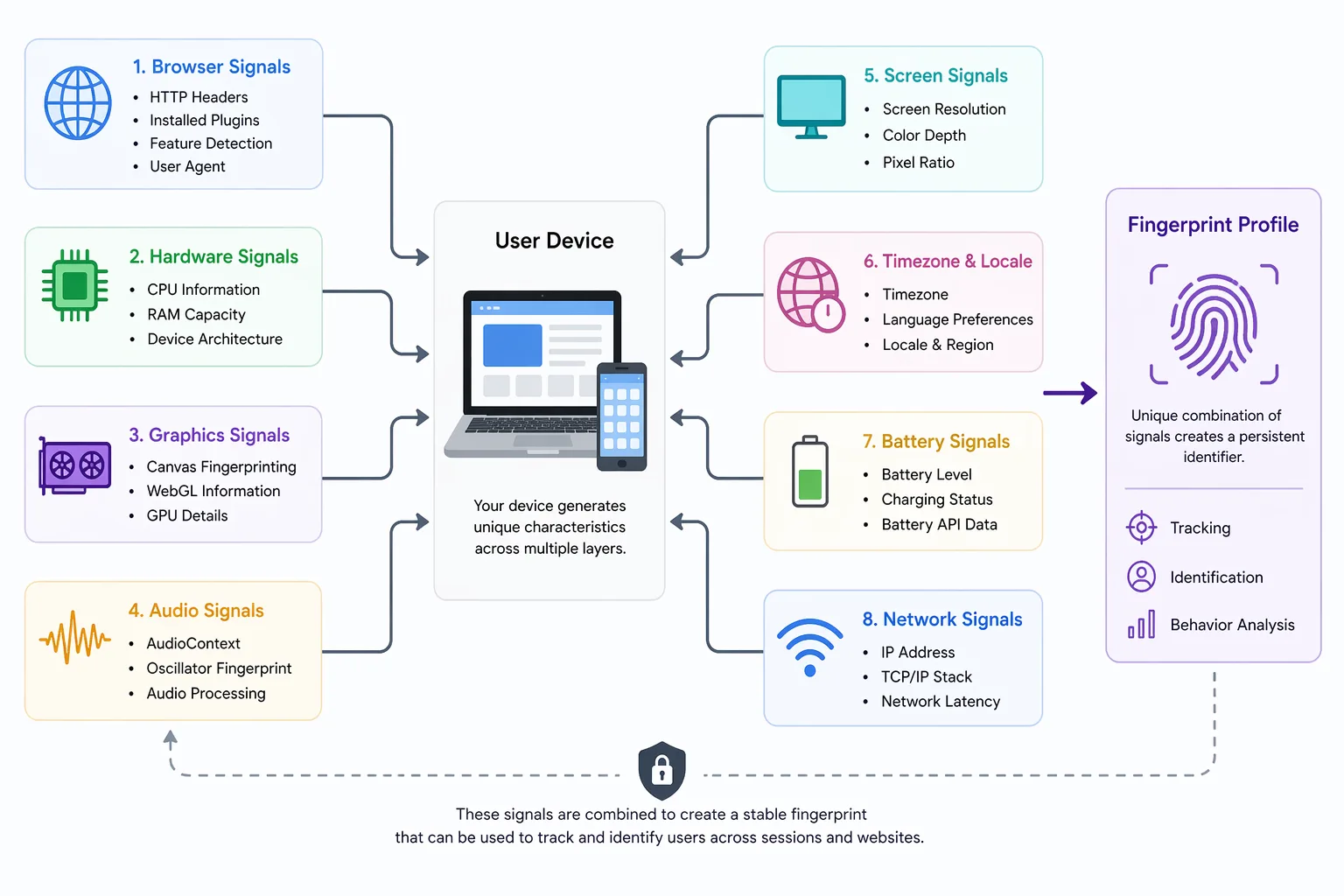
The collected data is compared with other signals such as IP address, timezone, and system configuration. Detection systems look for alignment between these attributes.
If the signals are consistent, the profile appears normal. If there are mismatches, such as a browser language that does not match the region suggested by the IP address, the system may flag the activity.
Integrating into the Fingerprint
The language and locale data is combined with other attributes to form a complete fingerprint. While it is not highly unique on its own, it strengthens the overall profile by adding contextual information.
Because these settings do not change frequently, they help maintain consistency across sessions.
Common Misconceptions About Language and Locale Fingerprinting
There are several misconceptions about language and locale fingerprinting that can lead to confusion about its role in tracking.
One common belief is that language settings are too common to be useful, but while many users share similar languages, the combination of preferences and regional formats increases uniqueness.
Another misconception is that changing language settings prevents tracking. While this alters one signal, mismatches with other attributes can actually increase detection risk.
There is also a belief that language fingerprinting alone can identify users, but it is typically used in combination with other signals. Its strength lies in supporting broader fingerprinting systems.
Real-World Examples of Language and Locale Fingerprinting
Language and locale fingerprinting is widely used in systems that require accurate identification and consistency.
In financial platforms, it helps detect fraudulent behavior by identifying accounts that operate with inconsistent regional settings. This allows systems to flag suspicious activity even when other signals appear normal.
In social media environments, language and locale fingerprinting contributes to detecting automated behavior. Platforms analyze language settings alongside other attributes to identify bots. Tools like Appilot help address this challenge by running automation on real Android devices, where system-level settings such as language and locale naturally align with other signals.
In analytics and tracking systems, language and locale data helps provide context for user behavior, improving identification across sessions.
The Technical Side of Language and Locale Fingerprinting
From a technical perspective, language and locale fingerprinting relies on low to moderate entropy. While it does not provide strong uniqueness, it plays a critical role in validating other signals.
The process involves collecting language preferences, normalizing the data, and comparing it with other attributes. This allows systems to detect inconsistencies and maintain accurate profiles.
Understanding these technical details helps explain why language and locale fingerprinting is an essential part of modern detection systems.
When Language and Locale Fingerprinting Applies
Language and locale fingerprinting becomes especially relevant in scenarios where consistency across signals is critical.
It is important when building automation systems, where maintaining aligned language and locale settings is necessary to avoid detection. It is also critical in fraud prevention systems, where identifying mismatched configurations can help detect suspicious activity. In privacy-sensitive applications, understanding this technique helps developers design systems that better account for tracking risks.
Frequently Asked Questions
Q: How does language and locale fingerprinting work?
It works by collecting your browser’s language preferences and regional settings and comparing them with other signals for consistency.
Q: What is language fingerprinting used for?
It is used for tracking users, detecting fraud, and identifying inconsistencies in behavior.
Q: Can you block language and locale fingerprinting?
You cannot fully block it, but you can reduce its effectiveness by maintaining consistent settings across your environment.
Q: Is language fingerprinting accurate?
It is not highly unique on its own but becomes useful when combined with other fingerprinting methods.
Q: Does changing language prevent tracking?
Changing language alone does not prevent tracking and can create mismatches that increase detection risk.
Q: How does language fingerprinting affect automation tools?
It can expose automation systems if language and locale settings do not align with other signals. Tools that use real-device environments, such as Appilot, tend to produce more reliable results because they maintain consistent system configurations.
Key Takeaways
Language and locale fingerprinting is a technique that uses your browser’s language preferences and regional settings as part of a broader fingerprint to track and identify users. While it is not highly unique on its own, it plays a crucial role in ensuring consistency across signals and detecting mismatches. It is widely used in fraud detection, automation, and analytics systems, making it an essential concept for understanding how modern tracking and detection systems work.