LinkedIn Automation for Real Estate Investors: Finding Deals at Scale
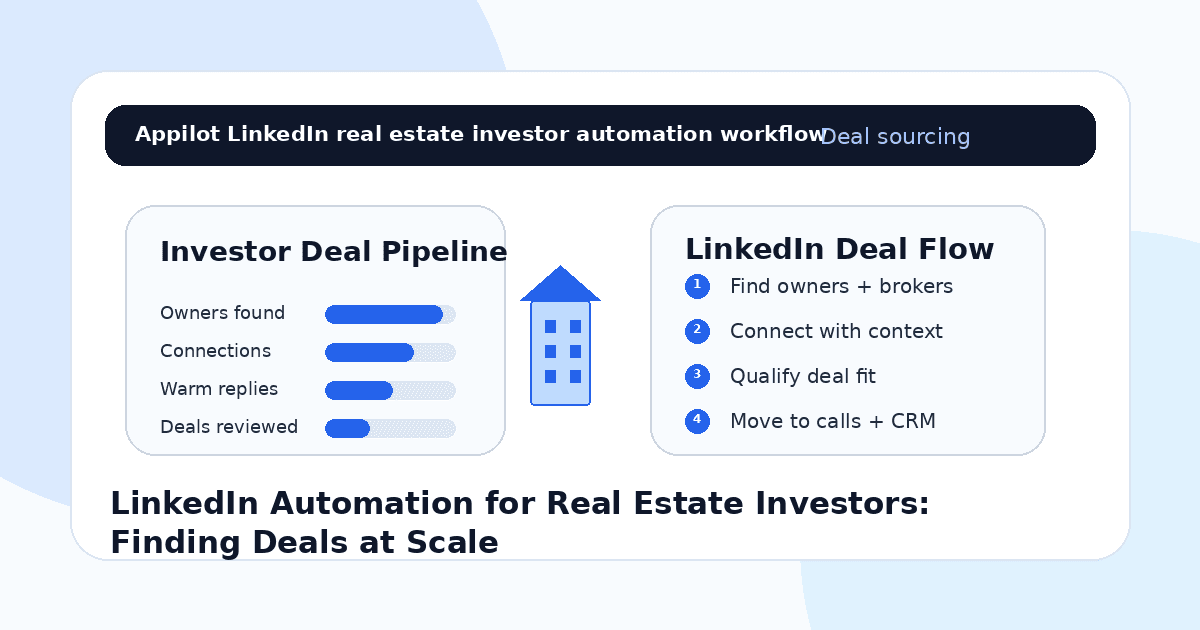
You know the kind of deal you want. Maybe it is multifamily, self-storage, small commercial, distressed assets, land, build-to-rent, short-term rentals, or off-market residential properties.
You also know that the best deals rarely appear neatly in your inbox.
You need relationships with owners, brokers, operators, developers, lenders, property managers, and local market contacts. You need conversations before the asset is publicly listed. You need a system that keeps sourcing active even when you are busy underwriting, touring, negotiating, or managing existing projects.
That is why real estate investors use LinkedIn automation. Not to spam property owners with generic offers, but to make relationship-based deal sourcing more consistent at scale.
The goal is not more random connections. The goal is more qualified conversations with people who can help you find, evaluate, or access better deals.
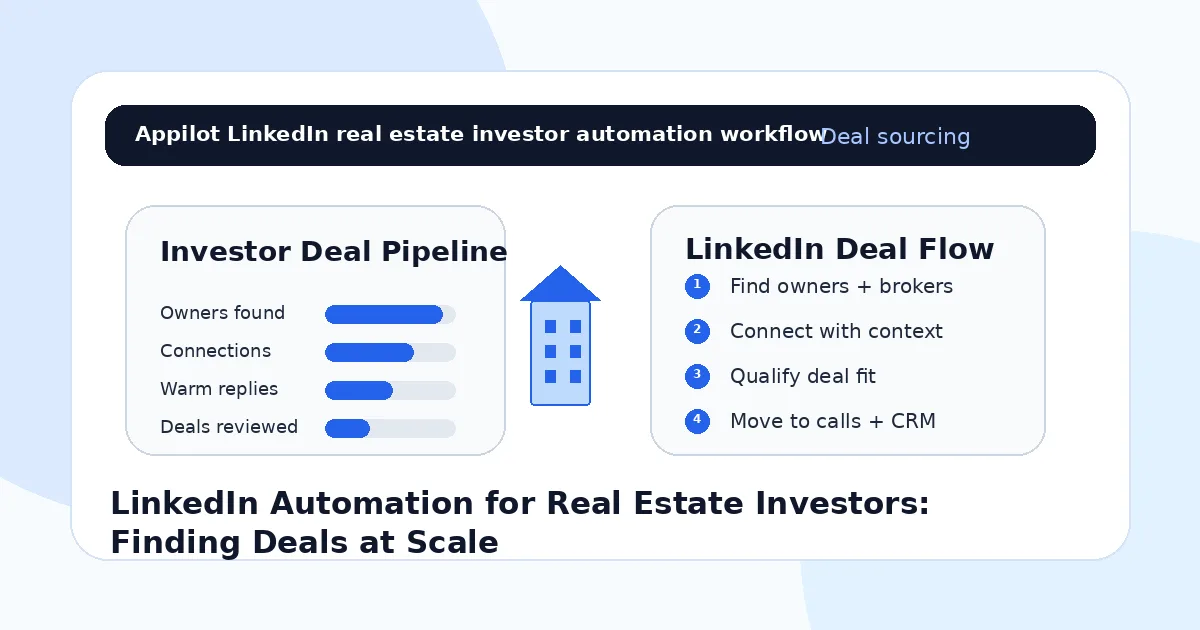
Why LinkedIn Works for Real Estate Investors
LinkedIn is useful for real estate investors because it is full of professionals connected to property decisions.
You can find owners, brokers, asset managers, developers, family offices, lenders, property managers, architects, construction leaders, operators, syndicators, and local business owners. Many of these people are not actively posting properties every day, but they may know about opportunities before they hit the market.
That is where LinkedIn becomes powerful.
Real estate deal flow is relationship-driven. A broker may remember you when a seller wants a quiet process. A property owner may respond when they are considering a sale. A local operator may introduce you to someone with a distressed asset. A lender may know which sponsors are exiting a project.
Most investors get LinkedIn wrong because they treat it like a cold pitch channel. They connect and immediately ask, “Do you have any deals?” That usually feels lazy.
A better approach is to use LinkedIn to build visibility, trust, and targeted conversations over time.
What LinkedIn Automation Means for Investors
LinkedIn automation means using software to handle repeated sourcing actions such as profile discovery, connection requests, follow-ups, profile visits, lead tracking, and outreach sequencing.
For real estate investors, the best use is not mass messaging. It is structured outreach to carefully selected market contacts.
Real-device automation is useful because it runs workflows through Android devices or emulators instead of relying only on fragile browser scripts or API shortcuts. That helps investors and acquisition teams manage sourcing activity across accounts, markets, and contact types in a more controlled way.
A platform like Appilot is built around this kind of workflow. It lets real estate investors run LinkedIn automation on Android devices or emulators from a browser dashboard, without coding, ADB setup, or keeping a laptop connected all day. That means sourcing workflows can stay active while the investor focuses on underwriting, site visits, capital relationships, and closings.
Automation should create more warm doors. The investor still has to build the relationship.
Step 1: Define the Exact Deal Profile
Before automating outreach, define your buy box clearly.
A weak target sounds like “real estate deals” or “commercial properties.” A stronger target sounds like “20–80 unit multifamily in secondary Midwest markets,” “self-storage facilities with operational upside,” “small retail centers with local tenants,” or “off-market single-family portfolios in growing rental markets.”
This matters because automation magnifies your targeting.
If your deal profile is vague, you will connect with too many people who cannot help. If your buy box is clear, automation helps you reach the right owners, brokers, operators, and market contacts more consistently.
Your buy box should include property type, location, size, price range, distress level, target returns, hold strategy, financing assumptions, and decision timeline.
Good automation starts with a clear investment thesis.
Step 2: Build Lists Around Relationship Sources
Real estate investors should not only target property owners.
Some of the best deal flow comes from people around the transaction. That includes brokers, property managers, attorneys, lenders, developers, contractors, appraisers, asset managers, local operators, city professionals, and other investors.
LinkedIn automation can help build segmented lists for each relationship source.
For example, one campaign might target multifamily brokers in Dallas. Another might target property managers in Phoenix. Another might target small business owners who own commercial buildings. Another might target asset managers at family offices.
Each group needs a different message.
This is where Appilot’s LinkedIn automation can fit naturally. It lets investors run repeated LinkedIn workflows through Android devices or emulators while managing targeting and outreach from one dashboard.
The better your list segments, the better your conversations.
Step 3: Send Connection Requests With Context
A connection request should not sound like a deal blast.
The first message should explain why the connection makes sense. It should be short, relevant, and tied to the market or asset type.
For example, “Hi Mark, I saw you work with multifamily owners in the Carolinas. I’m actively tracking small-to-mid-size multifamily opportunities in that region and thought it made sense to connect.”
That feels much better than, “Do you have any off-market deals?”
For property owners, the tone should be even more careful. A direct offer can feel too aggressive if there is no relationship. A softer message about local market interest, ownership experience, or future conversation often works better.
Automation can send connection requests consistently, but the message still needs investor judgment.
The goal is to start a relationship, not force a sale in the first touch.
Step 4: Use Follow-Ups to Learn, Not Just Pitch
Once someone accepts, the follow-up should open a useful conversation.
A broker might be asked what kind of assets are moving in the market. A property manager might be asked where owners are struggling with operations. A lender might be asked what they are seeing in financing terms. An owner might be asked whether they plan to hold long-term or would ever consider a conversation.
The best follow-ups are not desperate. They are thoughtful and market-aware.
For example, an investor could say, “Curious what you’re seeing in that market right now. Are owners mostly holding, or are more starting to test exits?”
That invites insight. It also creates a path toward deal conversation without sounding pushy.
One reason teams use Appilot-style workflows is that follow-up actions can be managed consistently while humans stay in control of the actual relationship-building.
Automation handles rhythm. Investors handle trust.
Step 5: Qualify Deal Fit Early
Not every conversation is worth deep follow-up.
A broker may only handle assets outside your buy box. An owner may have no interest in selling. A property manager may serve the wrong market. A lender may not work with your asset type.
Qualify gently.
Ask about property type, market, asset size, seller motivation, timeline, ownership goals, or upcoming opportunities. For brokers and intermediaries, ask what they specialize in. For owners, ask whether they are open to future conversations if the timing ever makes sense.
Do not over-push.
Real estate is long-cycle. Someone who is not ready today may become valuable later. A polite, organized nurture process can matter more than an aggressive first pitch.
Step 6: Move Serious Opportunities Into a Deal CRM
LinkedIn is good for starting conversations, but deal sourcing needs structure.
Once someone shows real interest, move the contact into a CRM, spreadsheet, acquisition pipeline, or deal management system. Track the person’s role, market, asset type, relationship status, last touch, next step, and any potential opportunity.
Without tracking, LinkedIn automation can create noise.
You may forget a warm broker, lose a seller conversation, or fail to follow up when timing changes. Real estate investors need long memory because deals often appear months after the first conversation.
A simple pipeline can include new contact, connected, follow-up sent, active conversation, deal mentioned, underwriting, site visit, LOI, negotiation, closed, or nurture.
Automation fills the top of the sourcing funnel. CRM discipline turns it into deal flow.
Step 7: Use Content to Build Credibility
LinkedIn automation works better when your profile gives people a reason to trust you.
If a broker, owner, or lender accepts your connection and checks your profile, they should understand what you buy, where you operate, and why you are credible.
Post content around your investment thesis, market observations, property lessons, operator experience, financing insights, renovation notes, case studies, and lessons from deals you have reviewed.
You do not need to reveal sensitive information. You need to show that you are serious, focused, and professional.
A clear LinkedIn profile makes outreach feel more credible.
Automation gets people to your profile. Your profile helps them decide whether to reply.
Step 8: Avoid Spammy Investor Behavior
Real estate outreach can quickly become annoying if it feels generic.
Do not send the same “I buy properties” message to everyone. Do not ask for deals before building context. Do not over-message owners who are not interested. Do not pretend to be local if you are not. Do not make vague claims about being able to close without proof.
The best investors are specific.
They say what they buy, where they buy, how they evaluate opportunities, and what kind of conversations they are open to having. That makes it easier for the right people to remember them.
LinkedIn automation should increase consistency, not reduce professionalism.
Common Mistakes Real Estate Investors Should Avoid
Targeting Too Broadly
“Property owners” is too vague. Segment by asset type, market, role, ownership profile, and likely deal relevance.
Asking for Deals Too Early
A first message should create context. Asking for off-market deals immediately can make the outreach feel transactional.
Using the Same Message for Everyone
Owners, brokers, lenders, and property managers need different outreach angles. Customize by relationship source.
Failing to Track Conversations
Deal flow often takes time. If you do not track contacts and follow-ups, warm opportunities can disappear.
Automating Without Credibility
If your LinkedIn profile does not explain your investment focus or proof, outreach will feel weaker and less trustworthy.
Is LinkedIn Automation Right for Real Estate Investors?
LinkedIn automation is a good fit if you have a clear buy box, target markets, and a repeatable sourcing process. It works especially well for investors sourcing commercial properties, multifamily deals, off-market opportunities, broker relationships, seller conversations, and capital or operator contacts.
It may not be right if you do not know what you buy, cannot respond to replies quickly, or do not have a system for tracking opportunities. Automation can create more conversations, but it cannot replace underwriting, credibility, or relationship-building.
Think of automation as sourcing infrastructure. It helps you reach more relevant people, but your investment discipline turns those conversations into deals.
Final Thoughts
Real estate investors use LinkedIn automation to scale relationship-based deal sourcing.
The winning workflow starts with a clear buy box, segmented contact lists, contextual connection requests, thoughtful follow-ups, early qualification, CRM tracking, and a credible profile. Automation keeps the sourcing motion consistent, while the investor handles trust, underwriting, and negotiation.
If you want to run LinkedIn automation without coding, ADB setup, or manual device management, Appilot gives real estate investors a browser-based way to control Android devices, emulators, and ready-to-use bots for LinkedIn and other platforms. You can check it out at appilot.app.
FAQs
Q1: Can real estate investors use LinkedIn automation to find deals?
Yes, investors can use automation to connect with owners, brokers, managers, lenders, and local contacts who may lead to deal flow.
Q2: What should real estate investors automate first?
Start with profile discovery, connection requests, light follow-ups, market contact lists, and routing warm replies into a CRM.
Q3: Is LinkedIn automation safe for real estate investing?
It is safer when outreach is targeted, gradual, and professional. Generic mass messages can still damage trust and account health.
Q4: Can Appilot help real estate investors automate LinkedIn?
Yes, Appilot can run LinkedIn workflows on Android devices or emulators from a browser dashboard without coding or ADB setup.
Q5: Does automation replace real estate networking?
No. Automation helps start more conversations, but investors still need relationships, underwriting, credibility, and follow-up to close deals.