Lost Track of Which Accounts Are Active? Here’s How to Organize (And Stay in Control)
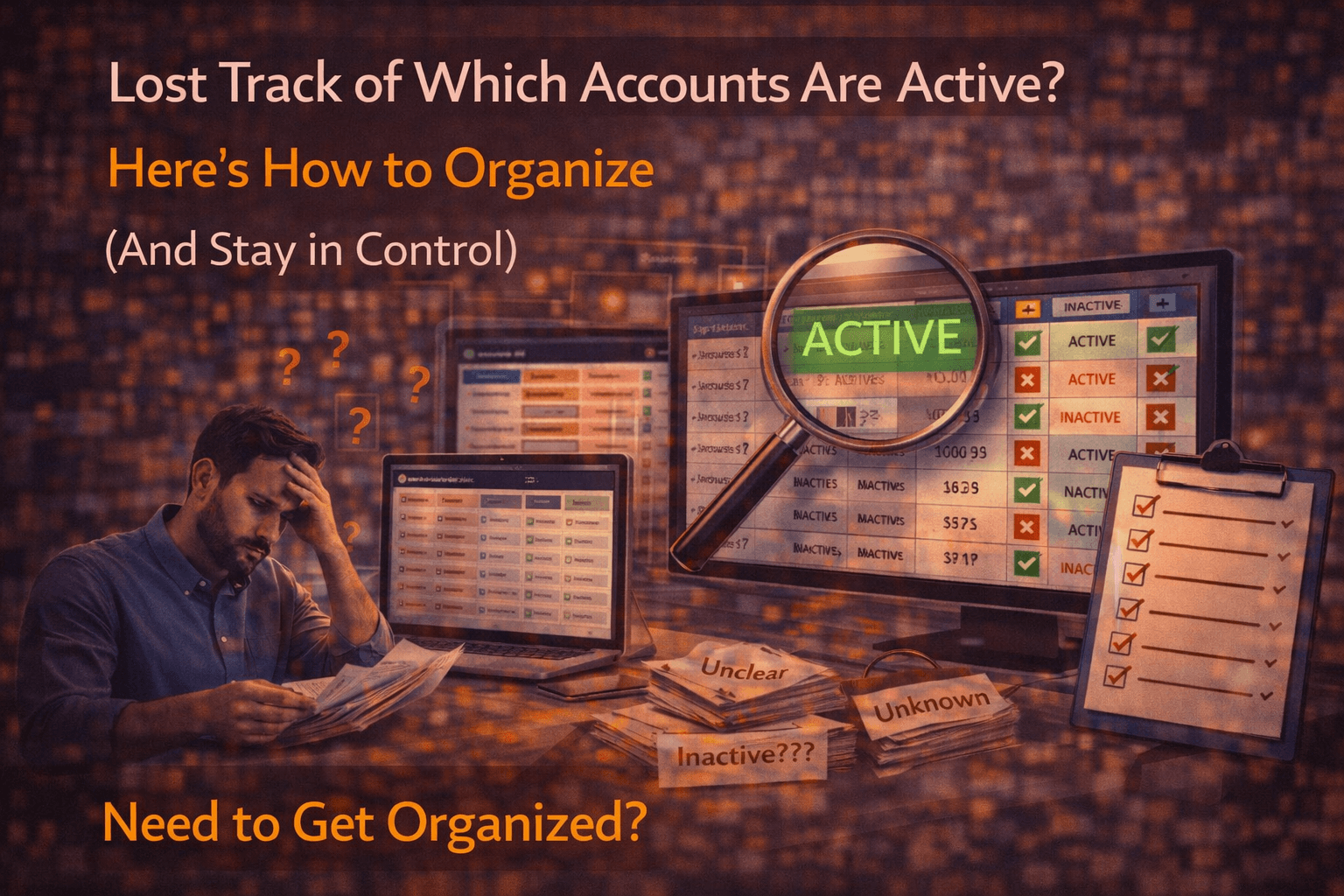
You’re Managing Accounts… But Not Sure Which Ones Are Actually Active
At some point, the list becomes too long to hold in your head. You have multiple clients, multiple platforms, multiple accounts per client, and what used to feel manageable now feels scattered.
You log in to check something and realize you are not even sure if the account is still in use, if it has been paused, or if it belongs to a client who is no longer active. Some accounts are being used daily, others have not been touched in weeks, and a few sit somewhere in between without clear status.
This is where confusion starts to turn into risk. You miss activity on important accounts, you spend time checking accounts that no longer matter, and your workflow becomes reactive instead of structured.
What makes this particularly frustrating is that the problem did not appear suddenly. It grew quietly as your number of accounts increased, and now it feels like everything is slightly out of sync.
This is not a memory problem. It is a system problem, and once you organize it correctly, the confusion disappears.
Why You Lose Track of Active Accounts
Most teams assume this happens because there are simply too many accounts to manage, but the real issue is that there is no structured system defining account status.
The first cause is lack of centralized tracking. Accounts are spread across different tools, spreadsheets, browsers, and devices, which makes it difficult to get a clear overview of what exists and what is currently active.
The second cause is undefined states. Many teams do not clearly define whether an account is active, paused, archived, or inactive, which means everything blends together without clear distinction.
The third cause is inconsistent workflows. Some accounts are managed actively, others are checked occasionally, and some are forgotten entirely, which creates gaps in awareness.
The fourth cause is scaling without structure. As more accounts are added, the complexity increases, but the underlying system remains the same, which leads to fragmentation.

The Hidden Cost of Disorganized Accounts
Losing track of account status is not just inconvenient, it affects every part of your operation.
You waste time checking accounts that do not require attention, which reduces your overall efficiency. At the same time, active accounts may not receive the attention they need because they are lost in the noise.
There is also a risk factor. Inactive or forgotten accounts can still be accessible, which creates security vulnerabilities and potential compliance issues.
From a client perspective, this leads to inconsistency. Some accounts receive timely updates while others fall behind, which affects trust and perceived reliability.
The biggest issue is scalability. As your account base grows, the lack of structure becomes a bottleneck that prevents you from managing everything effectively.
The Real Problem: No System Defines What “Active” Means
The core issue is not the number of accounts, but the absence of a system that defines and tracks their state.
Without clear definitions, every account exists in a gray area. You do not know whether it should be active, monitored, or ignored, which forces you to rely on memory and manual checks.
This creates a reactive workflow where you respond to what you notice instead of operating with a clear structure.
What you need is a system where account status is explicit and always visible.
The Complete Solution: Turn Account Management Into a Structured System
The only way to fix this permanently is to organize accounts into a system where their status is clearly defined and consistently maintained.
The first step is stabilization, where you create a complete inventory of all accounts, identifying which ones exist and where they are currently managed.
The second step is defining states. Each account should have a clear status such as active, paused, archived, or inactive, removing ambiguity from your workflow.
The third step is centralizing management. Instead of managing accounts across multiple disconnected environments, you bring them into a single structured system where their status and activity can be tracked consistently.
This is where most teams struggle, because maintaining centralized control across multiple accounts and platforms requires consistent environments and execution layers.
This is also where tools like Appilot become relevant.
Instead of managing accounts through scattered logins and devices, Appilot allows you to run workflows on real devices through a centralized system, which makes it easier to maintain consistency and track activity across accounts.
You could attempt to manage this manually using spreadsheets and separate tools, but as the number of accounts grows, maintaining accuracy becomes difficult. Appilot simplifies this by providing a controlled environment where execution and tracking are aligned.
The key shift is moving from scattered management to structured organization.
Why Structured Organization Solves This Completely
Once accounts are organized within a structured system, visibility improves immediately.
You can see which accounts are active, which are paused, and which require attention without needing to check each one manually.
Consistency improves because workflows are aligned with account status, ensuring that active accounts receive attention while inactive ones are clearly separated.
Coordination becomes simpler because everyone on the team operates within the same system, reducing confusion and duplication.
Most importantly, the system scales. Adding new accounts does not increase confusion because they are integrated into an existing structure.
How to Prevent This From Happening Again
Once your accounts are organized, the goal is to maintain clarity as your operation grows.
You ensure that every new account is added to the system with a defined status from the beginning, avoiding the buildup of ambiguity.
You monitor account activity regularly, ensuring that statuses remain accurate over time.
You standardize how accounts are accessed and managed, preventing fragmentation from reappearing.

Common Mistakes That Make This Worse
One of the most common mistakes is relying on memory instead of structure, which becomes unreliable as the number of accounts grows.
Another mistake is using disconnected tools, which creates fragmentation instead of clarity.
Some teams attempt to track accounts manually but do not update statuses consistently, which leads to outdated information.
The most critical mistake is assuming that confusion is inevitable, when it is actually a result of missing structure.
Conclusion: Organization Is What Makes Scale Possible
If you have lost track of which accounts are active, it is not because there are too many, it is because there is no system organizing them.
Once you define clear states, centralize management, and structure your workflow, the confusion disappears because every account has a place and a purpose.
You can continue managing this manually, but as your account base grows, the complexity will grow with it.
At some point, you either build a system that keeps everything organized or use one that already does.
That is where platforms like Appilot fit in, not as an extra layer, but as a way to create a structured, scalable environment where account management stays clear no matter how much you grow.