Managing Client Accounts: Multilogin and Appilot for Agencies
Why Client Account Management Becomes Difficult for Agencies
Agencies often manage many different types of accounts at the same time.
One client may need social media account management, another client may need affiliate campaign monitoring, another may need e-commerce seller account reviews, and another may require browser-based scraping workflows.
As the number of clients grows, the amount of daily work increases very quickly.
Teams may need to review notifications, monitor campaign performance, check dashboards, review account health, manage browser sessions, and organize repetitive tasks across many client profiles.
Without a structured system, client account management becomes difficult to scale.
What Multilogin Does for Agency Operations
Multilogin helps by creating separate browser environments for every client account.
Each browser profile can have its own fingerprint, cookies, proxy, timezone, browser version, and browsing environment.
This is useful because client accounts can remain separated from each other instead of being managed through the same browser session.
For agencies handling multiple clients, Multilogin provides the browser profile layer needed for more organized account management.
How Appilot Improves Agency Workflows
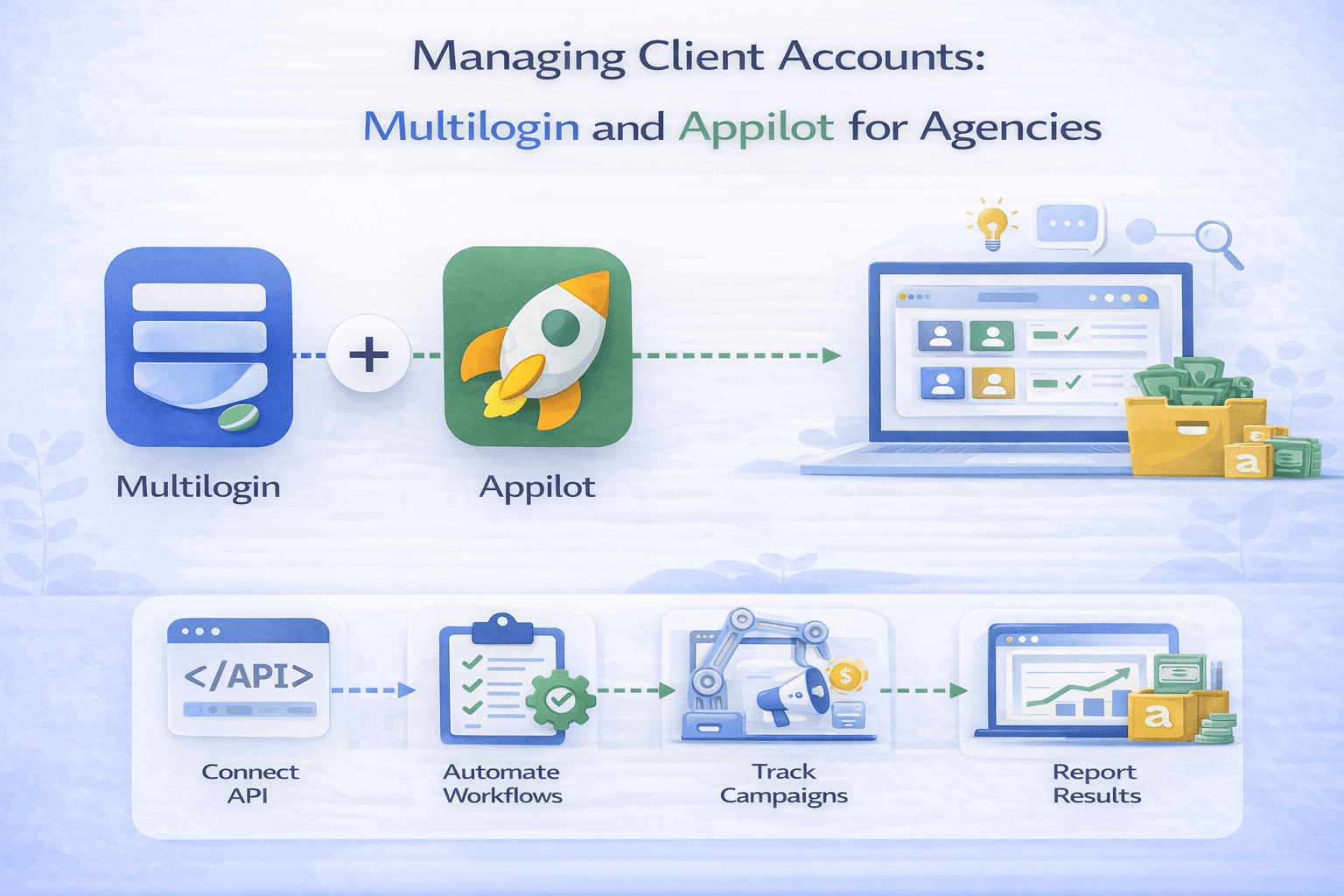
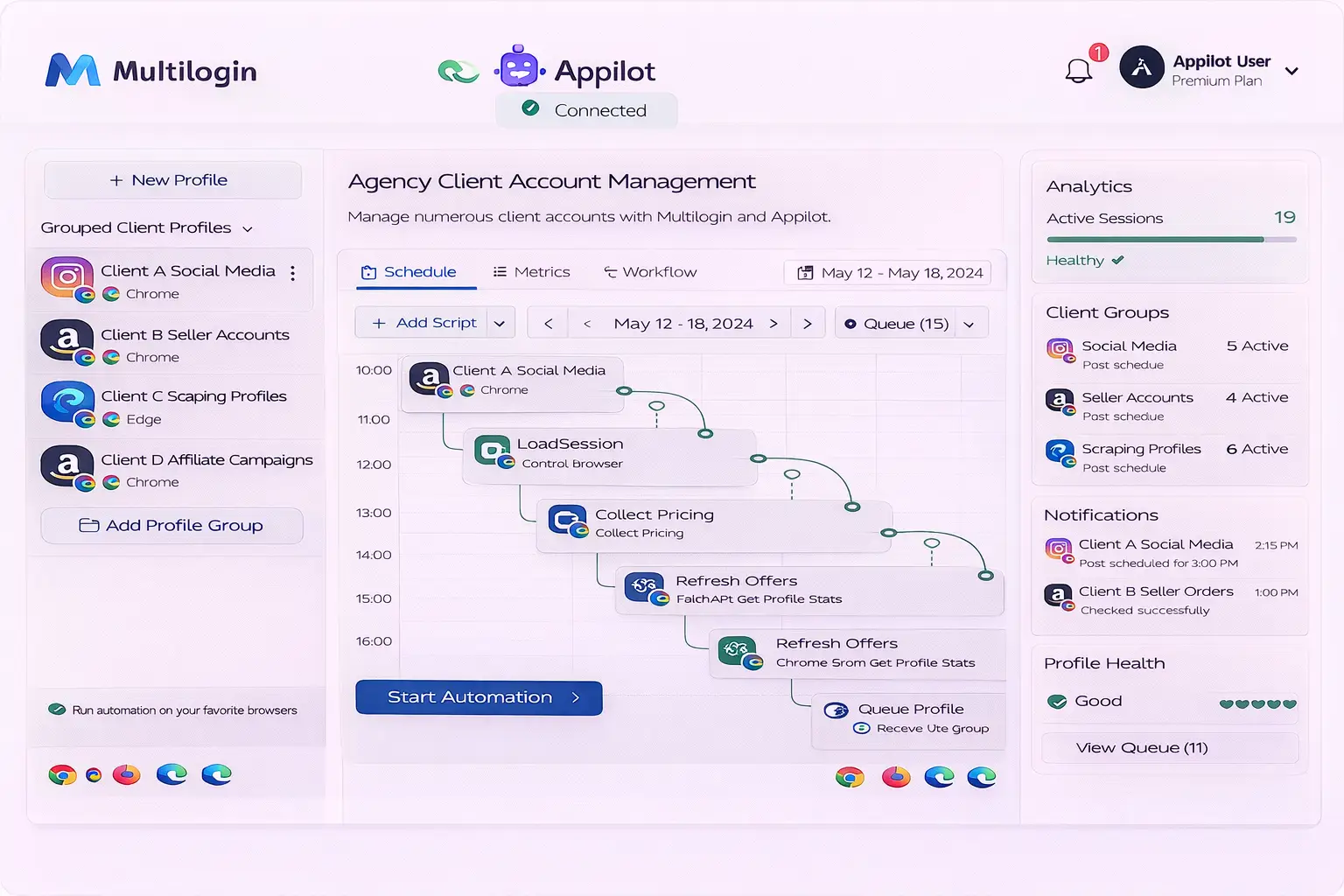
While Multilogin handles browser profile separation, Appilot handles workflow automation, scheduling, profile grouping, queue management, and task monitoring.
Appilot allows agencies to organize browser profiles by client, platform, campaign type, or use case.
Instead of logging into every account manually, agencies can launch browser profiles automatically, schedule repeated tasks, review notifications, monitor account health, and track workflow performance.
This saves time and makes larger client operations easier to manage.
Why Profile Grouping Matters for Agencies
One of the most important parts of client account management is organization.
Agencies often manage different platforms, different account types, and different workflows for every client.
Using Appilot, profiles can be grouped by client name, service type, platform, or internal team.
For example, one group may contain Instagram and TikTok profiles for a social media client, while another group may contain seller accounts for an e-commerce client.
This makes it easier to understand which workflows belong to which client accounts.
Using Multilogin and Appilot for Social Media Clients
Many agencies manage Instagram, TikTok, Facebook, and Twitter profiles for clients.
These accounts often require repeated browser tasks such as checking notifications, reviewing DMs, monitoring follower growth, tracking content performance, and monitoring account health.
Using Appilot with Multilogin makes it easier to automate these workflows across different client profiles.
This reduces repetitive work and helps agencies manage more accounts at the same time.
Using Multilogin and Appilot for E-commerce Clients
Agencies that manage e-commerce clients often need to monitor seller accounts, inventory levels, order volume, pricing changes, and account health.
Using Appilot with Multilogin allows these workflows to be automated across different seller profiles.
This helps agencies stay organized because different schedules and workflows can be applied to different client groups.
Using Multilogin and Appilot for Affiliate Marketing Clients
Affiliate marketing clients often require browser workflows such as campaign monitoring, traffic source reviews, landing page checks, and conversion tracking.
Using Appilot with Multilogin makes it easier to automate these browser tasks across different affiliate accounts.
This reduces repetitive work and helps agencies manage more campaigns with less manual effort.
Using Multilogin and Appilot for Web Scraping Clients
Some agencies manage browser-based scraping projects for clients.
These workflows often require browser profile launches, rotating proxies, repeated website visits, and queue management.
Using Appilot with Multilogin makes it easier to organize scraping profiles and automate browser sessions across different client groups.
This creates a more organized scraping workflow because browser activity can be scheduled and monitored from one dashboard.
How Scheduling Helps Agency Operations
Scheduling is important because different client accounts need different types of browser activity.
For example, social media notifications may need to be reviewed every morning, affiliate dashboards may need to be checked throughout the day, and scraping sessions may only need to run in the evening.
Appilot allows these workflows to be scheduled according to each client’s needs.
This creates a more organized process and reduces repetitive manual work.
Using Queue Management for Large Client Operations
Large agencies often manage many profiles and many workflows at the same time.
Trying to run every task at once can overload the system and make browser operations difficult to monitor.
Queue management helps by controlling how many tasks run at once, which profiles run first, and how failed actions are handled.
Appilot allows workflows to be organized into queues so that larger agency operations remain more stable.
How Multilogin and Appilot Help Reduce Detection Risk
No browser automation setup is completely safe, but Multilogin and Appilot help reduce obvious patterns.
Multilogin creates separate browser fingerprints and sessions for different client accounts.
Appilot helps by spreading browser activity across different times, rotating workflow order, and avoiding identical schedules.
This creates more realistic behavior because humans do not perform the same browser actions in exactly the same order every day.
Best Practices for Managing Client Accounts
It is always better to start with a smaller group of client profiles before scaling to larger operations.
You should also use reliable residential or mobile proxies because poor proxy quality can increase risk.
Regular browser profile maintenance is important because cookies expire, sessions break, and browser versions become outdated.
It is also important to review failed workflows, retry queues, and account health regularly.
Finally, avoid creating identical schedules across every client profile because more variation creates more realistic browser activity.
Frequently Asked Questions
Q1: Can Appilot manage multiple client profiles across Multilogin?
Yes, Appilot can manage multiple client profiles across Multilogin browser sessions.
Q2: Can profiles be grouped by client name or service type?
Yes, Appilot allows profiles to be grouped by client, platform, service type, or use case.
Q3: Is this useful for agencies managing social media, e-commerce, and affiliate clients?
Yes, Multilogin and Appilot can be useful across many agency services.
Q4: Can Appilot schedule different workflows for different client groups?
Yes, Appilot can apply different workflows and schedules to different client groups.
Q5: Does browser automation make agency operations completely safe?
No setup is completely safe, but browser separation, better scheduling, stronger proxies, and more realistic activity patterns can reduce obvious risks.
Conclusion
Managing client accounts becomes much easier when Multilogin and Appilot are used together.
Multilogin provides the browser profile separation needed for safer multi-account operations, while Appilot provides the scheduling, automation, queue management, and workflow organization needed for larger agency systems.
The result is a browser automation workflow that saves time, reduces repetitive work, improves consistency, and makes larger client operations much easier to manage.