Manual Growth vs Automation Bots: An Honest Comparison for Instagram
Instagram growth has always had two sides. One side says growth should be fully manual because real relationships, strong content, and authentic engagement are the only things that last. The other side says automation is necessary because manual work becomes too slow once you manage multiple accounts, clients, campaigns, or outreach workflows.
Both sides are partly right.
Manual growth is better for quality, trust, creativity, and real conversations. Automation bots are better for consistency, scale, repeatable workflows, and reducing time spent on routine actions. The problem starts when people treat either approach as a complete solution.
Manual growth alone can become painfully slow. Automation alone can become risky, spammy, and low-quality if it is used without strategy.
The best Instagram growth strategy in 2025 is usually not manual growth versus automation bots. It is manual strategy supported by careful automation.
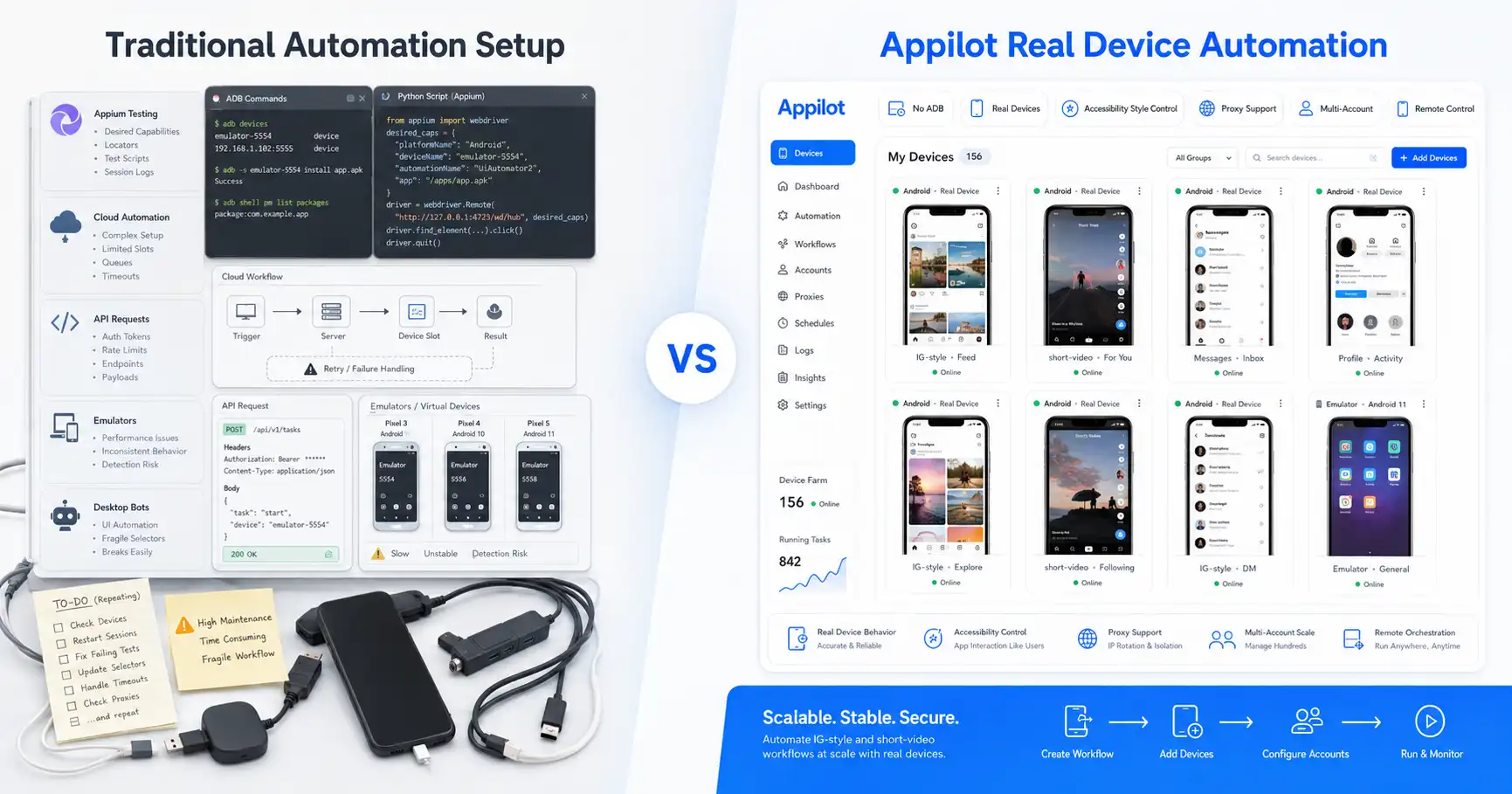
That is where tools like Appilot become useful. Appilot runs bots on real Android devices and emulators through a remote web dashboard, which helps users automate routine Instagram workflows without relying on desktop scripts, ADB, or always-on laptops.
What Is Manual Instagram Growth?
Manual Instagram growth means a real person handles the growth work directly. They create content, research the audience, reply to comments, send messages, engage with other accounts, test hooks, study analytics, and build relationships without relying heavily on automation.
This approach is strong because it gives the account a real human voice. A person can understand context, reply naturally, decide which conversations matter, notice content trends, and avoid awkward actions that a bot might perform without judgment.
Manual growth is especially useful for creators, personal brands, consultants, coaches, agencies, founders, and businesses that depend on trust. When someone is building a serious brand, the quality of each interaction matters.
The weakness is time. Manual Instagram growth can take hours every day. If one person manages one account, that may be fine. If a team manages ten, twenty, or fifty accounts, manual growth quickly becomes difficult to maintain.
This is why many users eventually start looking at automation.
What Are Instagram Automation Bots?
Instagram automation bots are tools that perform repetitive Instagram actions automatically or semi-automatically. Depending on the tool, these actions may include liking posts, following accounts, unfollowing users, viewing stories, sending messages, replying to comments, posting content, warming up accounts, browsing profiles, or managing outreach workflows.
Automation bots are attractive because they save time. Instead of manually doing the same actions every day, users can set up workflows and let software handle routine tasks.
But automation is not automatically good. A badly configured bot can hurt an account. If it follows too many users, sends repetitive DMs, uses weak proxies, comments generic phrases, or acts too quickly, Instagram may flag the account or reduce its reach.
The quality of automation depends on the tool, the setup, the strategy, and the limits.
Appilot is built around real-device automation, which means bots run on real Android devices and emulators instead of only relying on desktop-style workflows. That gives users a better operating layer for Instagram automation, but it still needs to be used carefully.
Manual Growth vs Automation Bots: The Main Difference
The biggest difference between manual growth and automation bots is judgment versus scale.
Manual growth gives the user human judgment. A person can decide whether a comment deserves a thoughtful reply, whether a prospect is worth messaging, whether a profile is relevant, and whether a conversation should continue.
Automation bots give the user scale. A bot can repeat routine actions consistently, run workflows on schedule, manage basic tasks, and reduce the amount of time spent on low-level work.
For Instagram, both matter. Growth is not just about doing more actions. It is about doing the right actions in a way that supports the account’s reputation and long-term value.
Manual work is better for strategy and relationship building. Automation is better for repetitive execution.
The mistake is using bots to replace thinking. The better approach is using automation to support a strategy that a human still controls.
Where Manual Growth Wins
Manual growth wins when quality matters more than volume.
A real person is better at understanding context, tone, intent, and brand voice. If someone leaves a thoughtful comment, a human can reply in a way that feels natural. If a prospect asks a detailed question, a human can respond with judgment. If a post performs well, a human can study why and adjust the content strategy.
Manual growth also wins for relationship building. Instagram is not only an engagement platform. It is a trust platform. People follow, reply, buy, and collaborate when they feel there is a real person or real brand behind the account.
Manual work is also safer for sensitive actions. If an account is new, valuable, or attached to a serious brand, a human-led approach reduces the chance of spammy patterns.
The downside is that manual growth does not scale easily. It can become slow, expensive, and inconsistent when the workload grows.
Where Automation Bots Win
Automation bots win when the task is repetitive, predictable, and time-consuming.
A bot can help with routine workflows that do not require deep human judgment. This may include warming up activity, checking app flows, viewing content, organizing basic engagement workflows, handling repeated account tasks, or supporting multi-account operations.
Automation also wins when consistency matters. A human may forget to perform a task every day. A bot can run the same workflow on schedule.
For agencies and phone farm operators, automation can be the difference between managing a few accounts and managing many accounts. Manual work alone becomes too expensive once the number of accounts grows.
The downside is risk. Bots can create problems when they are too aggressive, too repetitive, or too disconnected from strategy.
This is why real-device automation matters. Appilot helps users run automation on Android devices and emulators, which is a better fit for mobile-first workflows than older desktop-based bot setups.
Instagram Account Safety
Account safety should be the first concern when comparing manual growth and automation bots.
Manual growth is generally safer because a human naturally varies behavior. People pause, think, browse, reply differently, and avoid obvious spam patterns. But manual users can still make mistakes if they mass-message people, copy-paste comments, or follow too aggressively.
Automation bots can be riskier because they repeat actions at scale. If the setup is careless, the account may look unnatural quickly.
That said, not all automation is equal. A bot that runs too fast from a weak environment is very different from a carefully limited workflow running on a real Android device with proper proxy separation and realistic timing.
Appilot does not make automation risk-free. No tool can honestly claim that. But it gives users a stronger setup because automation runs through Android devices and emulators, and workflows can be managed remotely from a dashboard.
Safe automation still requires good limits, good proxies, account warmup, and human oversight.
Engagement Quality
Manual growth usually produces better engagement quality.
A person can choose who to engage with, write thoughtful replies, send relevant messages, and avoid wasting time on accounts that do not fit the target audience. This leads to better conversations and more meaningful relationships.
Automation bots can produce volume, but volume is not the same as quality. A bot may interact with accounts that are not relevant, send messages that feel generic, or perform actions that do not lead to real followers or customers.
The best approach is to let humans handle the high-value engagement while automation handles routine support tasks.
For example, a human should write the core outreach message, decide the targeting strategy, and handle important replies. Automation can help with warmup, repetitive navigation, basic workflow execution, and multi-account task management.
That balance protects quality while saving time.
Time and Cost
Manual growth costs time. Automation costs setup.
If a founder or creator only manages one account, manual growth may be the better investment. It allows them to understand their audience deeply and build trust directly.
But if an agency manages many accounts, manual growth becomes expensive. Every reply, comment, message, follow-up, and engagement action requires labor. Over time, the cost of manual work can become too high.
Automation reduces the time cost by moving routine work into repeatable workflows.
Appilot helps here because it removes some of the usual automation setup pain. Users do not need ADB, do not need to keep a laptop connected, and do not need to manage desktop-based bot infrastructure. They can control bots through a web dashboard and run workflows on Android devices or emulators.
For teams, that can save both time and operational effort.
Scaling Instagram Growth
Manual growth scales through people. Automation scales through systems.
If a brand wants to scale manually, it needs more team members, more training, more quality control, and more process documentation. This can work, but it becomes expensive and harder to manage.
Automation scales differently. Once a workflow is tested, it can be repeated across accounts or devices with less human effort.
But scaling automation without control is dangerous. More bot activity does not automatically mean more growth. It can mean more spam, more account risk, and worse engagement quality.
This is why scale needs strategy. The user should decide what should stay manual and what can be automated.
Appilot is useful because it supports real Android automation, remote dashboard control, proxy-aware workflows, and ready-to-use bots. That gives users a more stable foundation for scaling routine workflows without turning everything into low-quality spam.
Best Uses for Manual Growth
Manual growth is best for brand strategy, content creation, high-value replies, direct relationship building, community management, and sales conversations that require trust.
It is also best for new accounts that need careful warmup and accounts where reputation matters more than speed.
Manual growth should stay close to anything that requires judgment. If the message needs personality, context, persuasion, or empathy, a human should handle it.
For creators and founders, manual growth is often the best early-stage strategy because it teaches them what their audience cares about.
Automation should not replace that learning process too early.
Best Uses for Automation Bots
Automation bots are best for repeatable workflows that do not require deep judgment.
They are useful for account warmup support, routine navigation, scheduled tasks, multi-account operations, basic engagement workflows, workflow testing, and repetitive app actions.
For agencies, bots are useful because they reduce the amount of manual work required across many accounts.
For phone farm operators, bots are useful because they can help manage workflows across devices and accounts more consistently.
Appilot is especially relevant when automation needs to happen inside mobile app environments. Since it runs bots on Android devices and emulators, it is better suited for Instagram workflows than older desktop-based methods.
The key is to automate carefully, not aggressively.
Why Appilot Fits the Middle Ground
Appilot is useful because it does not force users to choose between fully manual work and reckless automation.
It gives users a way to automate routine Instagram workflows on real Android devices and emulators while still leaving strategy, creativity, and important conversations to humans.
This is the healthier model for Instagram growth.
A human should still decide the targeting, content angle, outreach logic, message quality, and brand voice. Appilot can help run the repeatable mobile workflows that support that strategy.
The no-ADB setup also makes the system easier to operate. Users do not need cables, drivers, laptop dependency, or command-line setup. They can manage bots through a remote web dashboard.
For agencies and growth teams, this makes automation more practical without turning the whole strategy into a spam machine.
The Honest Answer: Which Is Better?
Manual growth is better for quality. Automation bots are better for scale.
If you are building a serious personal brand, creator account, or high-trust business, manual growth should be the foundation. You need real content, real conversations, and a real understanding of your audience.
If you are managing many accounts, running repeated workflows, or operating an agency, automation becomes necessary because manual work alone is too slow.
The best answer is a hybrid approach. Use manual work for strategy and relationships. Use automation for repeatable workflows and operational scale.
Appilot fits that hybrid approach because it gives users real Android automation, remote dashboard control, no ADB setup, proxy support, and ready-to-use bots.
Final Verdict
Manual growth and automation bots are not enemies. They are tools for different parts of Instagram growth.
Manual growth wins when the goal is trust, creativity, relationship building, and high-quality engagement. Automation wins when the goal is consistency, time savings, multi-account operations, and repeatable workflow execution.
The mistake is relying completely on either one. Manual-only growth can be too slow. Bot-only growth can become low-quality and risky.
The best Instagram growth strategy in 2025 combines human judgment with careful automation.
Appilot helps with that balance by running bots on real Android devices and emulators, working without ADB, supporting remote dashboard control, and giving users ready-to-use automation workflows.
You can explore Appilot’s bot store and try it at appilot.app.
FAQ
Q1: What is the biggest difference between manual growth and automation bots?
Manual growth relies on human judgment and real conversations, while automation bots handle repeatable actions at scale. Manual is better for quality, and bots are better for consistency.
Q2: Are Instagram automation bots safe?
Bots can be risky if used aggressively or carelessly. Safer automation requires realistic limits, good proxies, account warmup, and human oversight.
Q3: Is manual Instagram growth better than automation?
Manual growth is better for trust, branding, and high-quality engagement. Automation is better for routine workflows and multi-account scale.
Q4: How does Appilot help with Instagram automation?
Appilot runs bots on real Android devices and emulators without ADB or laptop dependency. Users manage workflows remotely through a web dashboard.
Q5: What is the best Instagram growth strategy in 2025?
The best strategy is a hybrid approach. Use humans for content, strategy, and conversations, and use automation carefully for repeatable operational tasks.