Maskfog Integration with Appilot: How to Get Started
Managing multiple browser profiles manually becomes difficult once you are working across many accounts, campaigns, clients, and platforms. Opening browser profiles one by one, switching between proxies, checking dashboards, reviewing notifications, and repeating the same actions every day quickly becomes time consuming.
Maskfog Browser already helps by giving every browser profile its own fingerprint, cookies, proxy settings, timezone, browser version, and browsing environment. This makes it easier to separate accounts and reduce the chance of profiles becoming linked together.
The next challenge is workflow management. Once browser profiles are created, users still need a way to organize repeated browser actions, automate profile launches, and manage larger workflows across those profiles.
That is where Appilot becomes useful. Appilot adds a workflow layer on top of Maskfog Browser so you can automate browser launches, schedule profile tasks, group browser environments, and reduce the amount of manual work required every day.
With the right setup, Maskfog Browser and Appilot can save hours of work every week while making browser profile management much easier to scale.
Why Integrate Appilot with Maskfog Browser?
Maskfog Browser is designed for users who need isolated browser environments across different accounts, campaigns, clients, and platforms. Each profile can have its own fingerprint, cookies, user agent, proxy settings, browser version, timezone, and browsing history.
This is especially useful for people managing social media accounts, affiliate campaigns, ad accounts, e-commerce stores, scraping sessions, and client browser environments.
The issue is that profile separation alone is not enough. Once browser profiles are created, users still need to manually open profiles, visit websites, review dashboards, monitor notifications, and repeat browser actions every day.
Appilot solves that problem by turning browser profiles into organized workflows.
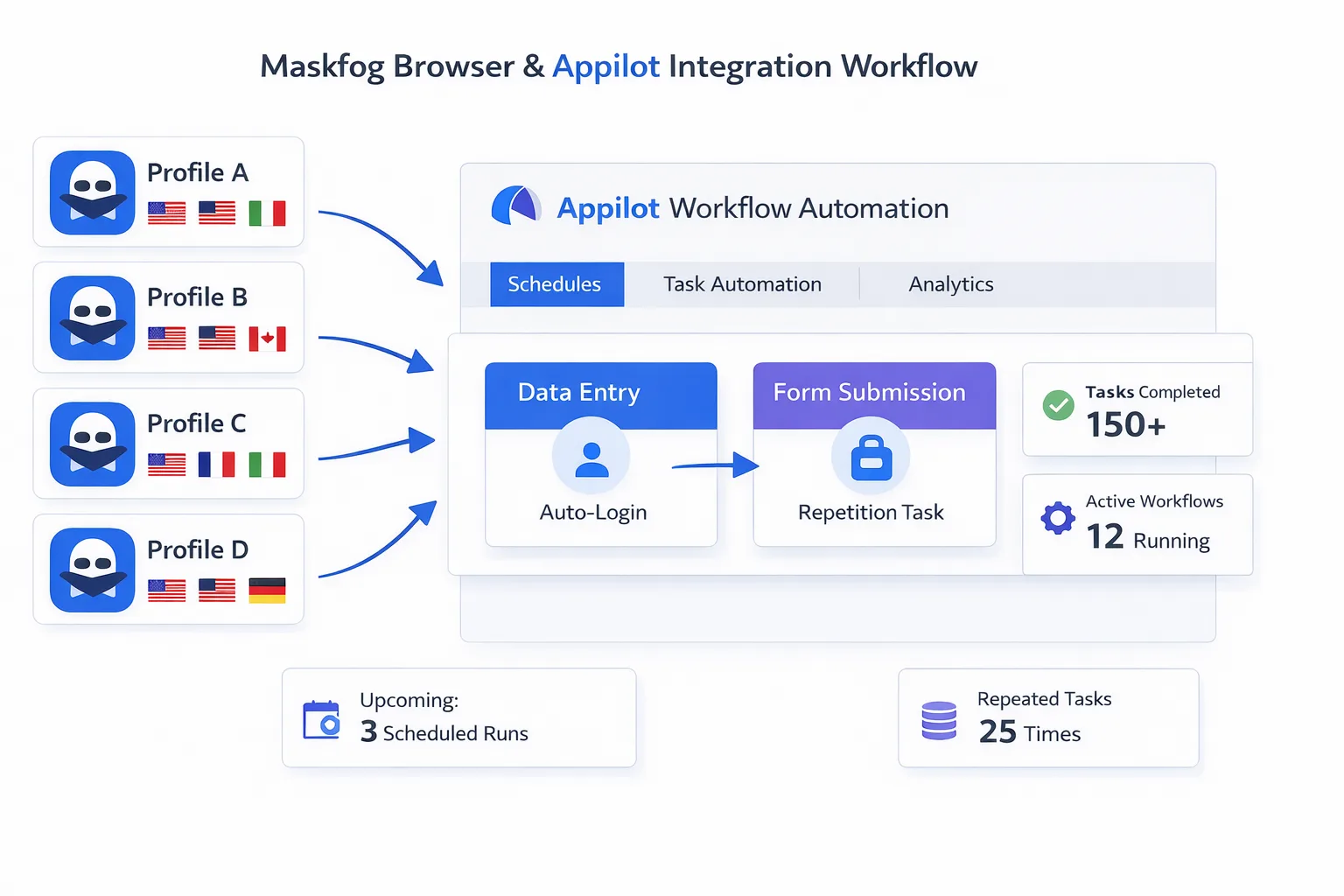
Instead of opening Maskfog Browser profiles manually every day, you can create schedules that launch profiles automatically, perform repeated browser actions, and close sessions after tasks are complete.
How to Get Started with Maskfog and Appilot
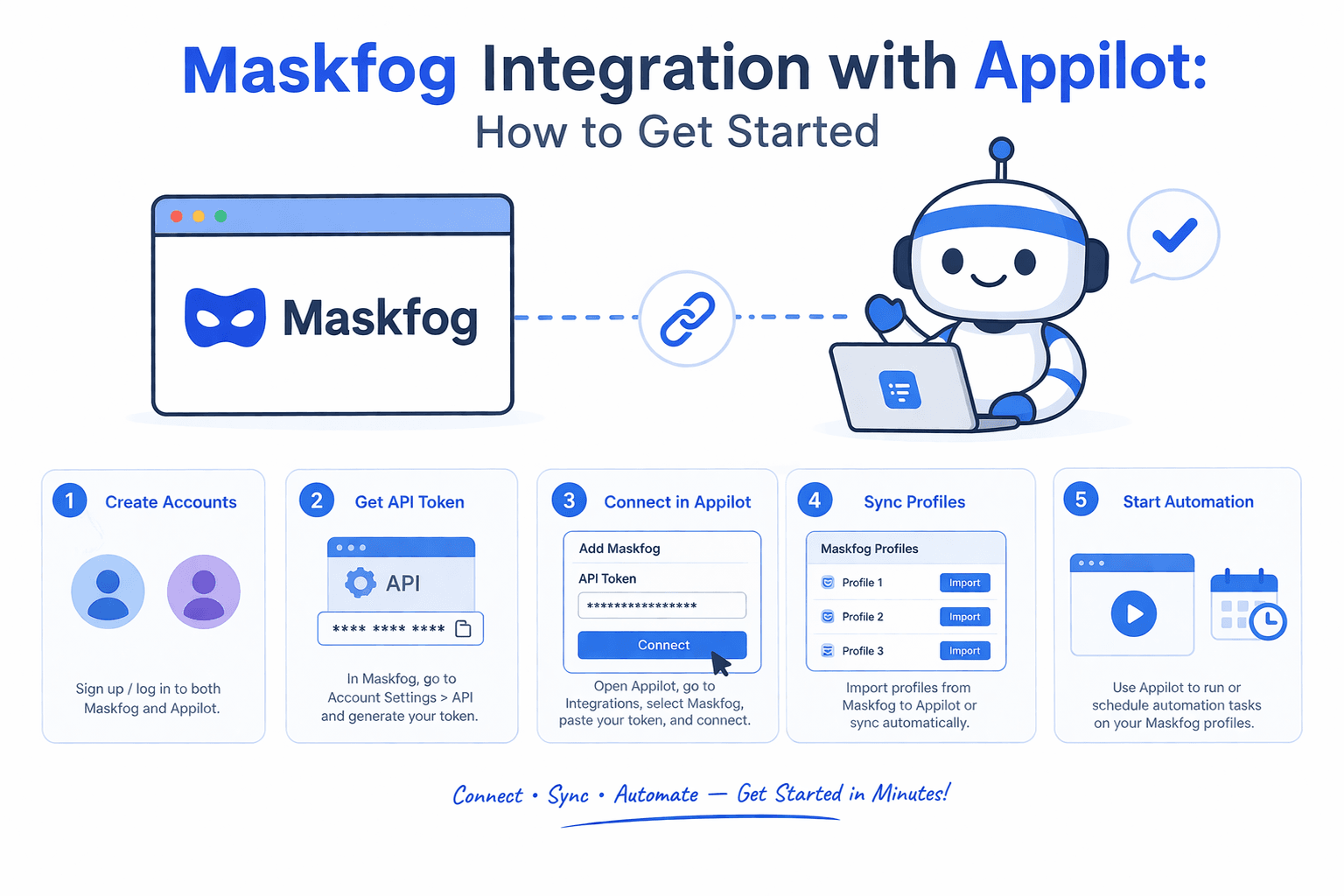
The first step is creating your browser profiles inside Maskfog Browser.
Most users begin by creating separate profiles for each account, client, platform, or campaign they manage. For example, you may create one profile for a Facebook account, another for a TikTok account, another for an Amazon seller dashboard, and another for a Shopify store.
Once your profiles are created, you should assign unique proxies, timezone settings, cookies, and browser fingerprints to each profile.
After that, connect your Maskfog Browser account to Appilot.
Most integrations begin by using API access or profile synchronization features that allow Appilot to read and manage browser profiles inside Maskfog Browser.
Once the connection is active, Appilot can import browser profiles into its dashboard.
Users can then organize browser profiles into groups based on platform, client, campaign, or account type.
Common Use Cases for Maskfog and Appilot
One of the most common use cases is social media management. Teams often need to launch browser profiles, review notifications, check messages, and monitor account performance across different platforms.
E-commerce sellers often use Maskfog Browser and Appilot to manage Shopify stores, Amazon accounts, supplier portals, and competitor monitoring.
Affiliate marketers use the setup to separate traffic source accounts, landing page builders, trackers, and ad accounts.
Agencies often organize browser profiles by client so they can manage social media accounts, business managers, and dashboards without mixing different accounts together.
Web scraping teams can use Appilot to launch browser profiles on schedules and organize repeated website visits more efficiently.
Crypto users often use this setup to manage wallet sessions, exchange accounts, and repeated browser activity.
Benefits of Maskfog and Appilot Integration
One of the biggest benefits is time savings. Instead of manually opening browser profiles every day, Appilot can automate repeated tasks across large groups of Maskfog Browser profiles.
Another major benefit is consistency. Manual work often leads to forgotten tasks, missed accounts, or inconsistent timing. Automated workflows make the process much more reliable because tasks run automatically at the same time every day.
Integration also makes it easier to scale. Once you have a workflow that works for ten profiles, it can usually be expanded to twenty, fifty, or even one hundred profiles.
It also improves organization because browser profiles can be grouped by team, platform, client, campaign, or geography.
Best Practices for Maskfog Integration
The best way to use Appilot with Maskfog Browser is to keep your browser profile groups organized.
Profiles should be grouped by platform, campaign, client, or use case so that workflows remain easy to understand.
It is also important to use good proxies and keep browser fingerprints realistic. If proxy locations, timezone settings, and browser fingerprints do not match each other, platforms may become suspicious.
You should also avoid opening too many profiles at the exact same time. Staggered launches usually create a more stable workflow and reduce the load on your machine.
Starting with smaller workflows and expanding gradually is much safer than trying to automate everything immediately.
Common Problems and How to Avoid Them
One common problem is profile launch failures. These are often caused by expired proxies, broken browser settings, or outdated profile configurations.
Another common issue is poor browser profile organization. If browser profiles are not grouped clearly, workflows can become difficult to understand.
Some users also run into timezone mismatches between browser profiles and proxies. This can create suspicious behavior patterns or scheduling issues.
Workflow overload can also become a problem if too many browser profiles launch at once.
The safest approach is to keep browser profiles organized, use realistic schedules, and scale your workflows gradually over time.
Frequently Asked Questions
Q1: Can Appilot automate multiple Maskfog Browser profiles at the same time?
Yes. Appilot can run workflows across multiple Maskfog Browser profiles simultaneously depending on your system resources and browser setup.
Q2: Do I need coding skills to use Maskfog Browser with Appilot?
No. Most users can connect Maskfog Browser with Appilot, import profiles, and create workflows without writing code.
Q3: Can I organize Maskfog Browser profiles into different groups?
Yes. Most users group profiles by platform, campaign, client, geography, or account type.
Q4: Is it safe to automate Maskfog Browser profiles?
Automation can reduce a lot of manual work, but it should be used carefully. It is important to use realistic browser settings, quality proxies, and gradual workflow expansion.
Q5: Can Appilot work with other antidetect browsers besides Maskfog Browser?
Yes. Appilot can also be used with other browser environments such as AdsPower, Dolphin Anty, Octo Browser, GoLogin, Multilogin, Kameleo, MoreLogin, VMLogin, Incogniton, BitBrowser, Undetectable Browser, Lalicat Browser, and Hidemyacc Browser.
Conclusion
Maskfog Browser is very useful for profile separation, browser fingerprinting, and multi-account management. Appilot adds the workflow layer that makes those browser profiles easier to automate and organize.
Together, Maskfog Browser and Appilot create a cleaner setup for social media management, affiliate marketing, e-commerce operations, ad account management, web scraping, and multi-account workflows.
The best way to get started is to organize your browser profiles clearly, create simple workflows first, and scale gradually over time.