Mobile Proxies vs Residential Proxies vs Datacenter Proxies: Full Comparison for Bot Operators
Proxy choice can make or break a bot operation. A good bot running on a bad proxy can still get blocked, challenged, rate-limited, or banned. A weaker bot running on a cleaner proxy may survive longer simply because the account environment looks more believable. That is why bot operators need to understand the difference between mobile proxies, residential proxies, and datacenter proxies before scaling any automation workflow.
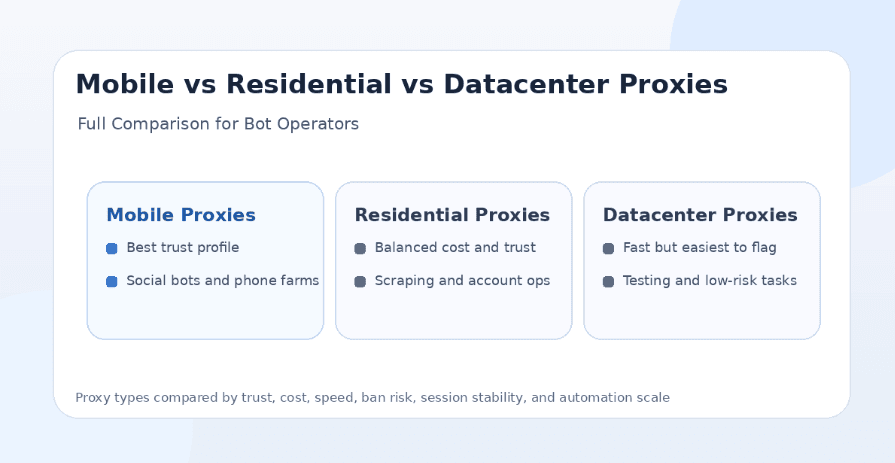
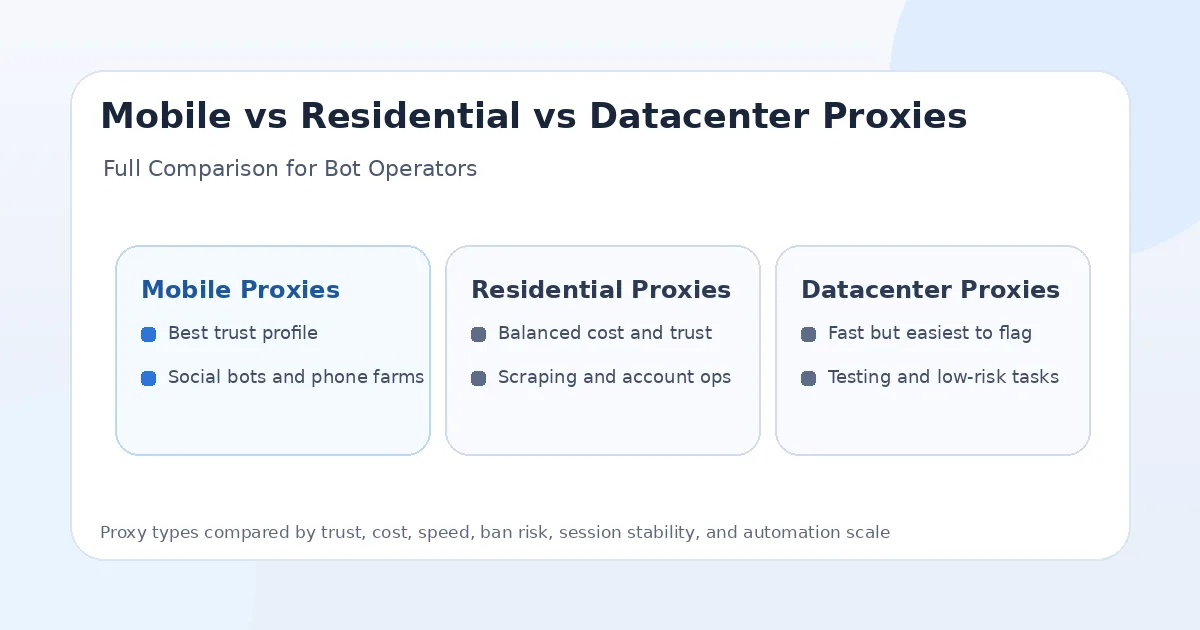
The simple version is this: mobile proxies usually have the strongest trust profile for social media automation, residential proxies offer a useful balance between cost and credibility, and datacenter proxies are fast and cheap but easier to detect on sensitive platforms. The best choice depends on what you are automating, how many accounts you manage, how strict the platform is, and whether you care more about cost, speed, or account safety.
For Appilot users running bots on real Android devices and emulators, proxy quality matters even more. Real-device automation helps create a more natural mobile environment, but the network layer still needs to make sense. If the device looks real but the IP looks suspicious, the account can still run into problems.
What Are Mobile Proxies?
Mobile proxies route traffic through IP addresses assigned by mobile carriers. In practical terms, the platform sees traffic coming from a mobile network rather than a normal home internet connection or cloud server. This is why mobile proxies are often considered the strongest option for social media bots, phone farms, and mobile app automation.
The main advantage is trust. Many real users browse Instagram, TikTok, Snapchat, Threads, YouTube, Reddit, Telegram, and other apps from mobile networks every day. Because mobile IPs are shared by many real users behind carrier-grade networks, platforms often treat them differently from obvious server IPs.
The downside is cost. Mobile proxies are usually more expensive than residential and datacenter proxies. They can also be slower, less predictable, and harder to manage if the provider rotates IPs too aggressively. For bot operators, mobile proxies are best used when account trust matters more than raw speed.
What Are Residential Proxies?
Residential proxies route traffic through IP addresses assigned to real home internet users. These IPs usually come from internet service providers rather than datacenter hosting companies. Because they look like normal household connections, they are often more trusted than datacenter proxies.
Residential proxies are a strong middle ground. They are usually cheaper than mobile proxies but more credible than datacenter proxies. They can work well for account creation, scraping, browsing, research, data collection, marketplace automation, and some social media workflows when configured properly.
The main weakness is quality variation. Not all residential proxies are equal. Some providers have cleaner pools, better location targeting, better session control, and more stable IPs than others. Poor residential proxies can still be abused, slow, unreliable, or already flagged by platforms.
What Are Datacenter Proxies?
Datacenter proxies come from hosting providers, cloud servers, and data centers. They are not tied to real home internet users or mobile carriers. This makes them fast, cheap, and easy to buy in bulk, but also easier for platforms to identify.
Datacenter proxies are useful for low-risk automation, testing, monitoring, API calls, basic scraping, and workflows where speed matters more than account trust. They are also useful for development because they are easy to rotate and cheaper to experiment with.
The problem is that sensitive social platforms often treat datacenter IPs with more suspicion. If an Instagram, TikTok, LinkedIn, Snapchat, or Reddit account suddenly logs in through a known server IP, that can look unnatural. Datacenter proxies are not always bad, but they are usually the weakest option for account-based social automation.
Mobile vs Residential vs Datacenter: The Main Difference
The main difference is how natural the IP looks to the platform. Mobile proxies look like traffic from a mobile carrier. Residential proxies look like traffic from a home internet connection. Datacenter proxies look like traffic from a server.
For social media bots, mobile proxies usually provide the best trust profile because social apps are heavily used on phones. Residential proxies are still useful, especially when the workflow does not need a mobile carrier identity. Datacenter proxies are best for speed, cost savings, and low-risk tasks.
This does not mean mobile proxies are always the best choice for everything. A mobile proxy is expensive and may be unnecessary for simple data checks. A residential proxy may be enough for moderate-risk workflows. A datacenter proxy may be fine for internal testing. The best proxy type depends on the job.
Which Proxy Type Gets Banned Less?
Mobile proxies usually get banned less for social media automation because they look closer to real mobile user traffic. This is especially important for platforms like Instagram, TikTok, Snapchat, Threads, and Telegram where mobile behavior is a core part of normal usage.
Residential proxies usually sit in second place. They are more believable than datacenter proxies but may not match mobile-first app behavior as well as mobile IPs. They can still work well when sessions are stable, locations are consistent, and account behavior is realistic.
Datacenter proxies usually carry the highest ban risk for account-based automation. They are easy to classify as server traffic and are often associated with bots, scraping, spam, and bulk automation. They can work for some tasks, but they are not ideal for valuable social accounts.
Proxy Trust Is Not Enough
A good proxy does not save a bad bot. If the account sends too many DMs, follows too many people, comments the same message repeatedly, scrapes aggressively, or changes behavior suddenly, it can still be restricted even on a mobile proxy.
Proxy trust works best when the rest of the environment also makes sense. The device should be stable. The account should be warmed up. The region should match the account history. The session should not jump between countries. The automation should use natural timing and realistic limits.
This is where Appilot’s real-device approach helps. Running bots on Android devices and emulators gives users a more natural execution layer, while strong proxies support the network layer. Both sides matter.
Static vs Rotating Proxies
Static proxies keep the same IP for a longer period, while rotating proxies change the IP periodically or on request. Both can be useful, but they solve different problems.
For account-based social media automation, static or sticky sessions are usually safer. A real user does not usually log into Instagram from five different IPs in one hour. Keeping one account tied to one consistent proxy location creates a more believable pattern.
Rotating proxies are more useful for scraping, research, data collection, search checks, or tasks where account identity is less important. Rotation helps distribute requests, but aggressive rotation can look suspicious when tied to logged-in accounts.
For bot operators, the rule is simple: use stable sessions for accounts and rotation for non-account-heavy data tasks.
Mobile Proxies for Social Media Bots
Mobile proxies are usually the best option for Instagram, TikTok, Snapchat, Threads, Twitter/X, Telegram, and other mobile-heavy platforms. They are especially useful when the bot runs on real Android devices or emulators because the device and network signals match more naturally.
For phone farms, mobile proxies are often the preferred choice. A real Android phone paired with a mobile proxy creates a much stronger environment than a desktop script running through a cheap datacenter IP.
The main challenge is cost. Mobile proxies can become expensive when managing many accounts. Operators need to balance account value against proxy spend. For high-value accounts, mobile proxies are usually worth it. For testing or low-risk workflows, they may be overkill.
Residential Proxies for Bot Operators
Residential proxies are a strong middle option for bot operators who need better trust than datacenter proxies but cannot justify mobile proxy pricing for every workflow. They can work well for account browsing, light automation, scraping, monitoring, and moderate-risk social tasks.
Residential proxies are especially useful when the platform does not require a mobile carrier-style footprint. They can also work well for web-based automation, marketplace bots, sneaker bots, form automation, search monitoring, and account workflows where a home internet IP is believable.
The key is quality. Cheap residential proxies with unstable sessions, poor locations, or abused IP pools can create more problems than they solve. Bot operators should prioritize clean pools, sticky sessions, good geo-targeting, and predictable performance.
Datacenter Proxies for Bot Operators
Datacenter proxies are best for speed, cost savings, testing, and low-risk automation. They are useful when the workflow does not depend on account trust or when the platform does not care much about server-origin traffic.
They can work well for development, internal testing, uptime checks, public data monitoring, API calls, and basic scraping where blocks are not a major concern. They are also easy to scale because they are cheaper and more available than mobile or residential proxies.
For social media accounts, datacenter proxies should be used carefully. They may trigger login challenges, suspicious activity warnings, or rate limits on sensitive platforms. They are usually not the best choice for Instagram, TikTok, Snapchat, LinkedIn, or Reddit accounts that matter.
Best Proxy Type for Instagram Bots
Mobile proxies are usually the best choice for Instagram bots. Instagram is mobile-first, and account trust depends heavily on device behavior, network consistency, action limits, and session history. A mobile proxy fits that environment better than a datacenter proxy.
Residential proxies can work for some Instagram workflows, especially if the account is warmed, the behavior is soft, and the session stays stable. They are often a reasonable option for lower-cost operations.
Datacenter proxies are the weakest option for Instagram account automation. They may work for testing or public checks, but they are risky for valuable accounts.
Best Proxy Type for TikTok Bots
Mobile proxies are also the best choice for TikTok bots because TikTok is heavily mobile-first and sensitive to account behavior. A TikTok account running from a real device or emulator with a stable mobile proxy usually has a stronger environment than one running from a server IP.
Residential proxies can work for lighter TikTok workflows, but users need to be careful with location consistency and session behavior. If the account looks like it is jumping between environments, risk increases.
Datacenter proxies are not ideal for TikTok account automation. They may be useful for testing or non-logged-in checks, but they are weaker for long-term account trust.
Best Proxy Type for LinkedIn Bots
LinkedIn is different from Instagram and TikTok because it has strong desktop usage as well as mobile usage. For LinkedIn automation, high-quality residential proxies can work well because a professional account logging in from a home internet connection is believable.
Mobile proxies can also work, especially for mobile app workflows or when running LinkedIn through real-device automation. They may be more expensive than necessary for some LinkedIn outreach setups.
Datacenter proxies are risky for LinkedIn accounts because the platform is sensitive to spam, scraping, and unusual login environments. For valuable LinkedIn accounts, residential or mobile proxies are usually safer.
Best Proxy Type for Reddit Bots
Residential proxies are often a strong choice for Reddit because Reddit has a mix of desktop and mobile usage. A stable residential IP can look natural for browsing, posting, and account activity when the behavior is reasonable.
Mobile proxies can also be useful, especially when Reddit workflows run through mobile apps or real-device environments. They may be better for account trust but can be more expensive than needed.
Datacenter proxies are risky for account-based Reddit automation, especially when posting, commenting, voting, or managing multiple accounts. They may still work for public data monitoring or low-risk scraping, but they should be used carefully.
Best Proxy Type for Telegram Bots
Telegram workflows vary a lot. For Bot API messaging, proxy needs may be different from user-account automation. For mobile Telegram workflows, mobile proxies can make sense because they match app usage more naturally.
Residential proxies can work well for Telegram account management and moderate automation. The key is to avoid suspicious behavior like cold blasting strangers, joining too many groups, or sending repetitive messages.
Datacenter proxies can work for backend bot infrastructure, but they are not always ideal for user-account automation. The best choice depends on whether the workflow uses official bot messaging, user accounts, mobile app sessions, or backend integrations.
Best Proxy Type for Scraping
For scraping, the best proxy type depends on the target. Residential proxies are often a strong default because they balance trust, scale, and cost. They are commonly used for web scraping, marketplace monitoring, search checks, and public data collection.
Datacenter proxies are useful when the target is not strict or when speed matters more than trust. They are cheaper and faster, but they may get blocked more often on protected sites.
Mobile proxies can work for scraping, but they are usually expensive. They make more sense when the target is mobile-first or when the data source treats mobile carrier traffic more favorably.
Best Proxy Type for Phone Farms
Mobile proxies are usually the best fit for phone farms because the device and network match naturally. A real Android phone with a mobile proxy is a strong setup for social media automation when combined with realistic behavior.
Residential proxies can still work in some phone farm setups, especially when cost is a concern. However, for mobile-first apps, mobile proxies usually create a more believable environment.
Datacenter proxies are not recommended for valuable phone farm accounts. They may save money upfront, but account restrictions can become more expensive than better proxies.
Where Appilot Fits
Appilot helps bot operators manage the device and automation layer, while proxies handle the network layer. The strongest setup combines both: real Android devices or emulators controlled through Appilot, paired with high-quality mobile or residential proxies.
Appilot is useful because it lets users run bots remotely through a web dashboard without ADB or a laptop. This removes many of the common problems in phone farm and emulator automation, such as device disconnects, local scripts, sleeping laptops, cables, and driver issues.
For social media automation, Appilot plus mobile proxies is usually the strongest setup. Appilot plus residential proxies can be a practical balance for some workflows. Appilot plus datacenter proxies is better reserved for testing or lower-risk tasks.
Cost vs Safety Trade-Off
Mobile proxies are usually the safest but most expensive. Residential proxies are usually the best balance. Datacenter proxies are usually the cheapest but riskiest for social accounts.
Bot operators should not choose proxies only by price. A cheap proxy that gets accounts banned is not cheap. The real cost includes account loss, verification issues, wasted time, lower success rates, and damaged campaign performance.
A good rule is to match proxy quality to account value. High-value accounts deserve mobile or strong residential proxies. Test accounts can use cheaper options. Low-risk scraping may use datacenter proxies if blocks are acceptable.
Common Proxy Mistakes
One common mistake is rotating IPs too often on logged-in accounts. This can make an account look like it is moving around unnaturally. For social media accounts, sticky sessions are usually better than rapid rotation.
Another mistake is using the same proxy for too many accounts. If multiple accounts behave similarly from the same IP, the platform may connect them. Account separation matters.
A third mistake is ignoring geography. If an account was created in one country and suddenly operates from a completely different region, that can create trust issues. Proxy location should match the account’s history and target market.
Final Verdict
Mobile proxies are the best choice for high-value social media automation, phone farms, and mobile-first bot workflows. They provide the strongest trust profile, especially when paired with real Android devices or emulators through Appilot.
Residential proxies are the best middle-ground option for many bot operators. They offer better trust than datacenter proxies while staying more affordable than mobile proxies. They work well for scraping, web automation, moderate social workflows, and account operations when sessions are stable.
Datacenter proxies are best for speed, testing, low-cost scraping, and low-risk automation. They are not ideal for valuable social media accounts because they are easier to detect and more commonly associated with bots.
For serious bot operators, the best setup is not just choosing one proxy type. It is matching the proxy to the workflow, keeping sessions stable, using realistic limits, and running automation from a believable device environment. Appilot helps with that device and workflow layer by letting users manage real Android devices and emulators remotely without ADB or laptop dependency. You can explore Appilot’s bot store and real-device workflows at appilot.app.
FAQs
Q1: Which proxy type is best for social media bots?
Mobile proxies are usually best for social media bots because they look closest to real mobile traffic. Residential proxies are a good cheaper alternative for moderate-risk workflows.
Q2: Are datacenter proxies safe for Instagram bots?
Datacenter proxies are usually risky for Instagram bots because they look like server traffic. They are better for testing, public checks, or low-risk automation.
Q3: Are residential proxies better than mobile proxies?
Residential proxies are cheaper and useful for many workflows, but mobile proxies usually have a stronger trust profile for social apps. The better choice depends on account value and risk level.
Q4: Should bot operators use rotating proxies?
Rotating proxies are useful for scraping, but logged-in social accounts usually need sticky sessions. Too much rotation can make account activity look suspicious.
Q5: Does Appilot work with proxies?
Yes, Appilot supports proxy-based workflows for real Android devices and emulators. Mobile and residential proxies are usually the strongest choices for serious social media automation.