Mother-Slave Method vs Follow/Unfollow: Which Instagram Strategy Works Better?
Mother-Slave Method vs Follow/Unfollow: Which Instagram Strategy Works Better?
Instagram growth strategies have changed a lot over the last few years. The old playbook was simple: find a target audience, follow people, wait for some of them to follow back, then unfollow the ones who did not convert. For a long time, this follow/unfollow method became one of the most common shortcuts for growing Instagram accounts.
Then came another strategy called the Mother-Slave Method. Instead of putting all automation pressure on the main account, users would create or manage several smaller accounts, often called slave accounts, and use them to drive attention toward one main account, usually called the mother account. These secondary accounts might follow users, view stories, like posts, comment, send DMs, or push traffic toward the main profile.
Both methods were built around the same goal: create more visibility without relying only on organic content. But Instagram in 2025 and beyond is very different from the old growth-hacking era. The platform now pays much closer attention to account behavior, session consistency, relationship signals, engagement quality, activity patterns, and whether growth looks authentic over time.
So the real question is not only which strategy grows faster. The better question is which strategy creates more stable, safer, and more sustainable Instagram growth.
What Is the Follow/Unfollow Method?
The follow/unfollow method is one of the oldest Instagram growth tactics. The basic idea is that an account follows users who match a target audience, waits for some of those users to notice the profile and follow back, then unfollows them later to keep the account’s following count low.
This strategy became popular because it was easy to understand and did not require advanced content strategy. If someone followed enough people in the right niche, some percentage would usually follow back. For early Instagram growth, that made the method feel effective.
But the problem is that follow/unfollow is now one of the easiest growth patterns for platforms and users to recognize. If an account follows too many people quickly, repeatedly unfollows large batches, or keeps cycling through the same activity pattern, the behavior can look unnatural. Even if the account avoids immediate restrictions, it may still build a weak audience because many followers came from curiosity or obligation rather than genuine interest.
The bigger issue is quality. Follow/unfollow can increase follower numbers, but it does not automatically create loyal followers, real buyers, engaged fans, or meaningful community growth. Many users who follow back may never interact with the account again. This creates a profile that looks bigger but performs weaker.
What Is the Mother-Slave Method?
The Mother-Slave Method is a more complex Instagram growth strategy. In this setup, the mother account is the main account that the user wants to grow. The slave accounts are secondary accounts used to attract attention, engage with users, or send traffic toward the mother account.
For example, a team might create several niche accounts around fitness, fashion, travel, crypto, ecommerce, or local services. These smaller accounts interact with target users and then guide attention toward the main brand or creator account. Sometimes they do this through profile links, shoutouts, DMs, comments, story mentions, or engagement activity.
The appeal of the Mother-Slave Method is that it protects the main account from doing all the heavy activity. Instead of the main account following and unfollowing hundreds of users, secondary accounts absorb more of the workload. This can make the main account look cleaner and more brand-focused.
However, this does not automatically make the method safe. If the secondary accounts behave aggressively, send repetitive messages, use weak infrastructure, or operate in obvious patterns, the system can still become unstable. The risk may shift away from the main account, but it does not disappear.
Why These Strategies Became Popular
Both strategies became popular because organic Instagram growth is difficult. Posting good content consistently takes time. Building a real audience takes patience. Testing hooks, Reels, captions, carousels, stories, offers, and audience positioning requires effort. Many users wanted a faster way to get attention.
Follow/unfollow gave users a simple action-based growth loop. The Mother-Slave Method gave more advanced operators a way to scale attention through multiple accounts. For agencies and growth teams, both methods seemed attractive because they could be turned into repeatable systems.
The issue is that Instagram growth is no longer just about getting attention. It is about getting the right attention. A strategy that creates profile visits but does not create trust, saves, shares, DMs, replies, or real engagement may not help the account long term.
Modern Instagram growth depends much more on content performance, audience relevance, account credibility, and meaningful interactions. This is why many older automation-heavy strategies now produce weaker results than they used to.
Follow/Unfollow: Main Advantages
The biggest advantage of follow/unfollow is simplicity. It does not require a large account network, complicated setup, or advanced infrastructure. A user can start with one account, target relevant profiles, and attempt to generate follow-backs.
It can also create short-term visibility. When a user receives a follow notification, they may visit the profile. If the profile is strong, some users may follow back. For very small accounts, this can create early movement.
Another advantage is that the main account gets direct exposure. The user who receives the follow sees the exact account you want to grow. There is no need to transfer attention from another account.
But these advantages are much weaker today because Instagram users are more aware of the tactic. Many people recognize follow/unfollow behavior immediately. If they follow back and later notice the account unfollowed them, it can damage trust.
Follow/Unfollow: Main Problems
The main problem with follow/unfollow is that it creates a very obvious behavioral loop. Following many users and then unfollowing them later is not how most normal users behave. When repeated at scale, the pattern can look artificial.
It also produces low-quality growth. Many users follow back only because they were followed first, not because they genuinely care about the content. This can lead to weak engagement, low story views, poor reach, and a follower base that does not convert.
Another problem is brand perception. For personal brands, agencies, SaaS companies, ecommerce stores, creators, and local businesses, aggressive follow/unfollow can make the account look desperate or spammy. A brand that wants trust should be careful with tactics that users already associate with growth hacks.
Follow/unfollow also puts pressure directly on the main account. If Instagram detects suspicious activity, the account you actually care about may face action blocks, verification requests, temporary restrictions, or reduced trust.
Mother-Slave Method: Main Advantages
The Mother-Slave Method is more flexible than follow/unfollow because it separates growth activity from the main account. The mother account can remain cleaner while secondary accounts drive attention toward it.
This can be useful for agencies or operators managing niche traffic. For example, a brand could use supporting niche pages to test audience segments, warm up interest, share content, or direct users toward the main offer. If done carefully, supporting accounts can act like a content and distribution network rather than a simple spam system.
Another advantage is scalability. Multiple secondary accounts can reach different audience segments, locations, or niches. This gives operators more room to test angles without changing the main account’s brand identity.
The method can also be more strategic if the secondary accounts have real content, clear positioning, and actual value. In that case, they are not just “slave accounts.” They become supporting assets that build their own audiences while sending relevant attention to the main account.
Mother-Slave Method: Main Problems
The Mother-Slave Method becomes risky when the secondary accounts are treated only as disposable automation accounts. If they post low-quality content, send repetitive DMs, use generic comments, or operate with obvious bot behavior, the network can look unnatural.
It is also harder to manage. A follow/unfollow strategy may involve one account, but the Mother-Slave Method can involve many accounts, many sessions, many devices, many proxies, and many workflows. Without good structure, the system becomes messy very quickly.
Another issue is relevance. If the secondary accounts attract the wrong audience, the traffic they send to the mother account may not help. A mother account does not need random visitors. It needs relevant people who are likely to engage, follow, buy, book, subscribe, or trust the brand.
The method can also fail if every secondary account points too aggressively toward the same main account. If the network looks coordinated in a low-quality way, it may create risk for the whole setup.
Which Strategy Works Better for Instagram Growth?
The Mother-Slave Method can work better than follow/unfollow when it is treated as a real distribution system instead of a spam network. If the secondary accounts have relevant niches, useful content, natural activity, and careful traffic direction, they can support the main account more effectively than simple follow/unfollow.
However, if both strategies are used aggressively, neither is a strong long-term strategy. Follow/unfollow is more obvious and puts the main account at direct risk. The Mother-Slave Method spreads activity across multiple accounts, but it can still create problems if the accounts behave unnaturally.
So the better answer is this: the Mother-Slave Method has more strategic potential, but only when it is built around real content, relevant audiences, stable account environments, and controlled workflows. Follow/unfollow is simpler, but it is weaker, more obvious, and less aligned with modern Instagram growth.
For safer growth, both strategies should move away from mass activity and toward realistic engagement, useful content, audience research, and controlled mobile workflows.
Why Follow/Unfollow Is Weaker in 2025
Follow/unfollow is weaker in 2025 because Instagram growth is no longer just about getting a notification in front of someone. Users are more selective, Instagram is more sensitive to repetitive behavior, and follower quality matters more than follower count.
A follow-back does not mean the user cares about your content. It does not mean they will watch your Reels, save your posts, reply to your Stories, click your link, or buy your product. If the account grows with people who do not truly care, the engagement rate can become weaker over time.
This is especially harmful for creators and brands. A profile with many followers but low engagement can look less credible than a smaller account with active comments, shares, saves, and conversations. Modern growth should focus on building an audience that actually responds.
Follow/unfollow also has a poor user experience. Many people dislike being followed and then unfollowed. It feels transactional, and it can make the brand look less trustworthy.
When the Mother-Slave Method Can Still Make Sense
The Mother-Slave Method can still make sense when it is used as a content network strategy rather than a pure automation trick. For example, a brand may operate several niche pages that publish useful content around related topics. These pages can build their own audiences and occasionally direct relevant users toward the main brand.
This is different from creating low-quality accounts only to spam follows and DMs. A proper supporting-account strategy should feel like a real media network. Each account should have a clear purpose, consistent content, relevant audience targeting, and natural engagement behavior.
For example, a fitness coaching brand could have a main coaching account and several supporting pages around workout clips, meal prep, motivation, and transformation stories. If these supporting pages provide value and guide people toward the main account naturally, the strategy can be much stronger than follow/unfollow.
The key is quality. The secondary accounts should not exist only to manipulate attention. They should be useful enough to stand on their own.
Why Real-Device Automation Matters for These Workflows
Instagram is a mobile-first platform, which means many important workflows happen inside the mobile app. DMs, account checks, profile actions, content interaction, story workflows, and app-based engagement are all shaped by the mobile environment.
This is why real-device automation has become more important for teams managing advanced Instagram workflows. Browser-only tools or old desktop bots may not match how Instagram is naturally used. Real-device workflows can be more suitable when teams need mobile app behavior, device sessions, and multi-account operations.
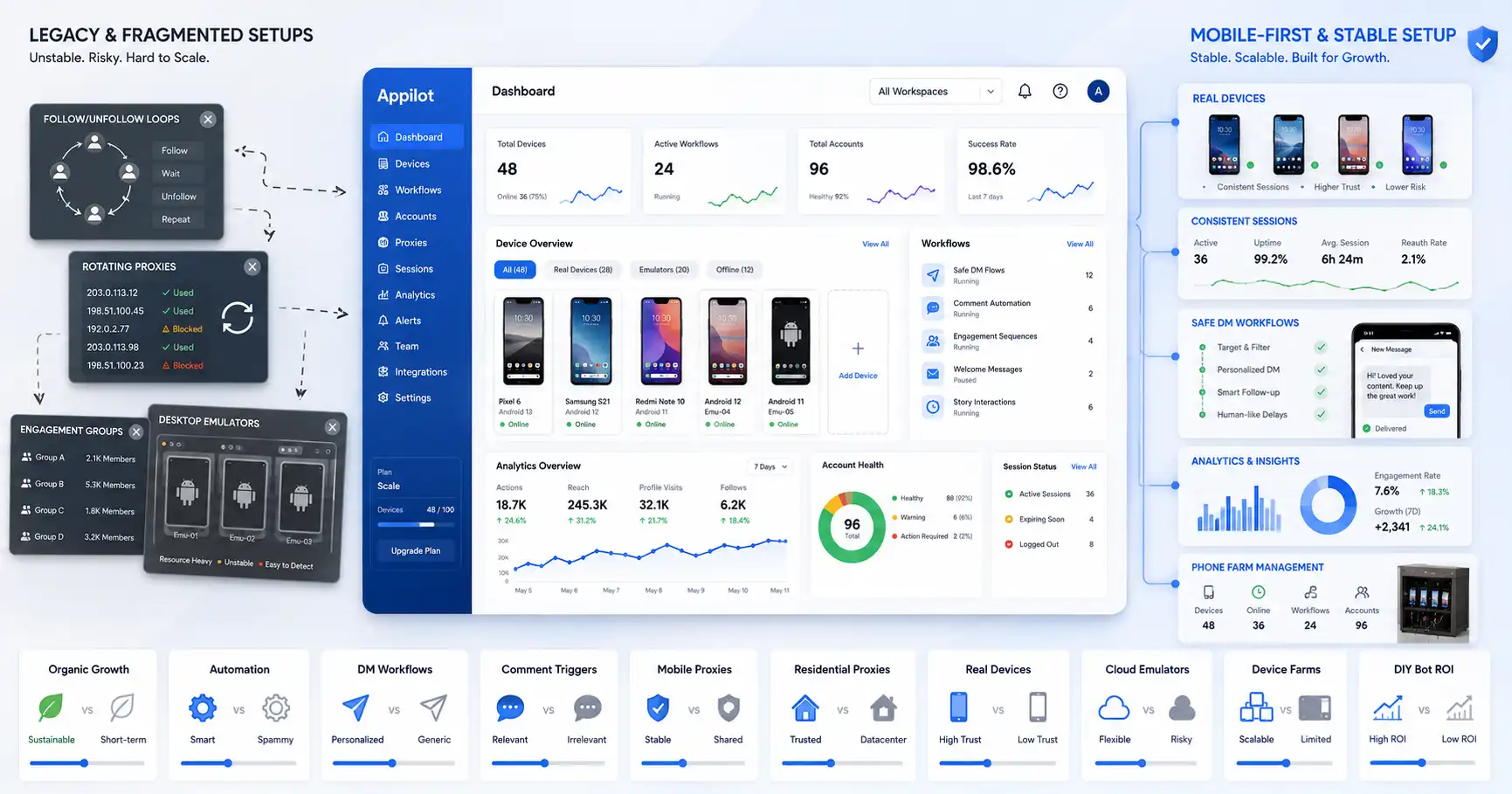
Appilot fits this shift because it is designed around real Android devices, emulators, and mobile workflows controlled from a web dashboard. For users comparing Mother-Slave Method vs follow/unfollow, Appilot can help manage the mobile execution layer more cleanly.
The goal is not to spam more actions. The goal is to create a more controlled system for managing Instagram workflows, accounts, devices, and repetitive mobile tasks. Whether a team uses supporting accounts, content workflows, DM processes, or engagement monitoring, real-device automation gives more control than manually handling every phone.
Appilot’s Role in Safer Instagram Growth Workflows
Appilot is useful for teams that need real-device Instagram automation, multi-account management, and mobile workflow control. Instead of relying only on old desktop bot tactics, teams can use Appilot to manage Android devices, emulators, and app-based actions from one dashboard.
For a Mother-Slave style setup, Appilot can help operators manage multiple accounts more consistently. It can support workflows across devices and make it easier to monitor activity. This is especially useful for agencies and phone farm operators who need structure instead of manually switching between accounts all day.
For users moving away from follow/unfollow, Appilot can support more controlled mobile workflows. Rather than pushing repetitive follow loops, teams can focus on account management, content interaction, DM handling, profile checks, and other tasks that support real growth operations.
The strongest use case is not aggressive automation. The strongest use case is workflow control. Appilot helps teams create a more organized mobile-first automation environment, which is better suited for modern Instagram growth than old follow/unfollow scripts.
Which Strategy Is Safer?
Follow/unfollow is usually riskier for the main account because all activity happens directly from the account you want to grow. If the behavior looks aggressive, the main account carries the full risk.
The Mother-Slave Method can reduce direct pressure on the main account, but it is not automatically safe. If the supporting accounts are low quality, over-automated, or obviously coordinated, the system can still create risk. It is safer only when the supporting accounts behave like real niche accounts and provide real value.
The safest strategy is neither pure follow/unfollow nor low-quality Mother-Slave automation. The safest strategy is a content-led, mobile-first workflow where automation supports consistency, monitoring, account operations, and real engagement instead of forcing artificial growth.
Which Strategy Builds Better Followers?
Follow/unfollow often brings weaker followers because many people follow back out of habit, curiosity, or social pressure. These users may not be interested in the content, product, or brand. Over time, that can hurt engagement quality.
The Mother-Slave Method can bring better followers if the supporting accounts are niche-relevant. When users discover the mother account through content that already matches their interests, they are more likely to follow for the right reason.
For example, a user who finds a skincare brand through a useful skincare tips page is more valuable than a random person who followed back after being followed. The first user has intent. The second user may not.
That is why the Mother-Slave Method has stronger potential when it is built around audience relevance and content quality.
Final Verdict
The Mother-Slave Method works better than follow/unfollow when it is used strategically, carefully, and with real content behind the supporting accounts. It gives teams more flexibility, better audience targeting, and less direct pressure on the main account.
Follow/unfollow is simpler, but it is also more obvious, more outdated, and more likely to create low-quality growth. It may still produce short-term movement, but it is not a strong foundation for serious Instagram growth in 2025 and beyond.
The best approach is to avoid treating either method as a shortcut. Instagram growth works better when teams focus on content quality, audience relevance, real conversations, mobile-first workflows, and consistent account management.
For teams that need to manage advanced Instagram workflows across multiple accounts and devices, Appilot provides a stronger foundation than old desktop bots or manual follow/unfollow routines. It supports real-device automation, Android and emulator workflows, and mobile app operations from a central dashboard.
FAQs
Q1: What is the Mother-Slave Method on Instagram?
The Mother-Slave Method is a growth strategy where several supporting accounts drive attention toward one main account. These secondary accounts may engage with target users, publish niche content, or direct traffic to the main profile.
Q2: Is follow/unfollow still effective for Instagram growth?
Follow/unfollow can still create short-term profile visits, but it is much weaker than before. It often brings low-quality followers, looks spammy, and can create risk for the main account.
Q3: Which is safer: Mother-Slave Method or follow/unfollow?
The Mother-Slave Method can be safer if supporting accounts are high quality, niche-relevant, and managed carefully. Follow/unfollow is usually riskier because it puts repetitive activity directly on the main account.
Q4: Can Appilot help with Mother-Slave Instagram workflows?
Yes, Appilot can help teams manage real-device Instagram workflows across Android devices and emulators. It is useful for multi-account operations, mobile workflow control, and organized account management.
Q5: What is the best Instagram growth strategy in 2025?
The best strategy is content-led growth supported by real engagement, consistent posting, relevant audience targeting, strong DMs, and controlled mobile workflows. Automation should support the process, not replace real value.