Understanding Mouse Movement Patterns: Human vs Bot
As bot detection systems become more behavior-driven, one of the most powerful signals they analyze is mouse movement. Unlike static properties that can be modified, mouse behavior reflects real-time human interaction and is difficult to replicate accurately. Subtle differences in movement patterns, speed, and variability allow systems to distinguish between real users and automated scripts.
Understanding mouse movement patterns is important because it highlights how modern detection focuses on behavior rather than identity. This guide explains how these patterns are analyzed and what separates human input from bot activity.
What Are Mouse Movement Patterns?
Mouse movement patterns refer to the way a cursor moves across a screen over time, including its speed, direction, acceleration, and pauses, where these movements form a behavioral signature that reflects how a user interacts with a webpage. Human movement is influenced by natural hand motion, decision-making, and visual feedback, while automated movement is generated programmatically, often resulting in different characteristics. These patterns can be captured and analyzed using JavaScript.
The Core Difference Between Human and Bot Movement
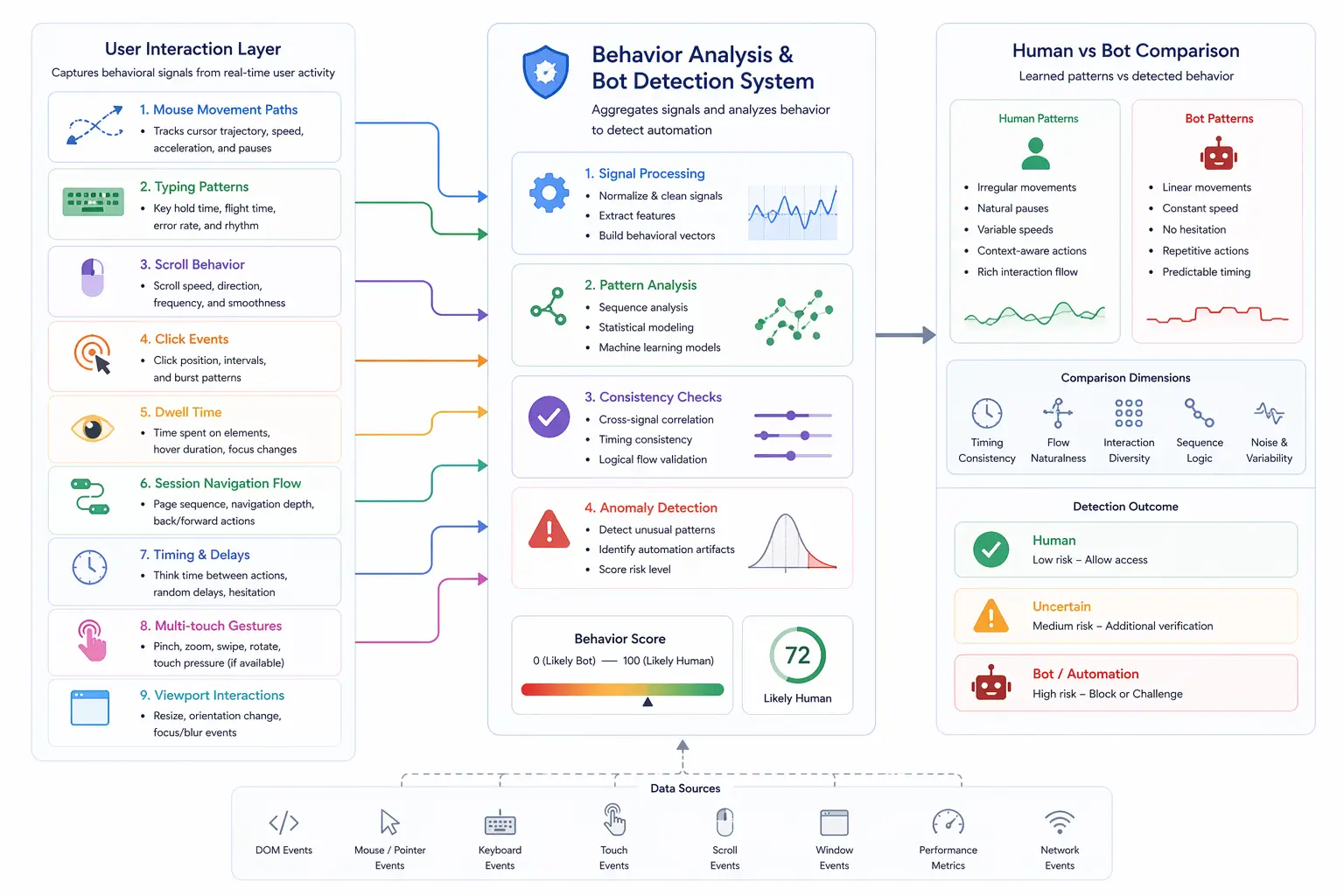
The core difference between human and bot movement lies in variability and imperfection, where human users exhibit irregular, non-linear motion with small adjustments and pauses, while bots often produce smooth, direct, or overly consistent paths. Humans rarely move in straight lines and frequently adjust their trajectory based on visual cues, whereas automated scripts tend to follow predefined paths. Detection systems rely on these differences to identify automation.
How Mouse Movement Is Tracked
Mouse movement is tracked using JavaScript event listeners that record cursor position over time, where each movement event captures coordinates and timestamps that can be analyzed to understand motion patterns. By collecting sequences of these events, systems can reconstruct the full movement path and evaluate characteristics such as speed changes, direction shifts, and pauses.
Key Characteristics of Human Mouse Movement
Human mouse movement has several distinctive characteristics, where it includes curved paths rather than straight lines, variable speed with acceleration and deceleration, and small corrections as the cursor approaches a target. Movements often include pauses or hesitations as users decide what to do next, and the overall pattern is irregular and context-dependent. These traits reflect natural motor control and decision-making processes.
Common Bot Movement Patterns
Bot-generated movement often differs significantly from human behavior, where it may follow straight or perfectly smooth paths, maintain constant speed, and lack the small adjustments seen in human input. Timing between movements may be uniform, and interactions can occur too quickly or too precisely. Even when randomness is introduced, the patterns may still lack the complexity of real human motion.
Why Mouse Movement Analysis Is Effective
Mouse movement analysis is effective because it captures real-time behavior that is difficult to fake accurately, where even advanced automation struggles to reproduce the natural variability of human input. Detection systems can analyze multiple aspects of movement simultaneously, making it harder for bots to pass all checks. This makes mouse behavior a strong signal in bot detection.
Mouse Movement vs Other Behavioral Signals
Mouse movement is often analyzed alongside other behavioral signals such as typing patterns, scrolling behavior, and interaction timing, where each signal provides additional context about user activity. While mouse movement focuses on cursor behavior, other signals capture different aspects of interaction. Combining these signals creates a more complete behavioral profile.
Limitations of Mouse Movement Detection
Despite its effectiveness, mouse movement detection has limitations because some users may exhibit unusual patterns due to accessibility tools, touch devices, or different input methods, where these variations can lead to false positives. Additionally, advanced automation tools may attempt to simulate human-like movement, reducing the effectiveness of simple detection techniques. Detection systems must account for these factors.
Mouse Movement Simulation vs Real Behavior
A key distinction in modern detection is the difference between simulated movement and natural input, where simulated movement attempts to recreate human patterns through algorithms, but often lacks the subtle complexity of real interaction. Real behavior is influenced by physical input devices, user intent, and environmental factors, creating patterns that are difficult to replicate exactly. This difference is a key focus of detection systems.
Mouse Movement vs Real-Device Environments
Another important distinction is between simulated environments and real-device environments, where simulated setups generate cursor movement through code, while real-device environments rely on actual hardware input or realistic input generation that aligns with system behavior. Tools like Appilot follow this approach by running automation on real Android devices, where interaction patterns, timing, and system responses reflect real-world usage. This reduces inconsistencies that detection systems rely on.
When Mouse Movement Analysis Is Most Critical
Mouse movement analysis is most critical in scenarios where user interaction is closely monitored, such as login systems, form submissions, and high-security platforms, where detecting automation is essential. In these contexts, detailed analysis of cursor behavior provides valuable insight into user authenticity.
Frequently Asked Questions
Q: What are mouse movement patterns?
They are cursor movements tracked over time to analyze behavior.
Q: How do they detect bots?
By identifying unnatural or consistent movement patterns.
Q: Can bots simulate mouse movement?
Yes, but it is difficult to match real human variability.
Q: Are mouse patterns used alone?
No, they are combined with other behavioral signals.
Q: Can real users be misclassified?
Yes, in some edge cases.
Q: How do real-device solutions compare?
Real-device solutions like Appilot produce natural interaction patterns, reducing detection risk.
Key Takeaways
Mouse movement patterns provide a powerful behavioral signal for distinguishing between human users and bots, where human movement is irregular, variable, and context-driven, while bot movement tends to be more consistent and predictable. By analyzing these patterns, detection systems can identify automation with high accuracy. Understanding how mouse behavior works is essential for navigating modern bot detection systems.