Mouse Movement Tracking: How Websites Detect Bots

As bot detection systems become more advanced, one of the most effective signals they rely on is mouse movement tracking. Instead of only analyzing technical data like IP addresses or browser fingerprints, websites now study how users move their cursor across the screen.
This approach works because human mouse behavior is naturally inconsistent and influenced by perception, reaction, and intent. Automated systems, even when sophisticated, often struggle to replicate these subtle patterns accurately. This guide explains how mouse movement tracking works and how it helps detect bots.
What Is Mouse Movement Tracking?
Mouse movement tracking is the process of recording and analyzing how a user’s cursor moves on a webpage. It captures data such as position, speed, direction, and pauses.
This data is used to identify patterns that distinguish human users from automated systems.
Unlike static detection methods, mouse tracking focuses on dynamic behavior, making it harder to fake.
The Core Principle Behind Mouse Tracking Detection
The core principle behind mouse movement tracking is natural irregularity. Human cursor movement is rarely straight or perfectly smooth.
It includes small adjustments, hesitation, acceleration, and changes in direction. These patterns are influenced by visual feedback and decision-making.
Bots, on the other hand, often generate movements that are too precise, linear, or consistent.
Detection systems use these differences to identify automation.
How Mouse Movement Tracking Works
Mouse tracking systems collect and analyze cursor data in real time.
Movement Path Analysis
The path of the cursor is analyzed to determine whether it follows natural curves or artificial straight lines.
Human movement tends to include slight deviations and corrections, while bots may produce overly direct paths.
Speed and Acceleration
Cursor speed is another important signal. Humans vary their speed depending on context, slowing down near targets and speeding up across empty areas.
Bots may move at constant speeds or follow predictable acceleration patterns.
Micro-Movements and Jitter
Small, subtle movements known as micro-movements are common in human behavior.
These include slight hand tremors and adjustments that occur naturally. Bots often lack this level of detail.
Pauses and Hesitation
Humans frequently pause while deciding where to click or what to do next.
These pauses vary in duration and occur at irregular intervals. Bots may either not pause at all or pause in consistent patterns.
Click Alignment
The relationship between cursor movement and click events is also analyzed.
Humans typically adjust their cursor before clicking, while bots may click immediately upon reaching a target.
Why Mouse Movement Tracking Matters
Mouse movement tracking is important because it captures behavior that is difficult to replicate.
While technical signals like IP and fingerprints can be modified, cursor behavior reflects real-time human interaction.
This makes it a strong indicator of authenticity.
It is widely used in modern bot detection systems to improve accuracy.
Common Patterns That Indicate Bots
Detection systems look for patterns that differ from typical human behavior.
Perfectly straight movement paths can indicate automation.
Constant speed without variation is another signal.
Lack of micro-movements or jitter can raise suspicion.
Instant clicks without hesitation may also indicate a bot.
These patterns are evaluated together rather than individually.
Mouse Tracking vs Other Behavioral Signals
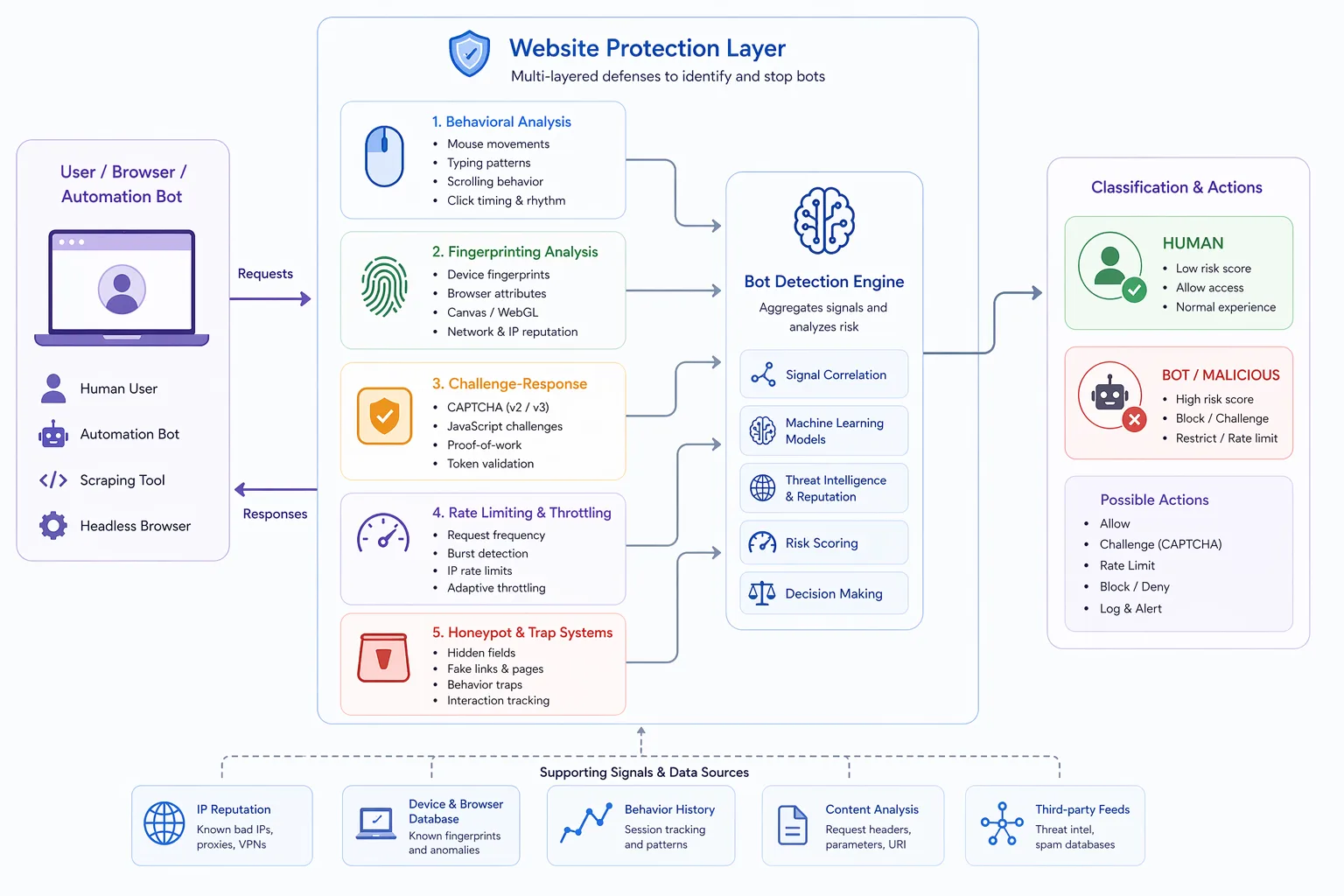
Mouse movement tracking is one part of a broader behavioral analysis system.
It is often combined with signals such as typing patterns, scrolling behavior, and navigation flow.
While each signal provides insight, combining them increases detection accuracy.
Mouse tracking is particularly useful because it reflects real-time interaction.
Limitations of Mouse Movement Tracking
Despite its effectiveness, mouse tracking has limitations.
False positives can occur, especially when users move quickly or use touchpads or accessibility tools.
There is also the challenge of advanced automation that attempts to simulate human-like movement.
These limitations require detection systems to use multiple signals.
Mouse Tracking vs Scripted Automation
Scripted automation often produces deterministic movement patterns.
Even when randomness is introduced, it may not fully replicate human variability.
Detection systems can identify these differences by analyzing multiple aspects of movement.
This makes simple simulation insufficient.
Mouse Tracking vs Real-Device Environments
A key distinction in modern detection is the difference between simulated behavior and natural behavior.
Mouse tracking can detect inconsistencies in simulated environments, even if technical signals appear correct.
Real-device approaches operate on actual hardware where cursor behavior naturally reflects human interaction. Tools like Appilot follow this approach by running automation on real Android devices, where interaction patterns align with real-world usage.
This reduces the need to artificially simulate movement.
When Mouse Movement Tracking Is Most Effective
Mouse tracking is most effective in scenarios where users interact directly with the interface.
This includes login pages, forms, and interactive applications.
In these contexts, cursor behavior provides strong indicators of authenticity.
Understanding this helps in designing systems that align with detection expectations.
Frequently Asked Questions
Q: What is mouse movement tracking?
It is the analysis of cursor behavior to detect bots.
Q: Why is mouse tracking effective?
Because human cursor movement is irregular and hard to replicate.
Q: What signals are analyzed?
Path, speed, pauses, jitter, and click alignment.
Q: Can bots mimic mouse movement?
They can try, but it is difficult to match human variability.
Q: Is mouse tracking used alone?
No, it is combined with other detection methods.
Q: How do real-device solutions compare?
Real-device solutions like Appilot naturally produce realistic interaction patterns, reducing reliance on simulation.
Key Takeaways
Mouse movement tracking is a powerful behavioral detection method that analyzes cursor paths, speed, pauses, and micro-movements to distinguish humans from bots. It works because human behavior is naturally irregular and difficult to replicate accurately. While it has limitations, it remains a key component of modern bot detection systems and is often combined with other behavioral signals for better accuracy.