Understanding Multi-Touch Gestures for Mobile Automation
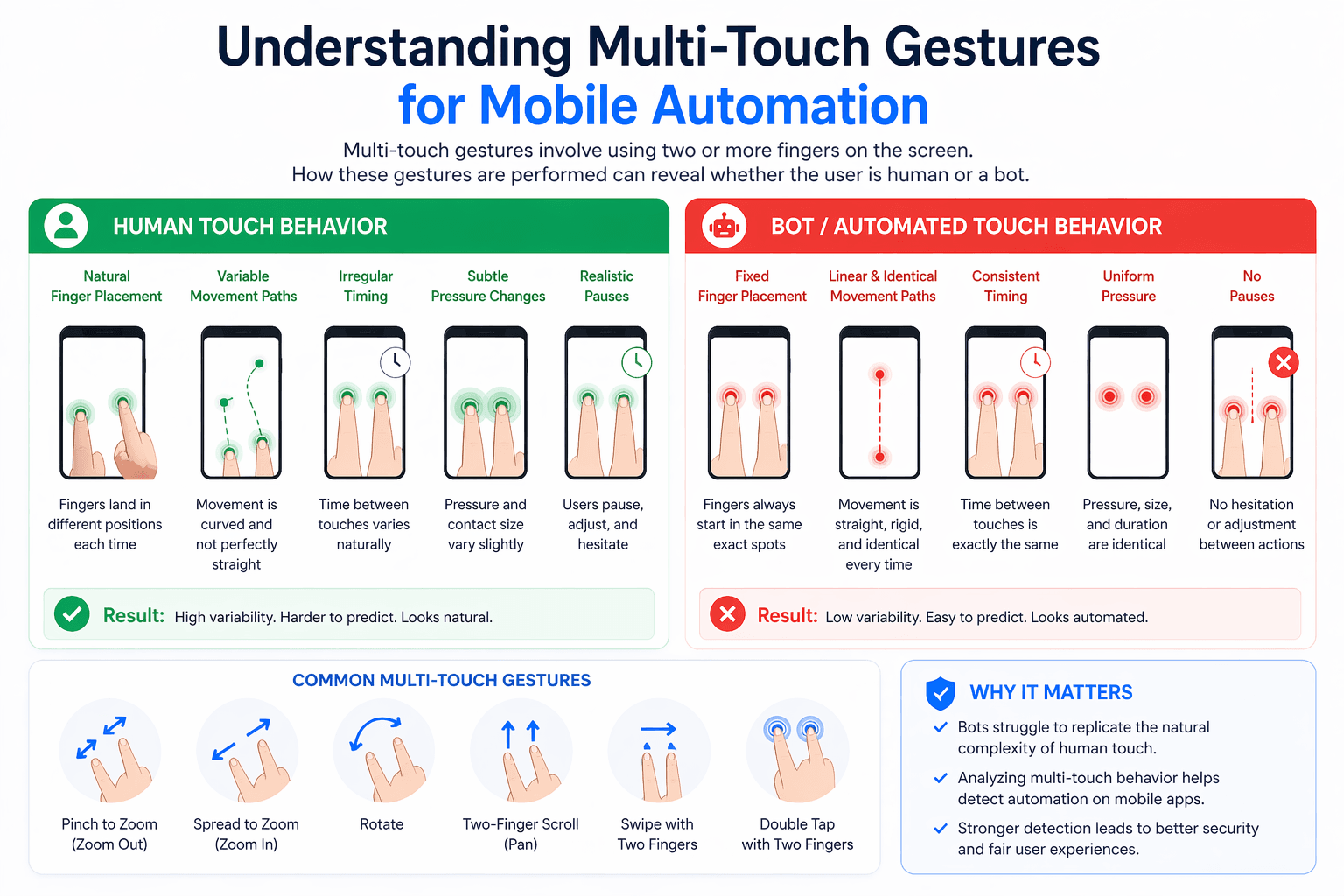
As mobile usage dominates modern web traffic, bot detection systems have expanded beyond desktop interactions to analyze mobile-specific behaviors. One of the most important of these behaviors is multi-touch interaction, which includes gestures like pinch, zoom, swipe, and multi-finger taps. These gestures reflect how users naturally interact with touchscreens and are difficult to replicate accurately in automated environments.
Understanding multi-touch gestures is important because they introduce a new layer of behavioral complexity that detection systems can analyze. This guide explains how these gestures work and how they are used in automation and detection.
What Are Multi-Touch Gestures?
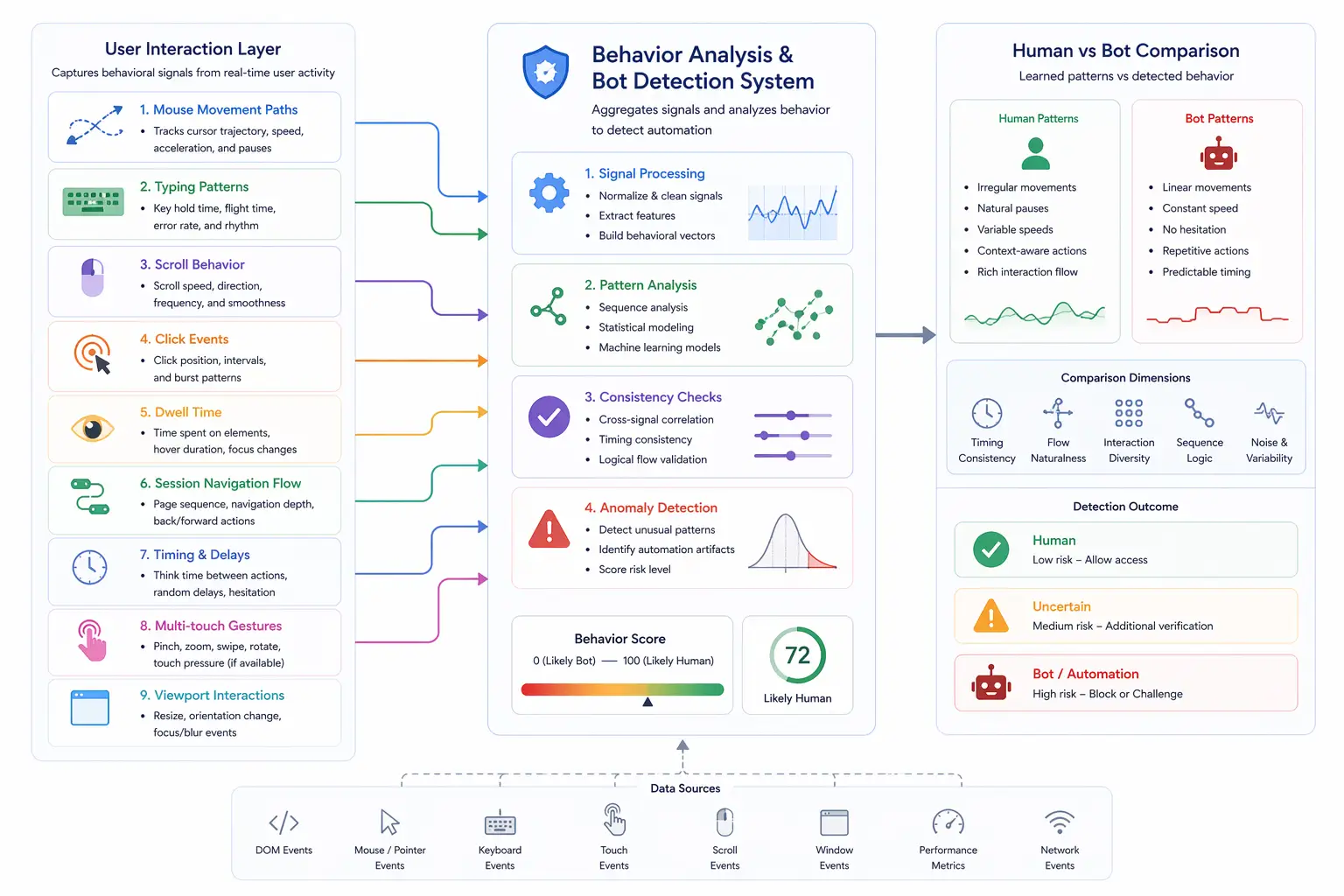
Multi-touch gestures refer to interactions on a touchscreen that involve more than one point of contact at the same time, where users can perform actions such as zooming with two fingers, rotating elements, or executing complex swipes. These gestures rely on simultaneous input, timing coordination, and spatial relationships between touch points, making them more complex than single-touch interactions.
The Core Idea Behind Multi-Touch Behavior
The core idea behind multi-touch behavior is coordination and natural input, where real users perform gestures with slight variations in timing, pressure, and movement across multiple fingers. These interactions are influenced by physical hand motion and user intent, resulting in patterns that are irregular and context-driven. Detection systems use these characteristics to distinguish between human input and automated gestures.
How Multi-Touch Gestures Are Tracked
Multi-touch gestures are tracked using JavaScript touch events that capture data such as touch points, movement paths, and timestamps, where events like touchstart, touchmove, and touchend record how multiple points interact with the screen over time. By analyzing these events, systems can reconstruct the gesture and evaluate its characteristics.
Key Characteristics of Human Multi-Touch Gestures
Human multi-touch gestures include natural variability in finger placement, movement speed, and coordination, where gestures are rarely perfectly synchronized and often include slight delays between touch points. Movements are curved and adaptive, reflecting real-time feedback from the interface. These interactions are influenced by the user’s intent and the context of the action, creating complex and dynamic patterns.
Common Bot Gesture Patterns
Bot-generated gestures often lack the complexity of human interaction, where touch points may move in perfectly synchronized ways, follow linear paths, or maintain constant speed. Timing between touch events may be uniform, and gestures may be executed too precisely or too quickly. Even when randomness is introduced, the patterns may still appear artificial compared to real human input.
Why Multi-Touch Analysis Is Effective
Multi-touch analysis is effective because it captures a high level of interaction complexity that is difficult to simulate accurately, where detection systems can analyze spatial relationships, timing differences, and movement patterns across multiple touch points. This makes it harder for automated systems to replicate all aspects of human gestures, providing a strong signal for detection.
Multi-Touch vs Single-Touch Interaction
Single-touch interactions involve one point of contact and are easier to simulate, while multi-touch gestures require coordination between multiple inputs, making them more complex. Detection systems often prioritize multi-touch analysis because it provides richer behavioral data and exposes inconsistencies more easily.
Limitations of Multi-Touch Gesture Analysis
Despite its effectiveness, multi-touch analysis has limitations because not all users perform complex gestures, and some interactions may vary based on device type or user preference, where these variations can lead to false positives. Additionally, advanced automation tools may attempt to simulate multi-touch gestures more accurately, reducing the effectiveness of simple detection techniques.
Multi-Touch Simulation vs Real Behavior
A key distinction in modern detection is the difference between simulated gestures and natural interaction, where simulated gestures attempt to replicate human patterns through programmed input, but often lack the subtle coordination and variability of real gestures. Real behavior is influenced by physical input and user intent, creating patterns that are difficult to reproduce exactly. Detection systems focus on these differences.
Multi-Touch vs Real-Device Environments
Another important distinction is between simulated environments and real-device environments, where simulated setups generate touch input through code, while real-device environments rely on actual hardware input or realistic system-level interaction. Tools like Appilot follow this approach by running automation on real Android devices, where gesture patterns, timing, and system responses reflect real-world usage. This reduces inconsistencies that detection systems rely on.
When Multi-Touch Analysis Is Most Critical
Multi-touch analysis is most critical in mobile-first applications, high-security platforms, and environments where touch interaction is a primary mode of input, where detection systems rely on detailed analysis of gestures to identify automation. In these contexts, realistic multi-touch behavior is essential for avoiding detection.
Frequently Asked Questions
Q: What are multi-touch gestures?
They are interactions involving multiple touch points on a screen.
Q: Why are they important for detection?
Because they are complex and difficult to simulate accurately.
Q: Can bots simulate multi-touch gestures?
Yes, but it is challenging to match real human behavior.
Q: Are multi-touch gestures always used?
No, but they are important in mobile environments.
Q: Do detection systems rely only on gestures?
No, gestures are combined with other behavioral signals.
Q: How do real-device solutions compare?
Real-device solutions like Appilot produce natural gesture patterns, reducing detection risk.
Key Takeaways
Multi-touch gestures provide a complex and valuable behavioral signal for detecting bots in mobile environments, where human gestures are variable, coordinated, and context-driven, while bot gestures tend to be more consistent and precise. By analyzing these patterns, detection systems can identify automation with high accuracy. Understanding multi-touch behavior is essential for navigating modern mobile bot detection systems.