Understanding Performance API Fingerprinting

As tracking techniques become more advanced, websites are increasingly using subtle signals to identify users. One of these signals comes from the Performance API, which provides detailed timing information about how a browser executes tasks. While originally designed for measuring performance, this API can also be used for fingerprinting.
Understanding Performance API fingerprinting is important because it focuses on how a system behaves rather than what it reports. This makes it harder to spoof and more reliable for detection systems.
What Is Performance API Fingerprinting?
Performance API fingerprinting is a method of identifying users based on timing and execution data collected through the browser’s Performance API, where instead of relying on static properties, it analyzes how quickly and consistently a browser performs certain operations. These timing measurements reflect underlying hardware, system load, and browser behavior, creating a unique performance profile. Because these characteristics are difficult to replicate exactly, they can be used to distinguish between environments.
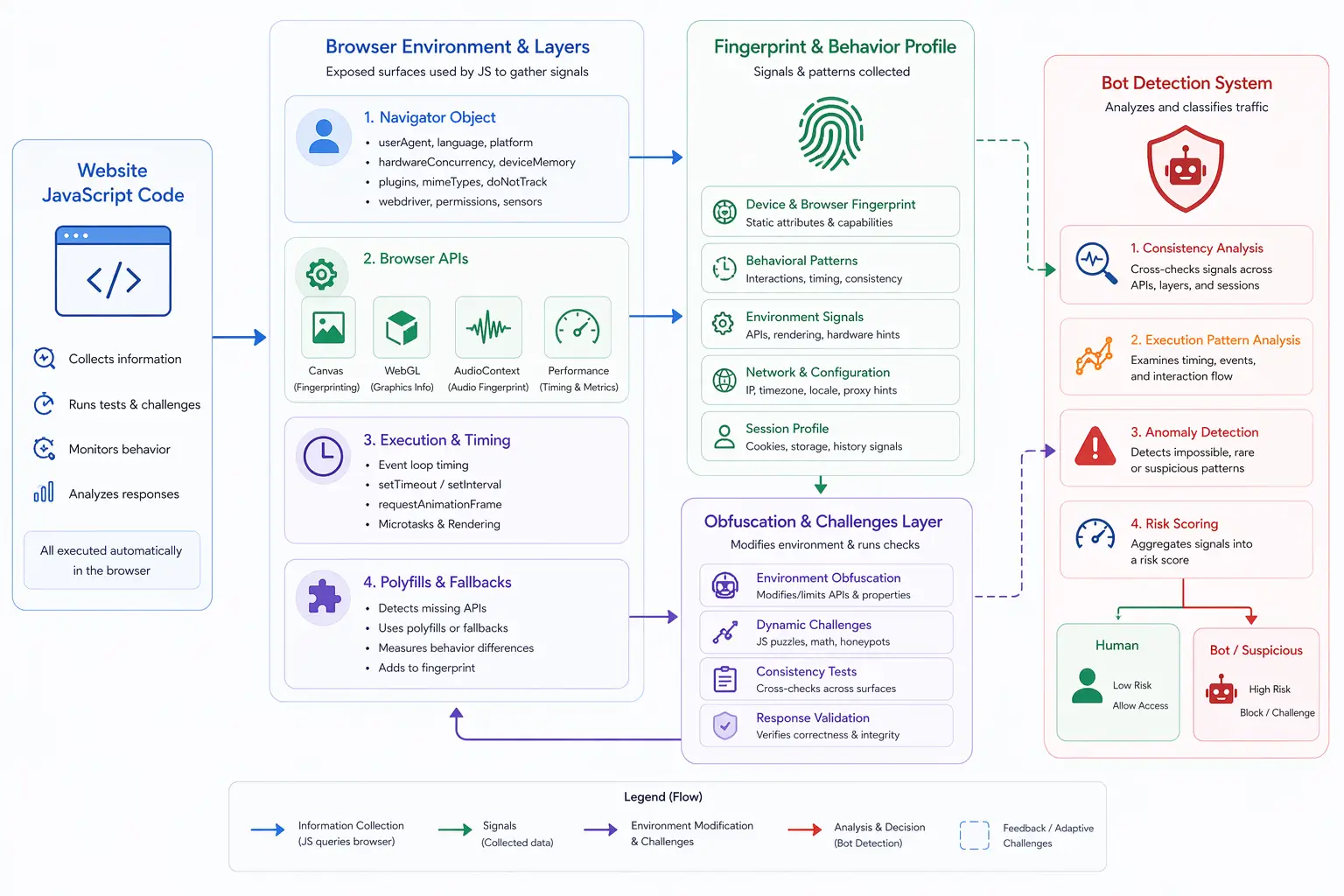
The Core Idea Behind Performance-Based Fingerprinting
The core idea behind performance-based fingerprinting is that every device has unique execution characteristics, where factors such as CPU speed, memory, and system configuration influence how tasks are processed. Even small differences in timing can create identifiable patterns when measured precisely. Detection systems use these patterns to build fingerprints that are based on behavior rather than declared properties, making them more resilient to manipulation.
How the Performance API Works
The Performance API provides access to high-resolution timing data that allows developers to measure how long specific operations take, where it includes functions for tracking page load times, resource loading, and custom execution events. By capturing these metrics, websites can analyze patterns in execution speed, consistency, and variability. This data can then be used to infer characteristics about the device and environment.
How Performance API Fingerprinting Works
Performance API fingerprinting works by running specific tasks in the browser and measuring how long they take to execute, where these tasks can include rendering operations, JavaScript execution loops, or resource loading sequences. The results are collected and compared against known patterns or previous sessions, allowing the system to identify similarities or anomalies. Because timing behavior is influenced by hardware and system conditions, it provides a deeper level of insight than static properties.
Why Performance Fingerprinting Matters
Performance fingerprinting matters because it captures real behavior rather than reported values, where this makes it difficult for automated environments to fully replicate. Even if surface-level properties are modified, underlying performance characteristics often remain unchanged, creating detectable differences. This makes performance data a valuable signal in both fingerprinting and bot detection systems.
Common Signals Used in Performance Fingerprinting
Performance fingerprinting relies on various timing-related signals, where execution time for JavaScript operations provides insight into CPU performance, resource loading times reflect network and system efficiency, and frame rendering timing reveals graphics processing behavior. Variability in these measurements, such as jitter or consistency, also contributes to the fingerprint. These signals are combined to create a performance profile that can be compared across sessions.
Performance API Fingerprinting vs Traditional Fingerprinting
Traditional fingerprinting focuses on static attributes such as browser version, screen resolution, and installed fonts, while Performance API fingerprinting focuses on dynamic behavior. Static attributes can be modified or spoofed more easily, but performance characteristics are harder to control because they depend on real hardware and system conditions. This makes performance-based fingerprinting a stronger and more reliable method in many cases.
Performance Fingerprinting and Bot Detection
Bot detection systems use performance fingerprinting to identify automation by analyzing execution patterns, where automated environments may produce timing results that are too consistent, too fast, or otherwise unrealistic compared to real devices. These anomalies can indicate the presence of headless browsers or modified environments. By combining performance data with other signals, detection systems can improve accuracy.
Limitations of Performance API Fingerprinting
Despite its effectiveness, Performance API fingerprinting has limitations because timing data can be affected by external factors such as system load, background processes, and network conditions. This variability can introduce noise into the fingerprint, making it less stable over time. Additionally, some browsers limit the precision of timing measurements to reduce tracking accuracy, which can affect data quality.
Performance Fingerprinting vs Other Fingerprinting Methods
Performance API fingerprinting is often used alongside other techniques such as JavaScript fingerprinting and network analysis, where each method provides a different perspective on the environment. While JavaScript fingerprinting focuses on properties and API outputs, performance fingerprinting focuses on execution behavior, and network analysis examines routing and connectivity. Combining these approaches creates a more comprehensive detection system.
Performance Fingerprinting vs Real-Device Environments
A key distinction in modern detection is the difference between simulated environments and real-device environments, where performance fingerprinting can reveal inconsistencies in setups that attempt to mimic real hardware. Simulated environments may not accurately reproduce timing behavior, leading to detectable differences. Real-device approaches operate on actual hardware where execution timing, resource handling, and system performance naturally align, and tools like Appilot follow this approach by running automation on real Android devices, ensuring that performance signals reflect real-world conditions. This reduces mismatches that detection systems rely on.
When Performance Fingerprinting Is Most Critical
Performance fingerprinting is most critical in scenarios where distinguishing between real users and automated systems is essential, such as fraud detection, account security, and high-value transactions, where accurate identification can prevent abuse. In these contexts, performance data provides a reliable indicator of authenticity.
Frequently Asked Questions
Q: What is Performance API fingerprinting?
It is identifying users based on browser timing and execution data.
Q: What data does it use?
Execution time, load time, and performance metrics.
Q: Why is it hard to spoof?
Because it depends on real hardware and system behavior.
Q: Is it used for bot detection?
Yes, to identify unrealistic execution patterns.
Q: Does it replace other fingerprinting methods?
No, it is used alongside them.
Q: How do real-device solutions compare?
Real-device solutions like Appilot produce consistent performance signals, reducing detection risk.
Key Takeaways
Performance API fingerprinting uses timing and execution data to identify users based on how their browser behaves rather than what it reports. By analyzing execution speed, consistency, and variability, it creates a unique performance profile that is difficult to spoof. While effective, it has limitations due to variability and browser restrictions, and it is often combined with other fingerprinting methods. Understanding this technique is essential for navigating modern tracking and detection systems.