Understanding Proxy Blacklists and How to Avoid Them

When using proxies in browser automation, one of the most common challenges is getting blocked. Even high-quality proxies can end up on blacklists, leading to failed requests, captchas, or restricted access. Understanding why this happens is essential for maintaining reliable automation.
Proxy blacklists are used by websites to identify and block suspicious IP addresses. If your proxy gets flagged, it can affect all sessions using that IP. This guide explains how proxy blacklists work, why IPs get blocked, and how to avoid these issues.
What Are Proxy Blacklists?
Proxy blacklists are databases or systems that track IP addresses associated with suspicious or unwanted activity. Websites use these lists to filter incoming traffic and block requests from flagged IPs.
When an IP is blacklisted, it may face restrictions such as captchas, rate limits, or complete denial of access.
Blacklists can be maintained internally by websites or shared across multiple platforms through third-party services.
The Core Principle Behind Blacklists
The core principle behind proxy blacklists is risk identification. Websites monitor traffic patterns and flag IPs that exhibit behavior associated with bots or abuse.
Once flagged, the IP is added to a blacklist and treated as untrusted. This allows websites to protect their systems from automated or malicious activity.
However, blacklisting is not always perfect and can sometimes affect legitimate users.
How IPs Get Blacklisted
IP addresses can be blacklisted for several reasons.
High Request Volume
Sending too many requests from a single IP in a short period of time is one of the most common triggers. This behavior differs from normal user activity and can raise suspicion.
Repetitive Patterns
Automation often creates predictable patterns, such as identical actions performed at consistent intervals. Detection systems can identify these patterns and flag the IP.
Low-Quality Proxy Sources
Using proxies from known datacenter ranges or previously flagged networks increases the likelihood of blacklisting.
These IPs may already have a poor reputation before being used.
Suspicious Behavior Signals
Other signals, such as inconsistent geolocation, mismatched fingerprints, or abnormal interaction patterns, can contribute to blacklisting.
Websites often combine multiple signals to make decisions.
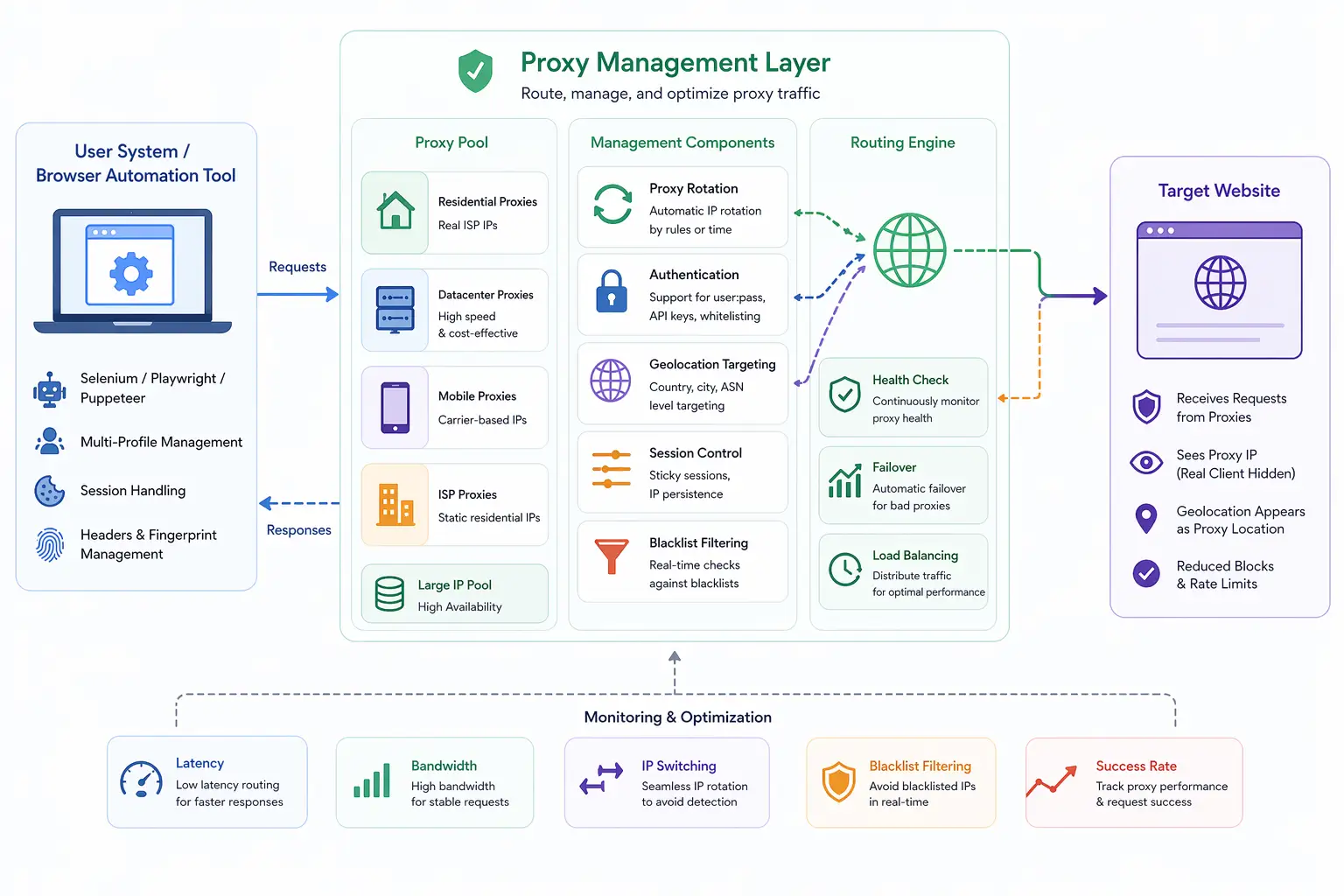
Types of Proxy Blacklists
There are different types of blacklists depending on how they are maintained.
Some websites maintain internal blacklists based on their own detection systems. Others rely on shared databases that aggregate information across multiple platforms.
There are also real-time systems that evaluate IP reputation dynamically rather than relying on static lists.
Understanding these types helps explain why some IPs get blocked quickly while others remain usable longer.
Why Blacklists Matter in Automation
Blacklists directly impact the success of automation workflows.
If an IP is blacklisted, all requests routed through it may fail or require additional verification. This can disrupt operations and reduce efficiency.
In large-scale setups, blacklisting can lead to significant losses in performance and reliability.
Managing IP reputation is therefore a critical part of automation.
Common Mistakes That Lead to Blacklisting
One common mistake is overusing a single proxy. Concentrating too much activity on one IP increases the likelihood of detection.
Another mistake is ignoring behavior patterns. Even with high-quality proxies, unrealistic interaction patterns can trigger blacklisting.
There is also the issue of poor proxy selection. Using low-quality or already flagged IPs increases risk from the start.
These mistakes can be avoided with proper planning and monitoring.
How to Avoid Proxy Blacklists
Avoiding blacklists requires a combination of strategies.
Distributing traffic across multiple proxies helps reduce load on individual IPs. This can be achieved through proxy pools and controlled rotation.
Maintaining realistic behavior patterns is also important. Interactions should mimic normal user activity rather than automated sequences.
Using high-quality proxies with good reputation reduces the likelihood of being flagged.
Consistency across signals, including geolocation and browser configuration, helps maintain credibility.
Regular monitoring of proxy performance and status allows quick replacement of flagged IPs.
Proxy Blacklists and Fingerprinting
Blacklisting is not based solely on IP addresses.
Detection systems often combine IP reputation with fingerprinting signals. Even if a proxy is not blacklisted, inconsistent or suspicious fingerprints can lead to blocking.
This means that avoiding blacklists requires alignment across all layers of the environment.
Limitations of Avoidance Strategies
While it is possible to reduce the risk of blacklisting, it cannot be eliminated completely.
Detection systems are constantly evolving, and new methods can identify previously undetected patterns.
There is also the challenge of scale. As the number of requests increases, maintaining low detection risk becomes more difficult.
These limitations highlight the need for continuous optimization.
Proxy Blacklists vs Real-Device Environments
A key distinction in modern automation is the difference between managing IP reputation and using realistic environments.
Proxies can help manage network identity, but they do not change how the browser or device behaves. This can still lead to detection even if the IP is not blacklisted.
Real-device approaches operate on actual hardware with natural behavior patterns. Tools like Appilot follow this approach by running automation on real Android devices, where network, browser, and device signals align naturally, reducing reliance on avoiding blacklists alone.
This creates a more robust setup.
When Blacklist Management Is Critical
Blacklist management is critical in scenarios involving high-volume automation, sensitive workflows, and strict detection systems.
In these environments, maintaining IP reputation and avoiding flags is essential for success.
Understanding how blacklists work helps in designing more reliable systems.
Frequently Asked Questions
Q: What is a proxy blacklist?
It is a system that tracks and blocks IP addresses associated with suspicious activity.
Q: Why do proxies get blacklisted?
Due to high request volume, repetitive patterns, and poor IP reputation.
Q: Can blacklisted IPs be reused?
Sometimes, but it depends on how long they remain flagged.
Q: Do residential proxies get blacklisted?
Yes, any proxy type can be blacklisted if misused.
Q: How can you avoid blacklisting?
By distributing traffic, using quality proxies, and maintaining realistic behavior.
Q: How do real-device solutions compare?
Real-device solutions like Appilot reduce reliance on IP reputation by aligning network, browser, and device signals naturally.
Key Takeaways
Proxy blacklists are systems used by websites to identify and block IP addresses associated with suspicious activity. IPs can be flagged due to high request volumes, repetitive patterns, low-quality sources, or inconsistent signals. Avoiding blacklists requires distributing traffic, maintaining realistic behavior, and using high-quality proxies. While these strategies reduce risk, they must be combined with consistent browser and device-level signals to be effective.