Proxy Rotation vs Mobile Proxies: Which Is Safer for Instagram Bots?
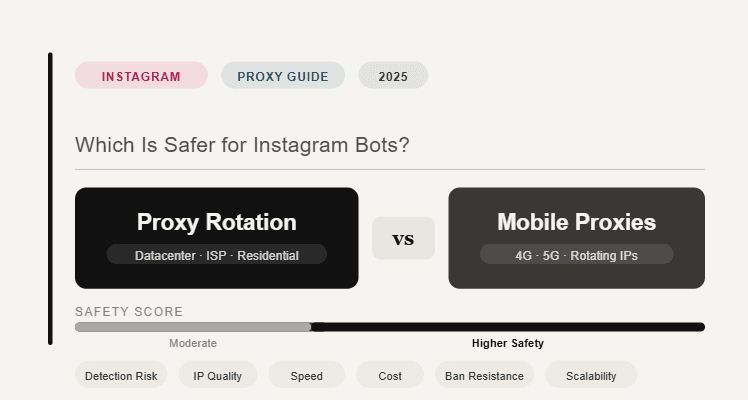
Instagram automation depends on more than scripts, delays, and action limits. The network environment behind each account matters a lot. If an Instagram account logs in from unstable IPs, jumps between regions, changes network identity too often, or operates from infrastructure that does not match normal user behavior, the workflow can become fragile very quickly.
This is why proxy strategy is such a common topic among Instagram bot users, agencies, phone farm operators, and multi-account teams. Two terms appear again and again: proxy rotation and mobile proxies.
At first, both sound similar because both involve changing network routes. But they are not the same. Proxy rotation is a method of changing IP addresses. Mobile proxies are a type of network infrastructure that routes traffic through mobile carrier networks. One is a rotation strategy. The other is an infrastructure category.
The safer choice depends on how the workflow is designed. But in general, stable mobile proxies are usually safer than aggressive proxy rotation for Instagram bots because they better match mobile-first behavior and can support more consistent account environments. However, mobile proxies are not magic. If they are rotated too aggressively, shared poorly, or used with spammy automation, they can still create account risk.
What Is Proxy Rotation?
Proxy rotation means switching the IP address used by an account or automation workflow. This can happen every request, every few minutes, every session, every login, or after a certain action count. Some systems rotate automatically from a large pool of datacenter, residential, or mobile IPs.
The idea behind proxy rotation is simple. Instead of sending all activity through one IP address, the system spreads activity across many IPs. This can reduce repeated traffic from a single address and help manage larger workflows.
But for Instagram bots, aggressive rotation can create a serious problem: inconsistency.
Normal Instagram users do not usually log in from a new city, country, or network every few minutes. They do not typically switch between unrelated IP ranges during one session. They do not appear from one location while the device, language, timezone, and account history suggest another.
When proxy rotation is too frequent or poorly controlled, it can make the account environment look unstable. That instability can create friction even if the bot’s actions are not extremely aggressive.
What Are Mobile Proxies?
Mobile proxies route traffic through mobile carrier networks. Instead of using traditional datacenter IPs, the account appears to operate through mobile network infrastructure. This can be useful for Instagram workflows because Instagram is heavily mobile-first and many real users access the platform through phones and mobile networks.
Mobile networks naturally involve some IP changes. Real users can move between towers, reconnect to networks, switch from Wi-Fi to mobile data, or receive new carrier-assigned IPs. Because of this, mobile proxies can sometimes feel more aligned with normal mobile usage than datacenter proxies.
However, the quality of the mobile proxy setup matters. A stable mobile proxy with consistent location and controlled session behavior is very different from a low-quality shared proxy that rotates unpredictably. The word “mobile” alone does not make a setup safe.
For Instagram bots, mobile proxies are safer when they support account consistency, realistic network behavior, and stable session history.
The Main Difference Between Proxy Rotation and Mobile Proxies
The main difference is that proxy rotation is about change, while mobile proxies are about network type.
Proxy rotation asks, “How often should the IP change?” Mobile proxies ask, “What kind of network should the account use?”
A datacenter proxy can rotate. A residential proxy can rotate. A mobile proxy can rotate. But not all rotation is safe, and not all mobile proxies are stable.
For Instagram automation, too much change is often the problem. Accounts usually need consistency more than constant new IPs. A safer setup gives each account a predictable network environment instead of making every session look disconnected from the last one.
This is why mobile proxies usually work best when they are not treated as a random rotating pool. They work better when each account has a consistent mobile proxy, stable region, controlled rotation window, and workflow limits that look more natural.
Which Is Safer for Instagram Bots?
Stable mobile proxies are generally safer than aggressive proxy rotation because they create fewer environmental contradictions. Instagram is a mobile-first platform, so mobile network behavior can align better with real app usage than constantly rotating generic IPs.
Aggressive proxy rotation can be risky because it makes an account look inconsistent. If the same account appears from multiple regions in a short time, uses different IP types across sessions, or changes networks too often, the account history becomes harder to trust.
That said, mobile proxies are not automatically safe. A mobile proxy setup can still be unsafe if the same IP is shared by many accounts, if locations change randomly, if the automation is too aggressive, or if the device environment does not match the network behavior.
The safest setup is usually a stable mobile-first environment: one account, one consistent device or emulator profile, one consistent region, one controlled mobile proxy, realistic pacing, and clear workflow limits.
Why Aggressive Proxy Rotation Can Hurt Instagram Accounts
Aggressive proxy rotation creates instability. Instagram accounts build history over time. They develop login patterns, device patterns, location patterns, session behavior, and engagement behavior. When the proxy changes too often, that history becomes inconsistent.
For example, an account may log in from one IP in New York, then perform actions from another IP in London, then appear from a datacenter IP in Germany, then reconnect from a mobile IP somewhere else. Even if the actions themselves are simple, the surrounding environment looks unnatural.
This can lead to verification pressure, suspicious login checks, action blocks, session resets, or lower account trust. It can also make manual recovery more difficult because the account no longer has a clean and predictable access history.
For Instagram bots, rotation should not be treated as a default safety feature. Rotation can help in some infrastructure designs, but random rotation is often worse than controlled consistency.
Why Mobile Proxies Are Usually Better for Mobile-First Workflows
Mobile proxies are usually better for Instagram bots because Instagram is used heavily on mobile devices. Mobile carrier traffic can look more natural than traffic from traditional datacenter networks, especially when the automation workflow also runs through mobile apps, Android devices, or emulators.
This is where real-device automation becomes important. A mobile proxy works best when the device layer also feels mobile. If the account uses a mobile proxy but the rest of the workflow behaves like a detached browser bot, the environment may still feel mismatched.
A strong mobile-first setup aligns the network, device, session, and workflow. The account operates through a mobile-like environment, uses consistent network routing, and performs actions with realistic timing.
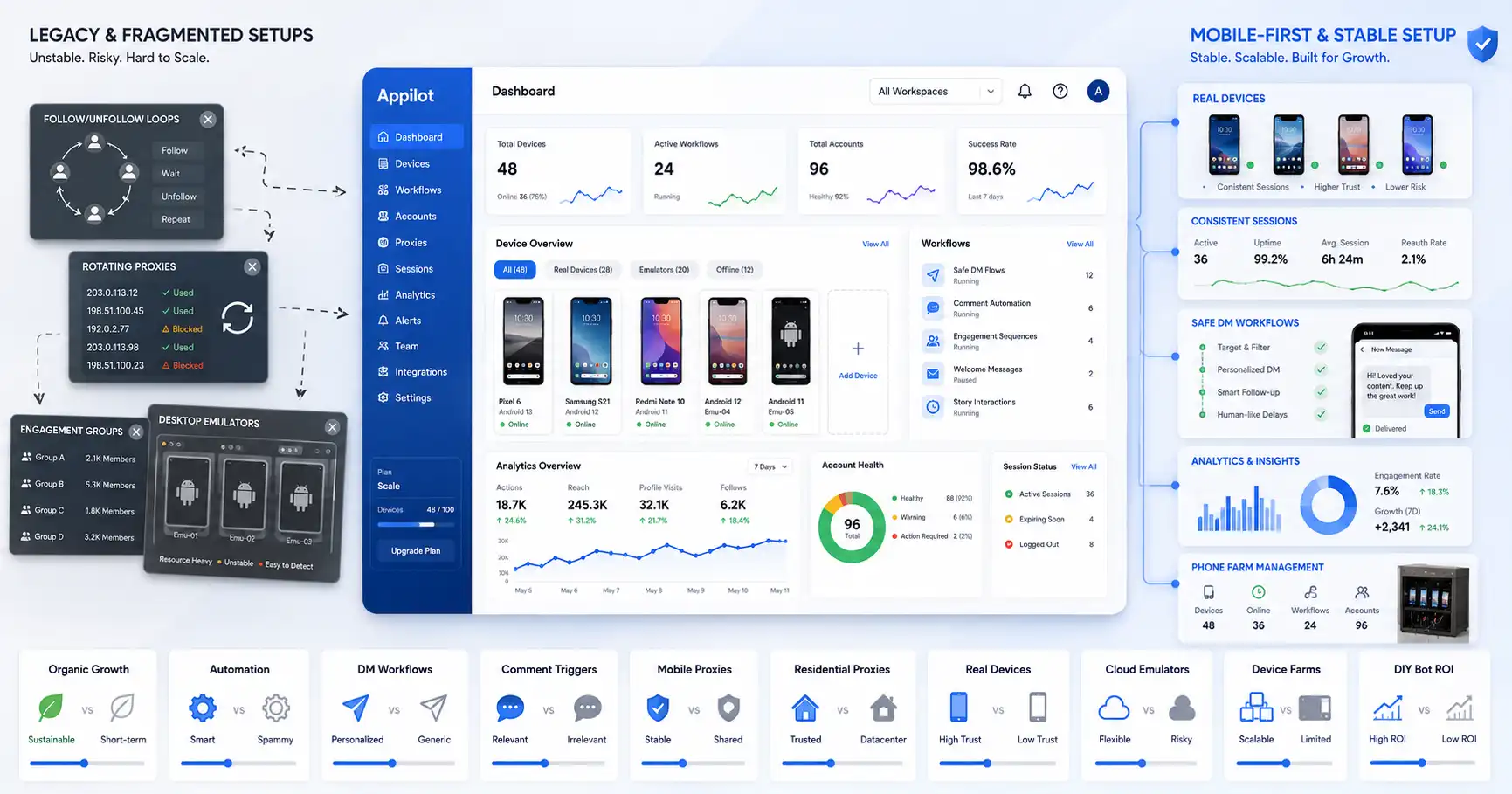
This is one reason Appilot’s real-device approach fits Instagram automation better than old desktop bot setups. Appilot focuses on Android devices, emulators, and mobile workflows, which can pair better with mobile proxy infrastructure than browser-only automation.
When Proxy Rotation Can Still Make Sense
Proxy rotation is not always bad. It can make sense when used carefully and for the right purpose. For example, rotation may be useful for non-account-based scraping, temporary research workflows, testing, or separating traffic across different tasks that do not require long-term session trust.
It can also make sense when rotation is controlled at the session level rather than the action level. A carefully managed setup may rotate only after a long session, after a cool-down period, or when an account is not actively logged in. This is very different from rotating every request or every few minutes.
For Instagram account automation, the safer rule is simple: avoid frequent random rotation on logged-in accounts. Logged-in accounts need continuity. If rotation breaks that continuity, it can create more risk than it solves.
When Mobile Proxies Can Still Be Risky
Mobile proxies can still be risky when they are used poorly. A low-quality mobile proxy shared across too many users may create reputation problems. A proxy that changes locations unpredictably can make the account history unstable. A setup that rotates too often can behave almost as badly as aggressive proxy rotation.
Mobile proxies also do not protect against bad automation behavior. If an account sends too many DMs, follows too many users, comments repetitively, or performs actions at unnatural speed, the account can still face restrictions. Instagram can restrict accounts for activity that appears to violate its terms around automated access and behavior.
In other words, mobile proxies improve the infrastructure layer, but they do not fix weak strategy. They should be part of a safer workflow, not a replacement for responsible limits, better content, and realistic account behavior.
The Safest Proxy Setup for Instagram Bots
The safest proxy setup is usually based on consistency. Each Instagram account should have a stable environment that does not change unnecessarily. That means consistent device profile, consistent region, consistent timezone, consistent proxy type, and consistent session behavior.
For most Instagram bot workflows, one account should not bounce between many IPs. It is usually better to assign one reliable mobile proxy or one stable mobile network profile to each account and keep it consistent. If rotation is needed, it should happen in a controlled way and not during active account sessions.
Agencies and phone farm operators should also avoid mixing too many accounts through the same network identity. Account separation matters. If many accounts share the same unstable proxy pool, one problem can affect the whole operation.
A safer workflow also requires conservative activity. Good infrastructure cannot save an account from spammy behavior. The account still needs realistic pacing, useful content, real engagement, and careful limits.
Proxy Rotation vs Mobile Proxies for Phone Farms
Phone farms usually benefit more from mobile proxies than aggressive proxy rotation. A phone farm is already built around mobile environments, so mobile network infrastructure fits more naturally than constantly changing generic proxies.
For a phone farm, the goal should be stable account-device-network mapping. Each account should be tied to a predictable device or emulator environment and a consistent network path. This makes the workflow easier to manage and reduces environmental contradictions.
Appilot fits this model because it helps teams manage Android devices, emulators, and mobile workflows from a web dashboard. When paired with stable mobile proxy infrastructure, teams can create a more coherent environment for Instagram operations.
Proxy rotation may still be useful for some separate research or testing tasks, but it should not be the default approach for logged-in Instagram account workflows.
Proxy Rotation vs Mobile Proxies for Agencies
Agencies managing multiple Instagram accounts need reliability more than random IP volume. Client accounts should not be treated like disposable test accounts. If an agency is responsible for account growth, DMs, posting, engagement, or account management, stability matters.
For agencies, mobile proxies are usually the better foundation because they support more realistic mobile environments. But the agency must still manage accounts carefully. Each client account should have its own controlled setup, consistent location logic, and safe workflow limits.
Aggressive rotation can create too many unpredictable issues. If a client account suddenly faces verification or login problems, it becomes harder to explain and harder to fix.
A professional agency should think in terms of account health, not only automation volume. The safer stack is real-device automation, stable mobile proxies, consistent sessions, and transparent workflow monitoring.
How Appilot Helps With Safer Instagram Bot Workflows
Appilot helps by focusing on the mobile execution layer. Instagram automation is not only about what proxy is used. It is also about where the action happens. If the workflow runs through real Android devices or emulators, it can better match the mobile-first nature of Instagram.
Appilot allows teams to manage mobile workflows through a web dashboard instead of manually operating every phone or relying only on desktop bots. This is useful for agencies, phone farm operators, growth teams, and multi-account managers.
When combined with stable mobile proxy infrastructure, Appilot can help create a more consistent setup. The account can operate through a controlled mobile environment, with better visibility into workflows and less dependency on random proxy rotation.
The main benefit is not bypassing Instagram. The benefit is building a cleaner operational system where accounts, devices, sessions, and networks align more naturally.
Which One Should You Choose?
Choose mobile proxies if your goal is long-term Instagram account management, mobile-first automation, phone farm workflows, real-device automation, or multi-account growth. Mobile proxies are usually better for maintaining a realistic network environment when paired with consistent devices and conservative workflows.
Choose proxy rotation only when the workflow does not depend on long-term account trust or when rotation is controlled carefully. Random rotation is usually not ideal for logged-in Instagram accounts.
For most Instagram bot users, the best setup is not “rotate as much as possible.” It is “stay consistent as much as possible.” Instagram accounts usually need stable environments, not constant identity changes.
Final Verdict
Mobile proxies are generally safer than aggressive proxy rotation for Instagram bots, especially when the workflow runs through real mobile environments like Android devices or emulators. They align better with mobile-first usage and can support more realistic account sessions.
Proxy rotation can still be useful in limited cases, but frequent random rotation can create suspicious account behavior. It often breaks session continuity, creates location inconsistencies, and makes accounts look less stable.
The safest approach is to combine stable mobile proxies with real-device automation, conservative activity limits, consistent account environments, and meaningful Instagram workflows. Appilot fits this approach by helping teams manage mobile app automation across Android devices and emulators from one dashboard.
For serious Instagram automation, safety is not about changing IPs constantly. It is about building an environment that behaves consistently over time.
FAQs
Q1: Are mobile proxies safer than proxy rotation for Instagram bots?
Yes, stable mobile proxies are usually safer than aggressive proxy rotation because they better support mobile-first behavior and consistent account sessions.
Q2: Is proxy rotation bad for Instagram automation?
Proxy rotation can be risky when it is too frequent or random. Logged-in Instagram accounts usually need stable network history instead of constant IP changes.
Q3: Can mobile proxies prevent Instagram restrictions?
No, mobile proxies cannot guarantee safety. Accounts can still be restricted if automation is aggressive, repetitive, spammy, or inconsistent with Instagram’s terms.
Q4: What is the safest proxy setup for Instagram accounts?
The safest setup is usually one account mapped to one consistent device or emulator profile, one stable region, one reliable mobile proxy, and realistic activity limits.
Q5: How does Appilot help with Instagram bot safety?
Appilot helps teams manage real-device and emulator-based Instagram workflows, making it easier to align accounts, devices, sessions, and mobile infrastructure in one controlled setup.