What Is Proxy Speed? Latency and Bandwidth Explained
When using proxies in browser automation, performance is just as important as anonymity. Slow proxies can lead to failed requests, delayed interactions, and unstable sessions. To understand performance, you need to look at two key factors: latency and bandwidth.
Understanding proxy speed is important because it directly affects how efficiently your automation runs. Whether you are managing multiple sessions or interacting with websites in real time, speed plays a critical role. This guide explains what proxy speed means and how latency and bandwidth impact performance.
What Is Proxy Speed?
Proxy speed refers to how quickly data can travel between your system and the target website through a proxy server. It is influenced by multiple factors, including network distance, server performance, and connection quality.
Proxy speed is not a single metric. It is a combination of latency, which measures delay, and bandwidth, which measures data transfer capacity.
Both factors work together to determine overall performance.
The Core Components of Proxy Speed
Proxy speed depends on two primary components: latency and bandwidth.
Latency determines how long it takes for a request to travel from your system to the server and back. Bandwidth determines how much data can be transferred within a given time.
A fast proxy requires both low latency and sufficient bandwidth.
What Is Latency?
Latency is the time delay between sending a request and receiving a response. It is usually measured in milliseconds.
Lower latency means faster communication, while higher latency results in delays.
Latency is affected by physical distance between the client and the server, network routing, and server processing time.
Why Latency Matters
Latency is critical in browser automation because many actions depend on real-time responses.
High latency can slow down page loads, delay interactions, and reduce overall efficiency. In time-sensitive workflows, even small delays can accumulate and impact performance.
Reducing latency improves responsiveness and reliability.
What Is Bandwidth?
Bandwidth refers to the amount of data that can be transferred over a connection in a given time, typically measured in megabits per second.
Higher bandwidth allows more data to be transmitted simultaneously, which is important for loading large pages or handling multiple requests.
Bandwidth does not affect how quickly a request starts but determines how fast large amounts of data can be delivered.
Why Bandwidth Matters
Bandwidth is important for handling heavy data loads. Websites with images, scripts, and dynamic content require sufficient bandwidth to load efficiently.
In automation, low bandwidth can lead to slow page rendering and incomplete data retrieval.
Ensuring adequate bandwidth helps maintain smooth performance.
Latency vs Bandwidth: Key Differences
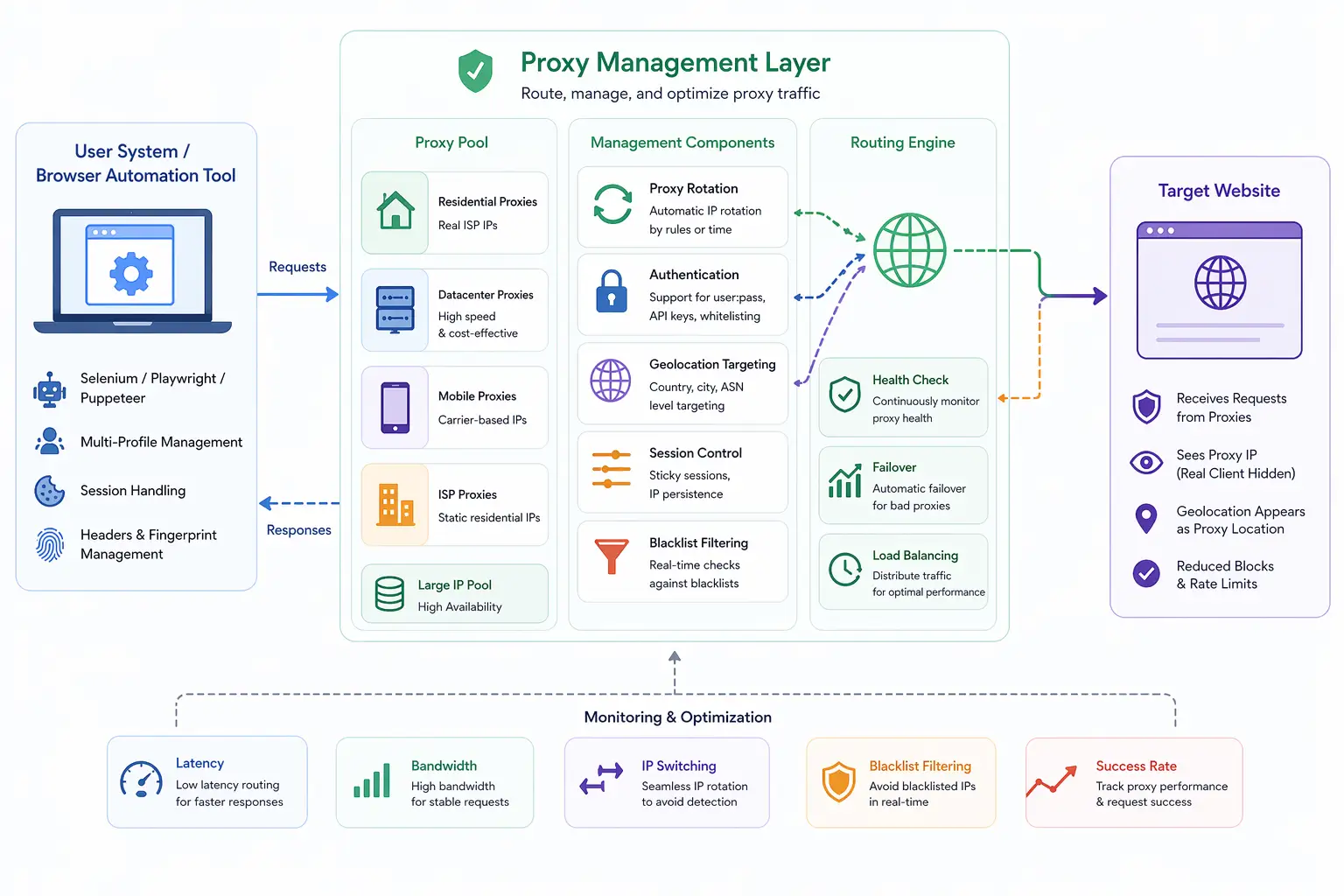
Latency and bandwidth are often confused, but they represent different aspects of performance.
Latency measures delay, while bandwidth measures capacity. A connection can have high bandwidth but still feel slow if latency is high.
For example, downloading a large file depends on bandwidth, while loading a webpage quickly depends more on latency.
Understanding this distinction helps optimize proxy performance.
Factors That Affect Proxy Speed
Several factors influence proxy speed.
Distance between your system and the proxy server plays a major role in latency. Closer servers generally provide faster response times.
The quality of the proxy provider’s infrastructure also affects performance. High-quality servers and optimized routing improve both latency and bandwidth.
Network congestion can reduce speed, especially in shared environments such as residential or mobile proxies.
These factors must be considered when selecting proxies.
Proxy Type and Speed
Different types of proxies offer different performance characteristics.
Datacenter proxies are typically the fastest because they run on high-performance servers with optimized connections. Residential proxies may be slower due to variability in real user networks. Mobile proxies can have higher latency due to cellular network behavior.
Choosing the right proxy type depends on the balance between speed and detection resistance.
Proxy Speed and Automation Performance
Proxy speed directly impacts automation efficiency.
Slow proxies can cause timeouts, failed requests, and inconsistent behavior. This can reduce the reliability of automation workflows.
Fast proxies improve responsiveness, allowing tasks to be completed more quickly and reliably.
Optimizing speed is essential for scaling automation systems.
Limitations of Proxy Speed Optimization
Improving proxy speed has limitations.
Even with fast proxies, performance can be affected by website response times and external network conditions.
Additionally, focusing only on speed can lead to trade-offs in detection resistance. For example, faster datacenter proxies may be easier to detect than slower residential ones.
Balancing speed with realism is important.
Proxy Speed vs Real-Device Environments
A key distinction in modern automation is the difference between proxy performance and overall environment performance.
Proxies only affect network speed. They do not change how the browser or device behaves, which can also impact performance.
Real-device approaches operate on actual hardware with integrated network connections. Tools like Appilot follow this approach by running automation on real Android devices, where network conditions and device performance naturally align.
This creates a more consistent environment compared to relying solely on proxy speed.
When Proxy Speed Matters Most
Proxy speed is most important in scenarios that require real-time interaction or high-volume data transfer.
It is critical for tasks such as dynamic browsing, large-scale data collection, and time-sensitive automation workflows.
Understanding when speed is a priority helps in selecting the right proxies.
Frequently Asked Questions
Q: What is proxy speed?
It is the performance of a proxy in terms of how quickly it can send and receive data.
Q: What is latency?
It is the time delay between sending a request and receiving a response.
Q: What is bandwidth?
It is the amount of data that can be transferred in a given time.
Q: Which is more important, latency or bandwidth?
Both are important, but latency often has a greater impact on responsiveness.
Q: Are faster proxies always better?
Not always, as faster proxies may be easier to detect.
Q: How do real-device solutions compare?
Real-device solutions like Appilot combine network and device performance naturally, providing consistent behavior beyond proxy speed alone.
Key Takeaways
Proxy speed is determined by latency and bandwidth, which together define how quickly and efficiently data is transmitted through a proxy. Latency affects response time, while bandwidth affects data transfer capacity. Both factors play a crucial role in browser automation performance, influencing reliability and efficiency. Choosing the right proxy involves balancing speed with other considerations such as detection resistance and consistency.