Random Delays and Human-Like Timing in Automation
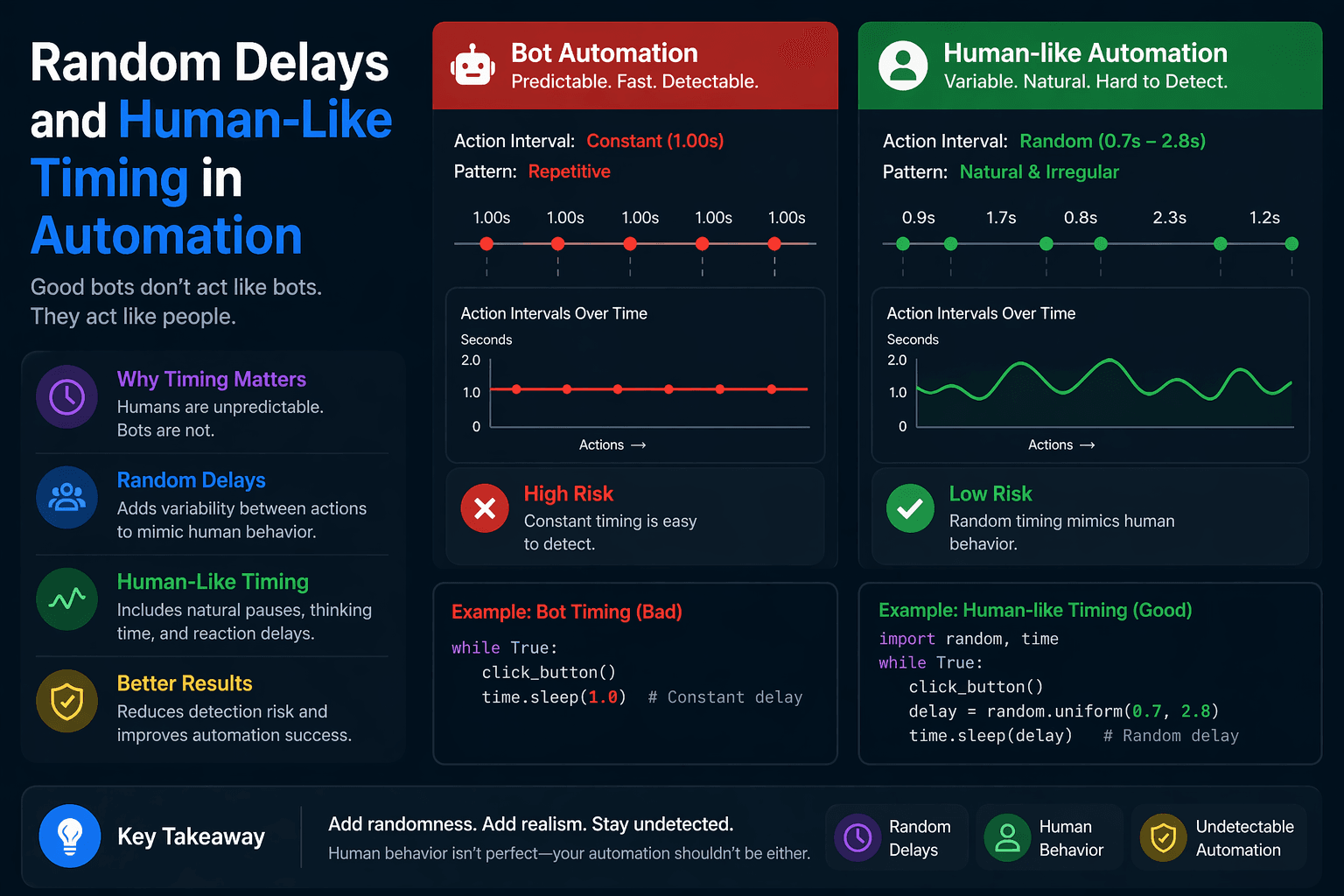
As bot detection systems increasingly focus on behavioral signals, timing has become one of the most critical indicators of authenticity. Human users do not interact with websites at perfectly consistent speeds; instead, their actions include natural pauses, hesitation, and variability. To mimic this, automation systems introduce random delays and timing patterns designed to resemble real user behavior.
Understanding random delays and human-like timing is important because it highlights how even the timing of actions can expose automation. This guide explains how timing works and how it is analyzed.
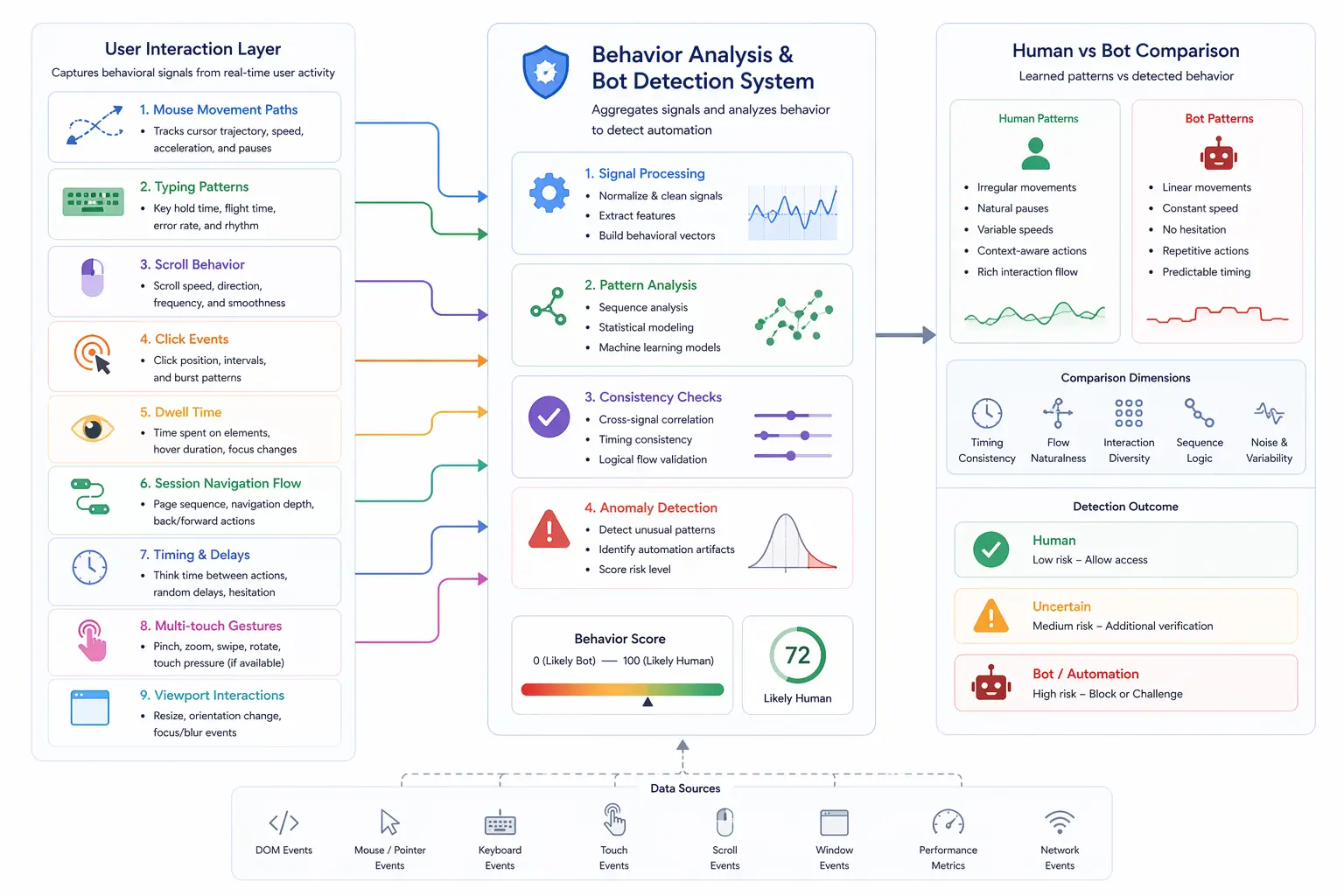
What Are Random Delays in Automation?
Random delays in automation refer to the intentional introduction of variable waiting times between actions, where instead of executing tasks instantly or at fixed intervals, the system pauses for different durations to simulate human interaction. These delays can occur between clicks, typing events, scrolling actions, and page transitions, and they are designed to create a more natural flow of activity.
The Core Idea Behind Human-Like Timing
The core idea behind human-like timing is variability and unpredictability, where real users do not follow precise or repeatable timing patterns. Human interaction is influenced by decision-making, reaction time, and attention, resulting in irregular intervals between actions. Detection systems rely on this variability to distinguish humans from bots, making consistent or overly structured timing a strong indicator of automation.
How Timing Is Measured
Timing is measured using JavaScript that records when actions occur and calculates the intervals between them, where events such as clicks, keystrokes, and scroll actions are tracked with timestamps. By analyzing these intervals, systems can determine whether the timing reflects natural human behavior or automated execution.
Common Timing Patterns in Humans
Human timing patterns include irregular delays, bursts of activity, and pauses that reflect thinking or reading, where users may act quickly in familiar situations and more slowly in complex ones. Reaction times vary depending on context, and actions are rarely evenly spaced. These patterns create a dynamic and context-dependent timing profile.
Common Timing Patterns in Bots
Bot timing patterns often differ significantly from human behavior, where actions may occur instantly or at fixed intervals, creating a predictable rhythm. Even when randomness is added, it may follow simple distributions that lack the complexity of real human timing. Bots may also execute sequences too quickly or without natural pauses, making them easier to detect.
Why Random Delays Are Used
Random delays are used to reduce the predictability of automated actions, where by introducing variability, automation attempts to mimic the irregular timing of human interaction. This helps avoid detection systems that look for consistent or unrealistic timing patterns. However, simple randomness is often not enough to fully replicate human behavior.
Limitations of Random Delay Techniques
Despite their usefulness, random delay techniques have limitations because they often lack context-awareness, where delays are added without considering the actual task or user intent. Real human timing is influenced by content, decision-making, and interaction complexity, which is difficult to simulate accurately. Detection systems can identify patterns that appear artificially random rather than naturally variable.
Timing Analysis in Bot Detection
Bot detection systems analyze timing patterns in detail, where they evaluate distributions of delays, consistency across sessions, and relationships between actions. They look for anomalies such as perfectly uniform intervals, unrealistic speed, or unnatural randomness. By combining timing analysis with other behavioral signals, detection systems can improve accuracy.
Random Delays vs Behavioral Simulation
Random delays are a basic form of behavioral simulation, where they introduce variability but do not fully replicate human interaction. More advanced simulation techniques consider context, interaction flow, and user intent, creating more realistic behavior. Random delays alone are often insufficient for avoiding detection.
Timing Patterns vs Real-Device Environments
A key distinction in modern detection is the difference between simulated timing and natural timing, where simulated timing relies on programmed delays, while natural timing emerges from real user interaction and system response. Real-device environments operate on actual hardware where timing, input response, and system behavior align naturally, and tools like Appilot follow this approach by running automation on real Android devices, ensuring that timing patterns reflect real-world usage. This reduces inconsistencies that detection systems rely on.
When Timing Analysis Is Most Critical
Timing analysis is most critical in scenarios where interaction behavior is closely monitored, such as login systems, form submissions, and high-security applications, where detection systems evaluate how quickly and consistently users act. In these contexts, realistic timing patterns are essential for avoiding detection.
Frequently Asked Questions
Q: What are random delays?
They are variable pauses added between automated actions.
Q: Why is timing important in bot detection?
Because it reveals real interaction patterns.
Q: Can randomness mimic human behavior?
Partially, but it often lacks realism.
Q: How do detection systems analyze timing?
By measuring intervals and identifying patterns.
Q: Are random delays enough to avoid detection?
No, more advanced simulation is needed.
Q: How do real-device solutions compare?
Real-device solutions like Appilot produce natural timing patterns, reducing detection risk.
Key Takeaways
Random delays and human-like timing are used in automation to mimic the natural variability of human interaction, but simple randomness is often not enough to fully replicate real behavior. Detection systems analyze timing patterns to identify inconsistencies that indicate automation, making timing a critical signal in bot detection. Understanding how timing works is essential for navigating modern detection systems.