How to Build a Real Estate Data Extraction System the Compliant Way
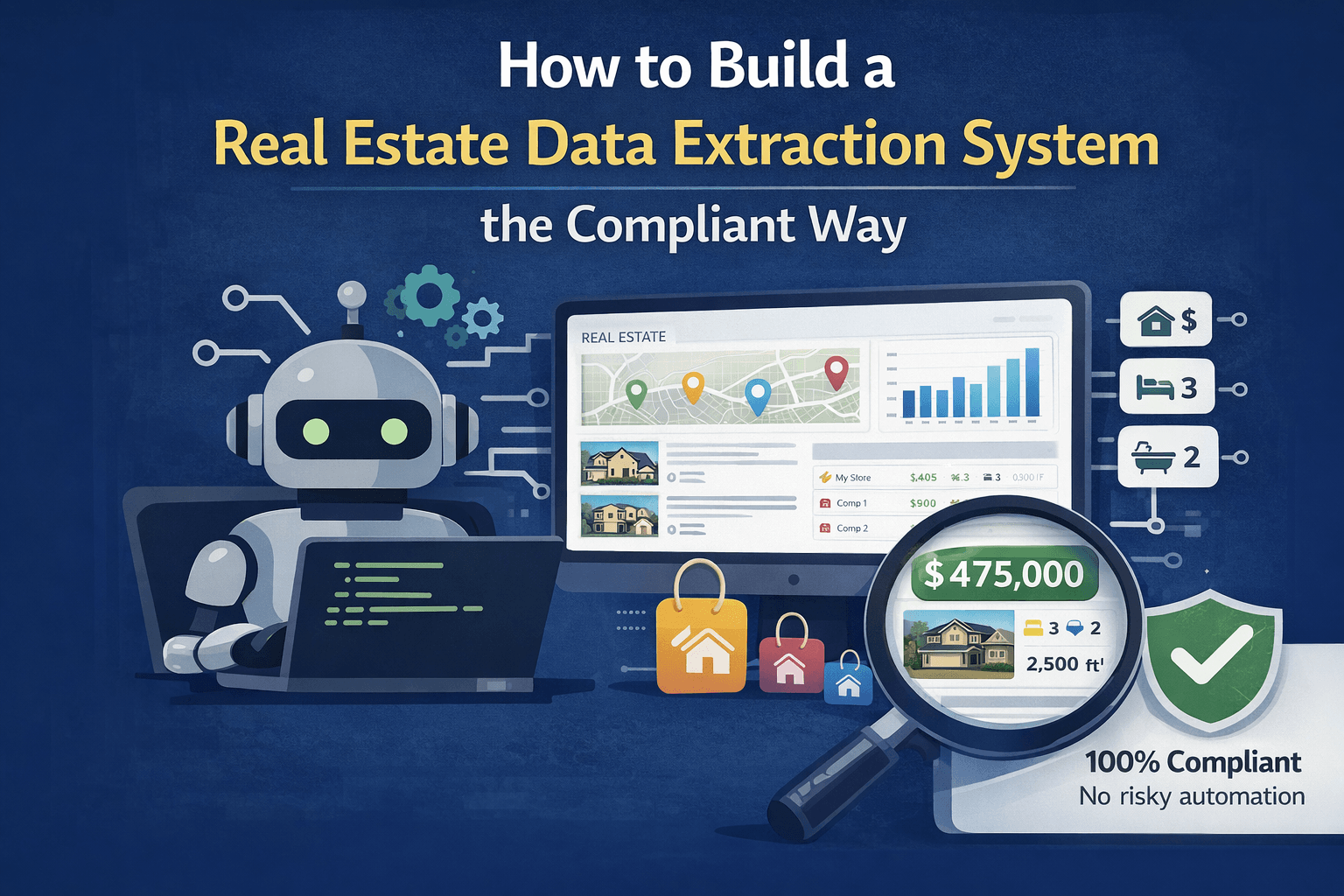
Real estate data moves fast. Listings update constantly, prices change daily, and property status can move from active to pending or sold within hours. That creates pressure for brokers, investors, PropTech teams, and analytics companies that need timely information to make decisions.
The first instinct is often to ask how to scrape large portals like Zillow or Realtor.com, but that is usually the wrong question. The better question is how to build a reliable, legal, and scalable real estate data system that can support the business long term without depending on unstable extraction methods.
This guide explains how compliant real estate data systems work, why major portal scraping is risky, what structured data sources are available, and how to build a feed-driven architecture that stays stable over time.
Why Real Estate Data Matters / The Opportunity
Real estate data matters because decisions around buying, selling, investing, lending, and forecasting all depend on timely property information. Delayed or incomplete data can cause teams to miss investment opportunities, misprice properties, or make poor market assumptions.
Real estate data extraction is becoming increasingly important because firms now operate across multiple cities, property types, and regions at the same time. Investors want faster alerts, brokerages want cleaner listing data, and PropTech companies need structured information that can support analytics, dashboards, and customer-facing products.
The opportunity is especially large when a business can move from scattered snapshots of listing data to a structured system that tracks changes over time. Historical context is often more valuable than any single listing view because it shows how the market is evolving rather than only what is happening right now.
1. Who This Use Case is For
This approach is useful for real estate brokerages, PropTech companies, investment firms, lead generation businesses, listing marketplaces, analytics teams, and data providers that need stable access to property information.
It is also valuable for smaller teams that only need a limited regional dataset because even one properly configured MLS feed is often more useful than a large amount of unstable scraped data.
Teams focused on forecasting, pricing models, investor alerts, rental analysis, or market trend reporting usually benefit the most because they need clean and consistent data over time rather than one-time snapshots.
2. What You'll Achieve
By implementing a compliant real estate data architecture, you will be able to collect structured listing data, monitor status changes, track price reductions, normalize property details, store historical trends, and trigger alerts when something important changes.
In practical terms, that means you can react to new listings faster, build more reliable dashboards, reduce data maintenance work, and create a stronger foundation for forecasting and market intelligence.
3. What You'll Need
Before building the system, you need to think of real estate data as an ingestion and normalization problem rather than a scraping problem. The goal is not to pull pages from portals as aggressively as possible. The goal is to build a structured pipeline that remains reliable over time.
Technical Requirements
The strongest systems start with MLS feeds, IDX access, RETS integrations, RESO Web APIs, county record databases, public property record providers, and licensed real estate data vendors. These sources provide cleaner and more stable data than portal scraping because they are designed for structured access.
Many firms also combine multiple data sources, including active listing feeds, sold data, ownership records, tax assessments, deeds, and transaction history. This allows them to build a fuller property profile instead of relying on one portal alone.
For browser-based internal workflows, some teams use automation tools such as Puppeteer, Playwright, or Selenium for internal QA testing, monitoring their own listings, checking ad placements, or performing competitive UX reviews. If a broader workflow also requires Android-side operational visibility, Appilot can support mobile-first review and real-device visibility because it works with Android devices and Accessibility Services. However, Appilot should not be treated as the primary data acquisition layer for portals that restrict automated access.
Skills and Knowledge
A technical team benefits from understanding APIs, ETL pipelines, data normalization, database design, queue systems, alerting logic, and historical trend analysis. Teams also need to understand licensing restrictions because some real estate data sources have specific rules about redistribution and storage.
Less technical teams can still build useful systems by starting with one licensed feed, one region, and a simple alert workflow rather than trying to cover the whole market immediately.
Time and Resource Investment
A smaller regional setup can often be built in a few days if the team already has access to a licensed feed. Larger systems that cover multiple cities, historical datasets, and advanced alerting require more planning because they involve schema design, feed monitoring, data quality checks, and ingestion pipelines.
The biggest investment is usually not in software. It is in making sure the data stays clean, consistent, and legally usable over time.
Appilot Integration Method #1 - The Complete Solution Approach
Implementing Real Estate Data Systems with Structured Feeds
There are two ways to think about real estate data extraction. One path treats it like a scraping problem and focuses mostly on portal extraction. The other path treats it like a structured data pipeline problem and focuses on feed quality, normalization, historical storage, and alerting.
The weaker approach usually starts with portal scraping because it looks easier in the beginning. However, it often becomes unstable as soon as the business tries to scale. Pages change, blocking increases, data becomes inconsistent, and legal risk grows.
The stronger approach starts with licensed MLS feeds, public records, and structured APIs, then builds ingestion pipelines, normalization logic, change detection, and reporting around those sources. That is how professional firms create stable systems that can scale over time.
Appilot can become relevant only in a supporting operational context where a team also needs Android-side workflow visibility or mobile-first operational review. Because Appilot works with real Android devices and mobile-first workflows, it can support broader operational environments where relevant, but it should not replace structured real estate data feeds or be treated as the core extraction engine.
Step-by-Step Implementation Guide
A sustainable real estate data system becomes much easier to build when it is broken into operational layers instead of treated like one large scraping project.
Step 1: Build a Data Ingestion Layer
The first step is connecting structured data sources such as MLS feeds, licensed APIs, county records, public property records, or broker partnerships. This ingestion layer is the foundation of the system because it determines how reliable the dataset will be over time.
The best approach is to start with one region and one trusted feed before adding more sources. That allows the team to validate the data model and make sure the workflow is stable before expanding into additional markets.
A common mistake is trying to collect everything at once before the ingestion layer is proven. That usually creates more complexity than value.
Step 2: Normalize the Property Data
The next step is normalization. Different feeds often use different field names, status codes, property types, and address formats. A normalization layer standardizes this information so that listings can be compared consistently across multiple regions and providers.
The normalization layer should standardize values such as MLS ID, address format, property type, listing status, price history, and listing timestamps.
const property = {
  mlsId: "A10234",
  address: "123 Main Street",
  status: "Pending",
  listPrice: 450000
};
function normalizeProperty(data) {
  return {
    id: data.mlsId,
    fullAddress: data.address.toUpperCase(),
    propertyStatus: data.status.toLowerCase(),
    price: data.listPrice
  };
}
console.log(normalizeProperty(property));
This type of logic is simple, but it reflects the broader principle that a clean schema is more valuable than collecting more raw fields.
Step 3: Add Change Detection Logic
A real estate data system should not simply store listings. It should track meaningful changes over time.
This includes new listings, price reductions, status changes, days-on-market increases, inventory shifts, and sold events. These signals are often more valuable than the raw listing itself because they reveal how the market is moving.
Change detection is what transforms a feed into an intelligence system. Without it, the business is only storing data rather than generating useful insight.
Step 4: Connect Alerts and Dashboards
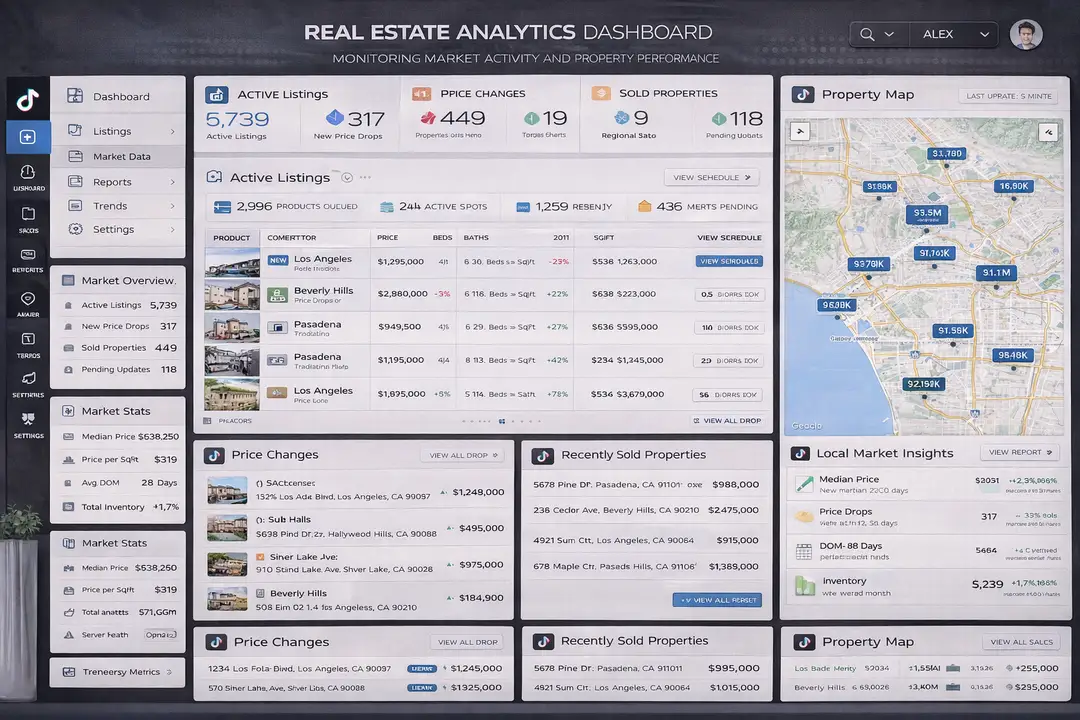
The next step is connecting the system to alerts, dashboards, and decision-making workflows. Important events should trigger Slack alerts, broker notifications, investor dashboards, or market anomaly detection systems.
This is where the data starts becoming operationally useful because it moves from storage into action.
The best systems connect data collection directly to the people or teams who need to respond to it.
Step 5: Track Historical Trends
Historical trend tracking is one of the most valuable parts of a real estate data system because it allows the business to see how listings evolve over time rather than only seeing the current state.
This includes price history, time on market, status changes, and historical sales activity. Trend data is usually more valuable than a static listing because it helps teams understand direction rather than only snapshots.
Appilot Integration Method #2 - Specific Feature Showcase
Supporting Mobile-First Operational Visibility in Real Estate Workflows
Some real estate teams work across both browser dashboards and mobile-first operational workflows. They may need to review alerts, listing changes, or internal reporting while moving between desktop and mobile environments.
The traditional approach can become fragmented because browser dashboards, listing feeds, notifications, and mobile review processes often exist in separate systems. That can create visibility gaps when teams need to react quickly.
Appilot can support this type of Android-side workflow visibility where relevant because it uses real Android devices and mobile-first workflows. In that supporting role, it can help teams review mobile operational context more clearly. The important distinction is that Appilot should support the broader operational workflow rather than becoming the primary method of extracting property data.
Common Challenges and Solutions
Even well-designed real estate data systems run into a few recurring issues, and most of them come from trying to scale too quickly without enough structure.
Challenge 1: Building on Scraped HTML
This is one of the biggest mistakes because scraped pages are fragile and eventually break when portals change layouts, blocking logic, or terms of service.
The solution is to build the core system around licensed feeds, APIs, and structured data providers rather than making scraping the foundation of the business.
Challenge 2: Ignoring Licensing Restrictions
Some teams focus only on extraction and forget that many real estate data sources have restrictions around redistribution, resale, and storage.
The solution is to understand licensing rules clearly before scaling the dataset. This protects the business from compliance issues later.
Challenge 3: Storing Snapshots Without History
Static listing snapshots are useful, but they become much more valuable when combined with price history, status history, and time-on-market tracking.
The solution is to store every meaningful change instead of overwriting old data. Trend visibility is more valuable than one-time snapshots.
Appilot Integration Method #4 - Real-World Case Study
Case Study: A Mid-Sized Analytics Firm Builds a Stable Real Estate Dataset
A mid-sized analytics firm covering 8 metro markets, 60,000 active listings, and more than 5 years of historical data needed a system that could support forecasting and investor-grade reporting without depending on unstable portal scraping.
Their earlier workflow was too fragile because it depended heavily on scraping public listing sites. The data was inconsistent, blocking risk was increasing, and maintaining the system was becoming expensive.
The improved model used licensed MLS feeds, automated ingestion pipelines, change detection logic, and hourly dashboard updates. This created a stable dataset that supported reliable forecasting, market reporting, and investor alerts.
The key improvement came from moving away from brittle extraction and toward structured feed-driven architecture.
Scaling Real Estate Data from 1 City to 20 Cities
The next stage of growth is not about scraping more pages. It is about improving architecture.
From 1 City to 20 Cities
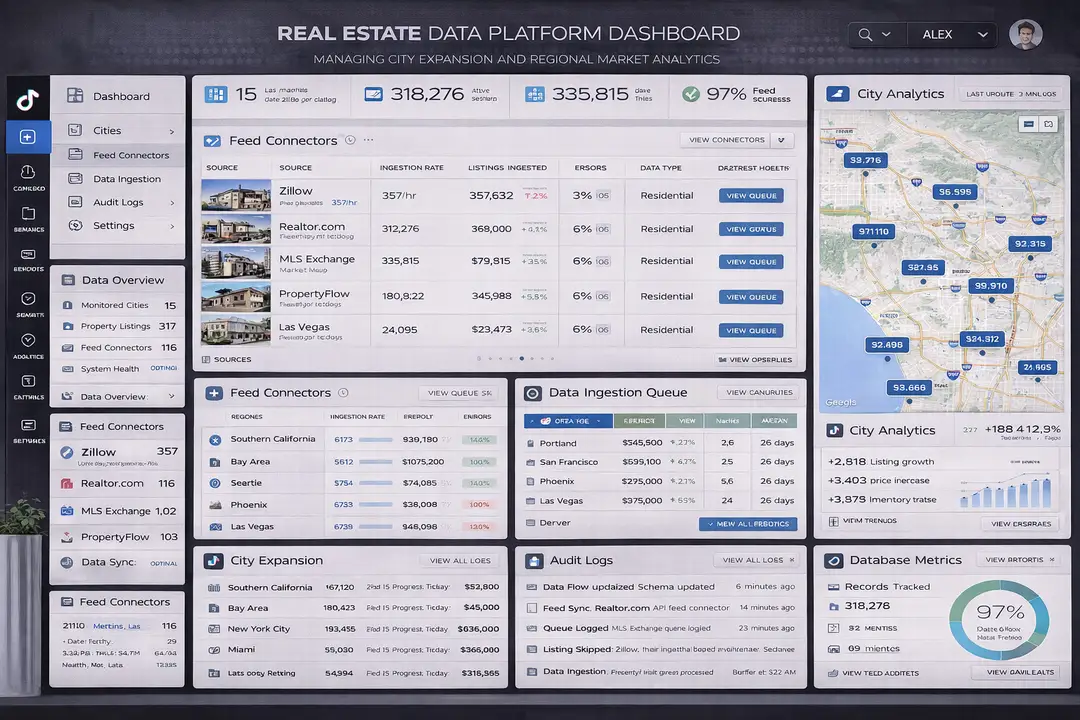
As more regions are added, the system needs centralized schema management, more feed connectors, queue-based ingestion, stronger audit logs, and better monitoring for feed failures.
Without these layers, every new city creates more operational complexity. With them, the system becomes easier to expand because every new feed fits into an existing structure.
Automation and Optimization at Scale
At scale, the best things to automate are feed ingestion, schema normalization, alerting, dashboard updates, and data quality monitoring.
The parts that should remain human-led are licensing review, market interpretation, forecasting decisions, and exception handling. That balance helps the system stay reliable as it grows.
Best Practices and Pro Tips
Best Practice 1 - Start with One Region
The best way to validate the architecture is to begin with one licensed MLS region before expanding. This allows the team to confirm that ingestion, normalization, alerts, and storage are working properly before scaling into additional markets.
Best Practice 2 - Separate Feed Collection from Analytics
The ingestion layer should remain separate from dashboards, forecasting, and reporting logic. This makes the system easier to maintain because changes to the analytics layer do not break the feed pipeline.
Best Practice 3 - Monitor Feed Quality Regularly
Even licensed feeds can fail, change field mappings, or experience delays. Teams should review feed quality regularly and implement alerting for missing records, schema changes, or stale data.
Tools and Resources
For structured real estate data access, MLS feeds, IDX systems, RETS integrations, RESO Web APIs, county record databases, public property record providers, and broker partnerships are the most reliable options.
For internal operations, teams often use databases, ETL tools, dashboards, Slack alerts, email notifications, and reporting platforms to manage ingestion and analysis.
Where Android-side workflow visibility is useful in broader operational environments, Appilot can support real-device review and mobile-first operational visibility, but the core data system should always remain centered on structured feeds and licensed sources.
Key Takeaways
Real estate data extraction works best when it is treated as a feed-driven data pipeline problem rather than a scraping problem. The strongest systems use MLS feeds, licensed providers, structured APIs, normalization layers, change detection, and historical tracking.
The biggest mistake is building analytics on unstable extraction methods. The smartest move is building a compliant, feed-driven system that remains reliable over time.
Frequently Asked Questions
Q1: Why is scraping large real estate portals risky?
Because major portals often use bot detection, legal restrictions, IP monitoring, and terms-of-service enforcement. Even if scraping works temporarily, it often becomes unstable over time.
Q2: What is the best source of real estate listing data?
MLS feeds, IDX access, RETS integrations, RESO APIs, and licensed data providers are usually the most reliable and structured sources.
Q3: Why is change detection more valuable than raw scraping?
Because tracking price reductions, status changes, and new listings creates actionable insight instead of only storing snapshots.
Q4: Can Appilot replace MLS feeds or licensed providers?
No. Appilot can support Android-side workflow visibility in broader operational systems where relevant, but it should not replace structured data feeds.
Q5: What is the best way to scale real estate data systems?
The best way is to add new feed connectors, centralize schema management, use queue-based ingestion, monitor feed quality, and scale architecture rather than scraping intensity.
Conclusion
Real estate data moves too fast to depend on fragile extraction methods.
The strongest firms do not build their systems around scraping portals. They build them around licensed feeds, structured ingestion, normalization, change detection, and historical tracking.
That approach creates more stable datasets, better forecasting, stronger reporting, and far less operational risk over time.