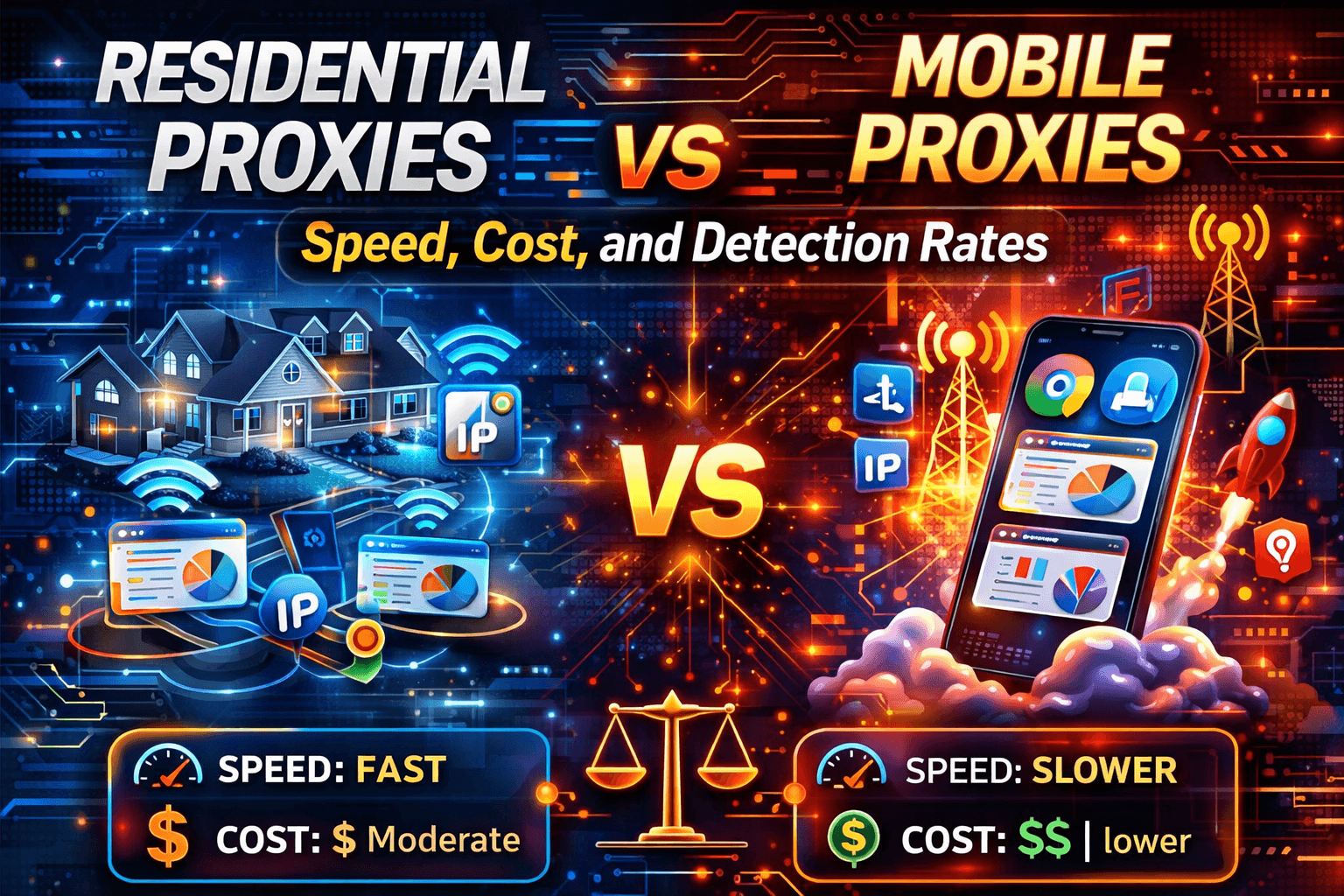
Residential Proxies vs Mobile Proxies: Speed, Cost, and Detection Rates
When running web scraping, automation, account management, or accessing geo-restricted content, proxies become an essential part of the infrastructure.
Two premium proxy categories dominate most serious use cases: residential proxies and mobile proxies.
Both use real consumer IP addresses, which makes them significantly harder to detect than datacenter proxies.
However, they differ greatly in speed, cost, IP behaviour, detection resistance, and scalability.
This guide breaks down when each type makes sense without unnecessary marketing hype.
Network Architecture Difference
Residential proxies route traffic through real home broadband connections.
These connections use ISP-assigned IP addresses, are usually tied to a single household device, and are often part of larger peer-to-peer networks.
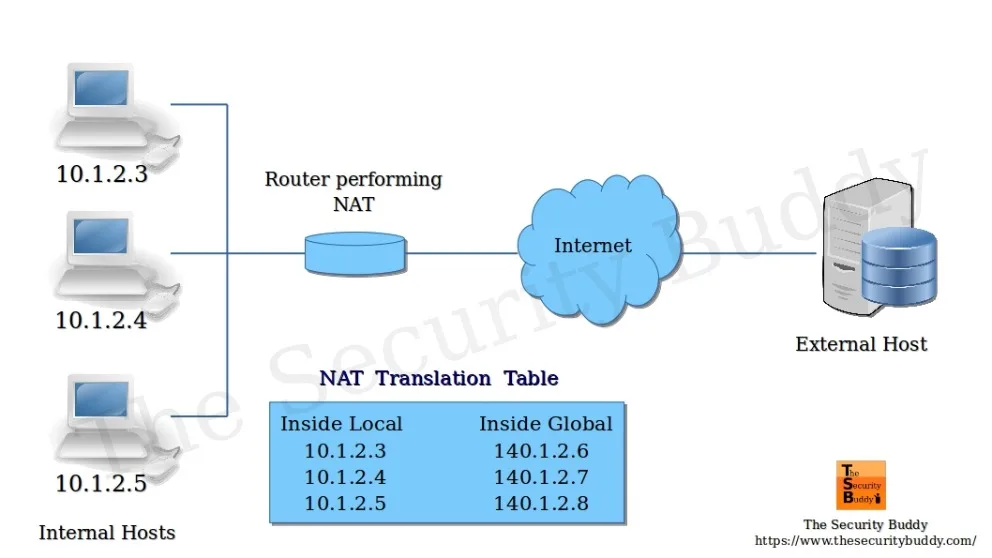
Mobile proxies work differently because traffic routes through mobile carrier networks such as 4G and 5G.
These networks often use carrier-grade NAT systems, where thousands of users can share the same IP ranges and IPs rotate frequently.
This architectural difference explains why mobile proxies are generally harder to detect.
What Are Residential Proxies?
Overview
Residential proxies use IP addresses assigned by real internet service providers.
Websites see them as normal home users.
They are widely used for web scraping, market research, price monitoring, automation workflows, and ad verification.
Key Features
Residential proxies provide real ISP IP addresses, rotating or static options, country and city targeting, ISP-level targeting, and very large IP pools.
Advantages
One of the biggest strengths of residential proxies is that they are faster, more affordable, highly scalable, and easier to integrate with automation tools.
For most automation workflows, residential proxies are the default workhorse solution.
Limitations
Residential proxies still have limitations.
They carry a slightly higher detection risk than mobile proxies, shared IP reputation can vary, and aggressive usage patterns can still trigger blocks.
What Are Mobile Proxies?
Overview
Mobile proxies use IP addresses assigned by mobile carriers across 4G, LTE, and 5G networks.
Examples of major mobile carrier networks include entity["company","Verizon","US telecommunications company"], entity["company","T-Mobile","US telecommunications company"], and entity["company","AT&T","US telecommunications company"].
Mobile IP ranges are usually shared among thousands of users through carrier NAT systems.
Key Features
Mobile proxies provide access to mobile carrier IP ranges, automatic rotation, shared NAT environments, and a much higher trust classification.
Advantages
Their biggest advantage is extremely low detection rates.
They are difficult to blacklist permanently, highly trusted by sensitive platforms, and especially useful for social media automation.
Limitations
The downside is that mobile proxies are slower, more expensive, have smaller IP pools, and usually offer more limited bandwidth.
Mobile proxies prioritise trust over speed.
Feature-by-Feature Breakdown
Speed
Residential proxies are generally faster and more stable.
Mobile proxies are slower because of carrier routing and NAT layers.
Cost
Residential proxies are usually cheaper and often use bandwidth-based pricing.
Mobile proxies are more expensive and often charge based on port allocation.
Detection Resistance
Residential proxies offer low detection risk.
Mobile proxies offer extremely low detection risk.
Mobile IP ranges are naturally trusted because they represent real user traffic moving through carrier networks.
IP Rotation
Residential proxies can be either static or rotating.
Mobile proxies usually rotate automatically and much more frequently.
Scalability
Residential proxies offer larger IP pools and are easier to scale.
Mobile proxies are more limited because the supply of clean mobile IPs is naturally smaller.
Detection Trust Spectrum
The typical trust ranking from lowest to highest usually looks like this: datacenter IPs, residential IPs, and then mobile carrier IPs.
Mobile proxies sit at the top because carrier-level traffic blends many users together naturally.
Scenario-Based Recommendations
Scenario 1: Large-Scale Web Scraping
The best choice is residential proxies.
They are faster, cheaper, provide larger IP pools, and scale more efficiently.
Using mobile proxies for large scraping tasks is often unnecessarily expensive.
Scenario 2: Social Media Automation & Account Safety
The best choice is mobile proxies.
They provide the highest trust, are much harder to blacklist, and work better for sensitive platforms.
Residential proxies may still work, but mobile proxies reduce the risk further.
Scenario 3: Budget-Conscious Automation
The best choice is residential proxies.
They provide a strong balance of cost and performance for most automation workflows.
Scenario 4: Mobile-First Real Device Workflows
An alternative here is Appilot.
Appilot is useful because it runs automation on real Android devices and operates inside genuine mobile environments.
However, it is important to understand that Appilot is not a replacement for proxies in all scenarios.
Instead, it works best alongside residential or mobile proxies when you need both real-device execution and IP diversity.
Scenario 5: Hybrid Strategy
For many advanced workflows, the best option is a hybrid approach.
Residential proxies can handle high-volume tasks while mobile proxies can be reserved for sensitive actions.
This creates a better balance between cost and trust.
Head-to-Head Summary
Residential Proxies
Advantages
Residential proxies are faster, cheaper, easier to scale, and provide access to very large IP pools.
Limitations
They still carry slightly higher detection risk and IP reputation can vary from one address to another.
Mobile Proxies
Advantages
Mobile proxies offer the lowest detection risk, the highest trust level, and are especially effective for social platforms.
Limitations
They are expensive, slower, and less scalable.
Appilot (Use-Case Specific)
Advantages
Appilot is useful for real Android-device execution, genuine mobile network behaviour, and mobile-first automation.
Limitations
It is not a proxy provider, does not replace IP rotation, and remains Android-focused.
Final Verdict
There is no universal winner.
Residential proxies are best when speed and scalability matter most.
Mobile proxies are best when trust and account safety matter most.
A hybrid approach is often the most practical choice for serious automation.
The best decision depends on platform sensitivity, budget, required scale, and overall risk tolerance.
If you are running mobile automation workflows, Appilot can fit naturally into a hybrid strategy because it combines real-device execution with more realistic mobile environments.
FAQs
Are mobile proxies better than residential?
They are safer from detection, but they are also slower and more expensive.
Which proxies are best for social media automation?
Mobile proxies generally offer higher trust.
Can residential proxies get blocked?
Yes, especially if they are overused or rotated poorly.
Do mobile proxies rotate automatically?
Most mobile proxies rotate frequently by default.
Are residential proxies good for scraping?
Yes, they are one of the most common options for scalable scraping.