Residential Proxy Integration: Browser Automation with Appilot
Residential proxies are one of the most important parts of browser automation because they help browser profiles appear more natural. Instead of connecting through datacenter IP addresses that may already be flagged or heavily used, residential proxies route browser traffic through real home internet connections. This makes browser activity look more like normal user behavior.
For users managing multiple accounts, browser profiles, social media sessions, e-commerce stores, affiliate campaigns, or scraping workflows, residential proxies can make a major difference. Even if you have strong browser fingerprints and separate browser profiles, using the wrong IP setup can still create overlap between accounts.
This becomes even more important once you start managing multiple browser types at the same time. Chrome profiles, Firefox sessions, antidetect browsers, and mobile browsers all benefit from residential proxy integration because it creates more realistic browsing behavior and stronger separation between browser sessions.
Appilot helps make residential proxy integration easier because it allows you to manage browser profiles, proxy groups, schedules, and automation rules from one place. Instead of manually assigning residential proxies to every browser profile, you can create organized systems that scale more efficiently.
Why Residential Proxies Are Different
Residential proxies are different from datacenter proxies because they use IP addresses assigned to real households by internet service providers. This makes them appear more trustworthy to most platforms.
Datacenter proxies are often faster and cheaper, but they can be easier to identify because they come from hosting companies or cloud providers. Residential proxies usually look more like real user traffic because the IP addresses belong to regular internet users.
This difference matters because many platforms monitor IP reputation. If a browser profile connects through an IP address that is known to belong to a datacenter, the activity may receive more scrutiny. On the other hand, residential IP addresses often blend in more naturally.
Residential proxies are especially useful for social media accounts, ad accounts, e-commerce stores, marketplace accounts, affiliate campaigns, and other high-value browser sessions where trust is important.
Why Residential Proxies Matter in Browser Automation
Browser automation depends on several layers working together. Browser fingerprints, cookies, time zones, browser types, device settings, and proxies all play a role in how browser sessions appear to platforms.
Many users focus heavily on browser fingerprints and antidetect browsers but underestimate the importance of proxy quality. Even if you have strong fingerprint settings, repeated use of low-quality IP addresses can still create problems.
Residential proxies help reduce this risk because they make browser traffic look more natural. Instead of sending activity through the same datacenter IP address repeatedly, browser sessions can rotate through different residential IPs based on browser profile, task, geography, or schedule.
This is especially useful when managing multiple browser profiles because it creates more separation between accounts. One profile can use a residential proxy from one city, another profile can use a different residential IP from another region, and another browser group can use a completely separate proxy pool.
The more browser profiles you manage, the more important residential proxy organization becomes.
Why Residential Proxy Integration Becomes Difficult
The challenge with residential proxies is not just finding them. The bigger challenge is managing them correctly across multiple browsers and browser profiles.
When you have large numbers of browser sessions, it becomes difficult to remember which proxies belong to which accounts, which profiles should use dedicated IPs, and which browser groups can share proxy pools.
Some browser platforms support proxy assignment directly, while others require additional browser extensions or separate settings. If you are working across Chrome, Firefox, GoLogin, AdsPower, Dolphin Anty, Multilogin, and mobile browsers, managing residential proxies manually becomes very time-consuming.
Another issue is matching proxies with browser fingerprints. If a browser profile is configured for the United States but connects through a residential proxy in another country, that mismatch can look suspicious.
There is also the issue of proxy reuse. Reusing the same residential IP address across too many accounts can still create overlap, even if the IP itself looks trustworthy.
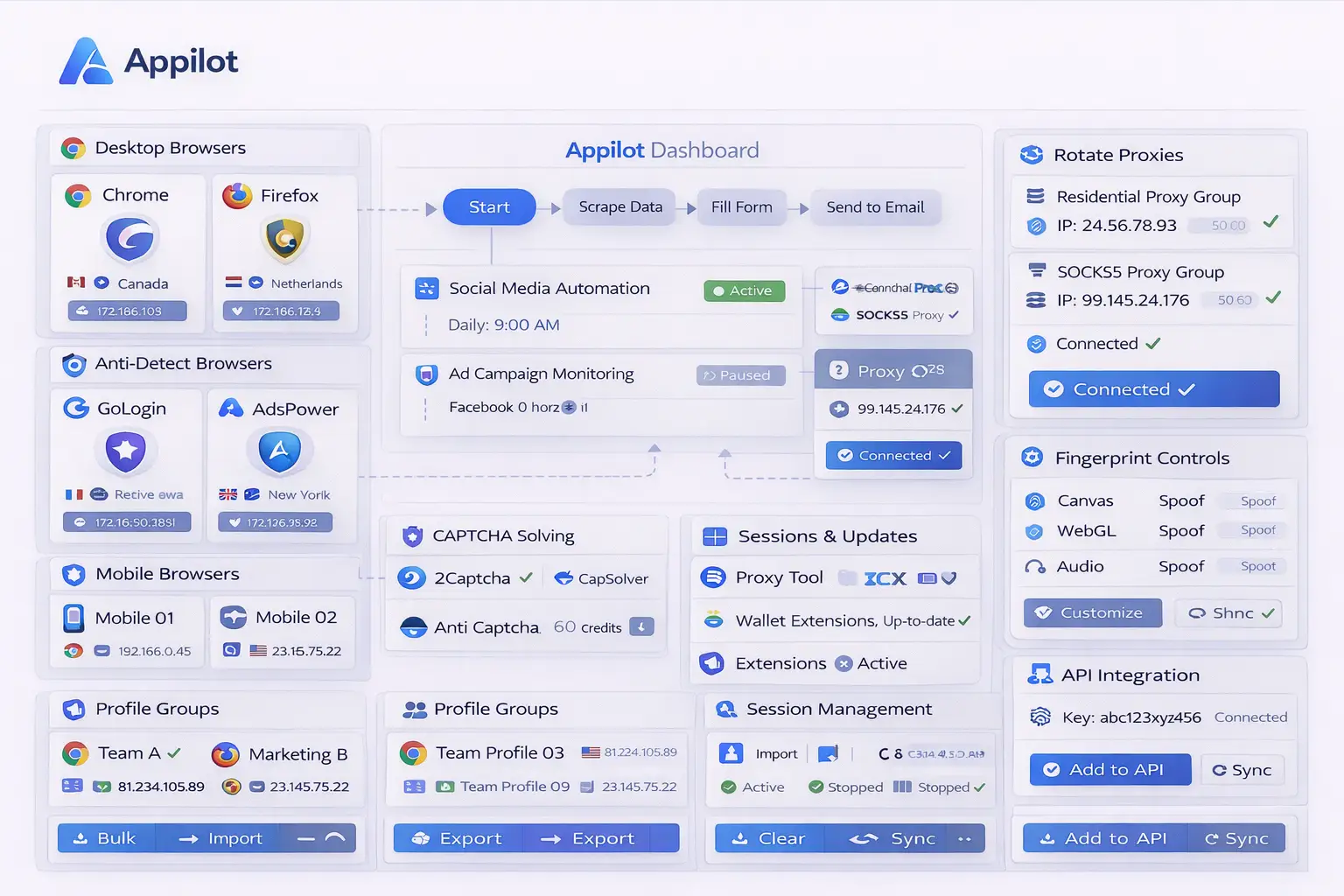
How Appilot Helps with Residential Proxy Management
Appilot makes residential proxy integration easier because it gives you one place to manage browser profiles, proxy groups, schedules, and browser assignments.
Instead of manually updating proxy settings inside every browser platform, you can create residential proxy groups inside Appilot and match them with specific browser profiles.
For example, you may assign one residential proxy pool to Facebook accounts, another proxy group to Amazon stores, and another to affiliate campaigns. This creates stronger separation between different browser activities.
Appilot can also help with proxy rotation. Instead of keeping the same residential IP address for too long, you can create rules for how often residential proxies should change.
Another useful feature is geographic organization. You can group residential proxies by country, city, or region and match them with browser profiles that use the same time zone, language, and browser fingerprint settings.
This makes browser sessions look more consistent and more realistic.
Appilot can also help prevent residential proxy overlap by limiting how many browser profiles can use the same proxy at one time. This creates better account separation and reduces the chance of repeated IP usage.
Best Practices for Residential Proxy Integration
One of the best practices is matching browser profile settings with the residential proxy region. If a browser profile is configured for a United States user, the residential proxy should also come from the United States.
Another important practice is keeping high-value accounts on dedicated residential proxies. Social media accounts, ad accounts, e-commerce stores, and crypto wallets often benefit from dedicated IP addresses instead of shared proxy pools.
You should also keep residential proxy groups separated by purpose. For example, social media proxies should stay separate from scraping proxies, affiliate proxies, and marketplace account proxies.
It is also important to avoid changing residential IP addresses too aggressively. While rotation is useful, excessive proxy changes during a session can look unnatural.
You should also monitor residential proxy quality regularly. Even residential IPs can become slower, flagged, or overused over time.
Finally, keeping browser profiles organized by proxy group makes it easier to scale larger browser operations without confusion.
Common Mistakes with Residential Proxies
One common mistake is assuming that residential proxies alone solve every browser automation problem. Residential proxies are important, but they should still be combined with strong browser fingerprints, profile separation, browser rotation, and schedule variation.
Another mistake is using the same residential proxy pool for every browser type and every account category. This creates overlap between browser sessions and weakens account separation.
Some users also choose the cheapest residential proxies available without considering quality. Low-quality residential proxies may still be slow, unstable, or previously flagged.
Another issue is forgetting to match browser settings with proxy location. A browser profile configured for Europe but connected through a residential proxy in Asia can create suspicious patterns.
Finally, some users forget to track which browser profiles are sharing the same residential IPs. Over time, this can lead to repeated IP activity and account overlap.
Frequently Asked Questions
Q1: Why are residential proxies better than datacenter proxies?
Residential proxies usually appear more natural because they use IP addresses assigned to real homes rather than datacenters or hosting providers.
Q2: Should every browser profile use its own residential proxy?
Not always, but high-value accounts often benefit from dedicated residential IP addresses to reduce overlap.
Q3: Can Appilot rotate residential proxies automatically?
Yes. Appilot can help automate residential proxy assignments, proxy groups, schedules, and browser-specific proxy rules.
Q4: Are residential proxies important for antidetect browsers?
Yes. Antidetect browsers are stronger when combined with high-quality residential proxies because both layers help create more natural browser sessions.
Q5: How often should residential proxies rotate?
The ideal rotation schedule depends on the type of activity. Some users rotate after every session, while others rotate daily or after several browser launches.
Conclusion
Residential proxies are one of the most important parts of browser automation because they help browser traffic appear more natural and reduce repeated IP activity. Without proper residential proxy integration, even strong browser fingerprints and antidetect browsers can become less effective.
Appilot makes residential proxy integration easier by helping you manage proxy groups, browser profiles, schedules, and browser-specific proxy rules from one place. This creates a more organized workflow and makes it easier to scale browser automation over time.
This blog structure follows the user's requested Appilot blog format with one centered image, paragraph-style sections, no service or product page references, and FAQ formatting preferences.