What Is Scroll Behavior Analysis? Detecting Non-Human Patterns
As bot detection systems evolve, they increasingly rely on behavioral signals rather than static identifiers. One of the most telling behavioral signals is how users scroll through a webpage. Scroll behavior reflects how a user consumes content, reacts to information, and navigates a page, making it difficult to replicate accurately with automation.
Understanding scroll behavior analysis is important because it highlights how subtle interaction patterns can reveal whether a user is human or automated. This guide explains how scrolling behavior is tracked and analyzed.
What Is Scroll Behavior Analysis?
Scroll behavior analysis is the process of monitoring and evaluating how a user scrolls through a webpage, where systems track movement patterns, speed, pauses, and direction changes to understand interaction behavior. Instead of focusing on what the user is viewing, the analysis focuses on how the user navigates the content. These patterns provide insight into whether the interaction is natural or generated by automation.
The Core Difference Between Human and Bot Scrolling
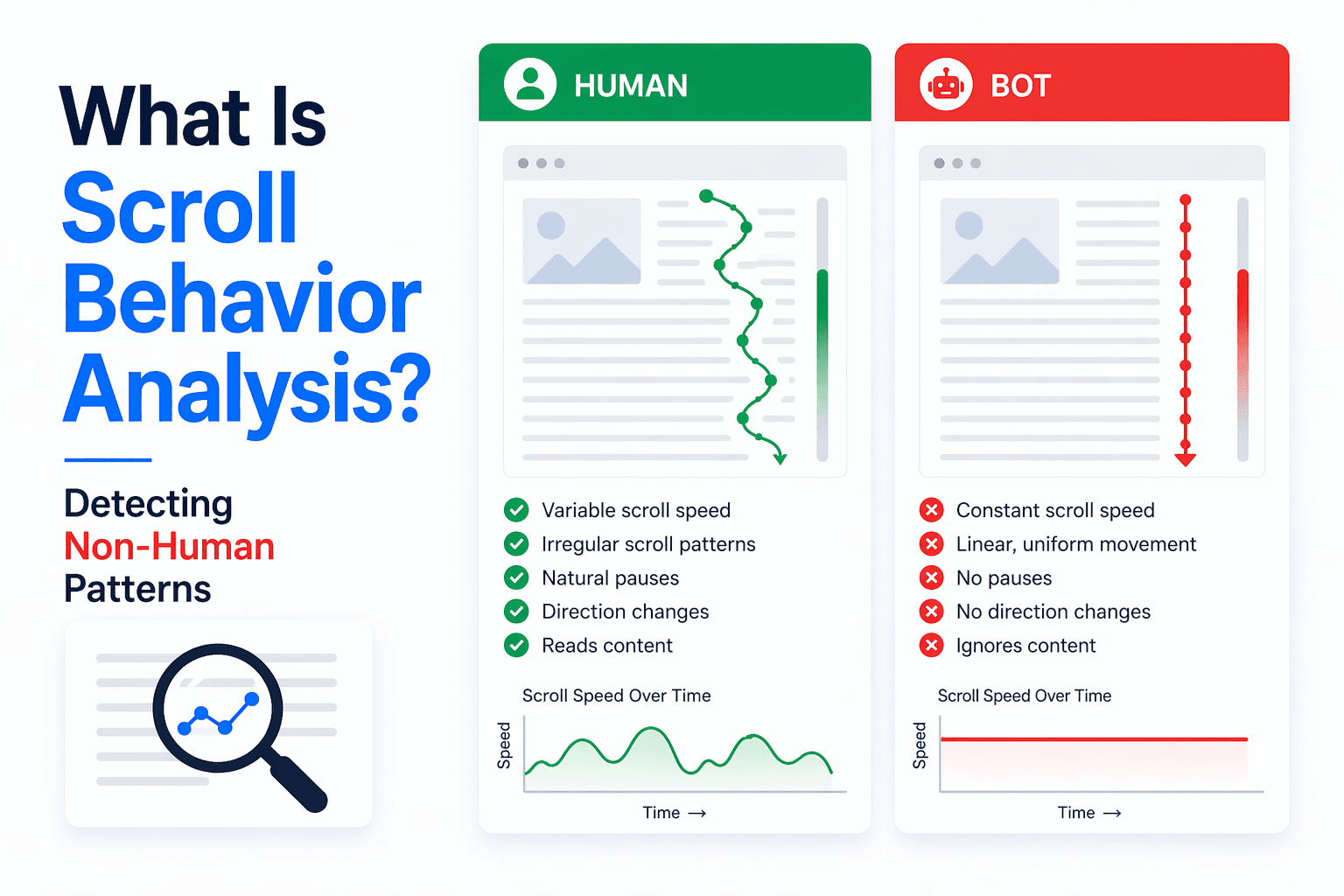
The core difference between human and bot scrolling lies in variability and intent, where human users scroll in a non-linear and context-driven manner, often pausing to read, adjusting speed, and occasionally scrolling back. Bots, on the other hand, tend to scroll in predictable ways, such as moving at constant speeds, jumping directly to specific positions, or scrolling without pauses. These differences are key indicators used in detection.
How Scroll Behavior Is Tracked
Scroll behavior is tracked using JavaScript events that capture scroll position and timestamps over time, where each event records how far the page has moved and when the movement occurred. By analyzing these sequences, systems can reconstruct the scrolling path and evaluate characteristics such as speed changes, pauses, and direction shifts.
Key Characteristics of Human Scroll Behavior
Human scroll behavior includes several natural traits, where users tend to scroll in bursts rather than continuously, pause to read content, and adjust their speed based on interest or complexity. They may scroll back up to revisit information, skip sections, or hesitate before continuing. These patterns are influenced by cognitive processing and content engagement, creating irregular and context-aware behavior.
Common Bot Scroll Patterns
Bot-generated scrolling often lacks the complexity of human interaction, where it may follow a fixed pattern such as scrolling at a constant speed or jumping directly to the bottom of the page. There may be no pauses, no backward movement, and no variation in speed, resulting in a uniform pattern that is easy to detect. Even when randomness is introduced, it may not reflect realistic reading behavior.
Why Scroll Analysis Is Effective
Scroll behavior analysis is effective because it captures real-time interaction patterns that are difficult to replicate accurately, where detection systems can analyze multiple aspects of scrolling simultaneously. This includes timing, direction, and variability, making it harder for bots to mimic all aspects of human behavior. As a result, scrolling provides a strong signal for distinguishing between humans and automation.
Scroll Behavior vs Other Behavioral Signals
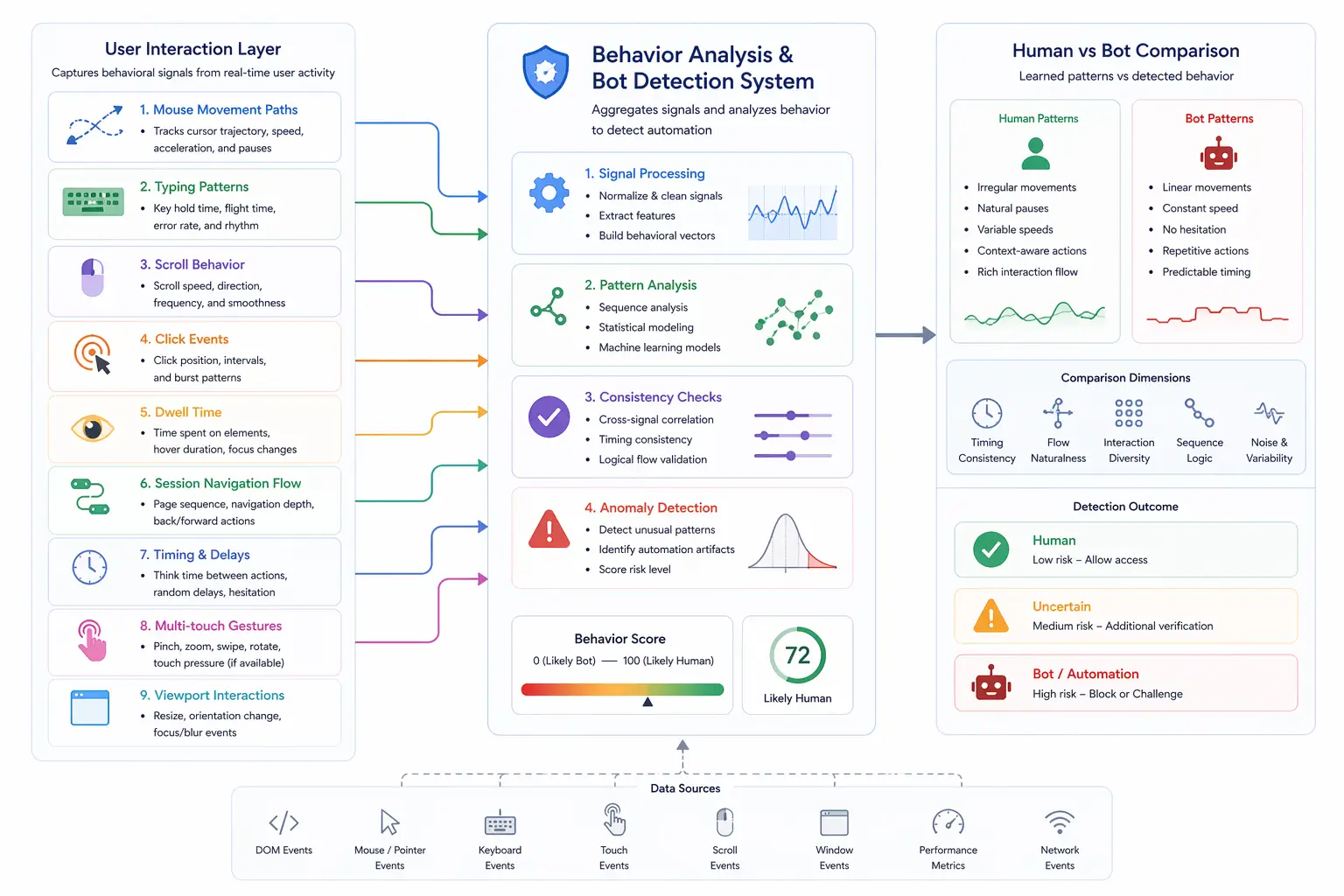
Scroll behavior is often analyzed alongside other behavioral signals such as mouse movement and typing patterns, where each signal provides additional context about user interaction. While scrolling reflects content navigation, mouse movement captures cursor behavior, and typing reveals input patterns. Combining these signals creates a more complete behavioral profile.
Limitations of Scroll Behavior Analysis
Despite its effectiveness, scroll behavior analysis has limitations because some users may exhibit unusual patterns due to different reading styles, accessibility tools, or device types, where these variations can lead to false positives. Additionally, advanced automation tools may attempt to simulate human-like scrolling, reducing the effectiveness of simple detection techniques. Detection systems must account for these factors.
Scroll Simulation vs Real Behavior
A key distinction in modern detection is the difference between simulated scrolling and natural interaction, where simulated scrolling attempts to replicate human patterns through programmed behavior, but often lacks the subtle complexity of real engagement. Real users scroll based on content relevance and personal interest, creating patterns that are difficult to model accurately. This difference is a key focus of detection systems.
Scroll Behavior vs Real-Device Environments
Another important distinction is between simulated environments and real-device environments, where simulated setups generate scrolling through code, while real-device environments rely on actual user input or realistic system-level interaction. Tools like Appilot follow this approach by running automation on real Android devices, where interaction patterns, timing, and system responses reflect real-world usage. This reduces inconsistencies that detection systems rely on.
When Scroll Behavior Analysis Is Most Critical
Scroll behavior analysis is most critical in scenarios where user engagement is closely monitored, such as content platforms, login systems, and high-security applications, where understanding how users interact with content is essential. In these contexts, scrolling patterns provide valuable insight into user authenticity.
Frequently Asked Questions
Q: What is scroll behavior analysis?
It is analyzing how users scroll to detect patterns.
Q: How does it detect bots?
By identifying unnatural or consistent scrolling behavior.
Q: Can bots simulate scrolling?
Yes, but it is difficult to mimic real user patterns.
Q: Is scroll analysis used alone?
No, it is combined with other behavioral signals.
Q: Can real users be misclassified?
Yes, in some cases with unusual behavior.
Q: How do real-device solutions compare?
Real-device solutions like Appilot produce natural interaction patterns, reducing detection risk.
Key Takeaways
Scroll behavior analysis is a powerful method for detecting bots by analyzing how users navigate content through scrolling. Human scrolling is irregular, context-driven, and includes pauses and adjustments, while bot scrolling tends to be more consistent and predictable. By evaluating these differences, detection systems can identify automation with high accuracy. Understanding scroll behavior is essential for navigating modern bot detection systems.