Shared Proxies vs Dedicated Proxies: Which Is Safer for Multi-Account Instagram?
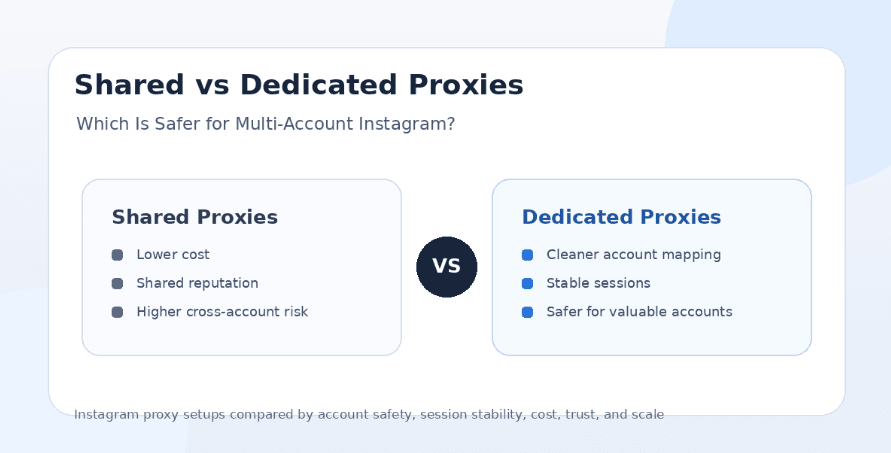
Running multiple Instagram accounts is not just about having a bot, a device, and a list of actions. The account environment matters just as much as the automation itself. If several accounts look connected through the same IP, behave too similarly, rotate locations too often, or share a suspicious proxy pool, Instagram may treat them as part of the same risky cluster.
That is why the shared proxies vs dedicated proxies debate matters for multi-account Instagram automation. Shared proxies are cheaper because multiple users or accounts may use the same proxy pool. Dedicated proxies cost more because the proxy is reserved for one user, one account, or one controlled account group. For serious Instagram bot operators, that difference can directly affect account safety, session stability, and long-term trust.
The short answer is that dedicated proxies are usually safer for multi-account Instagram workflows, especially when the accounts are valuable. Shared proxies can work for testing, scraping, low-risk browsing, or early experiments, but they carry more reputation risk because you do not fully control who else is using the same IP environment.
What Are Shared Proxies?
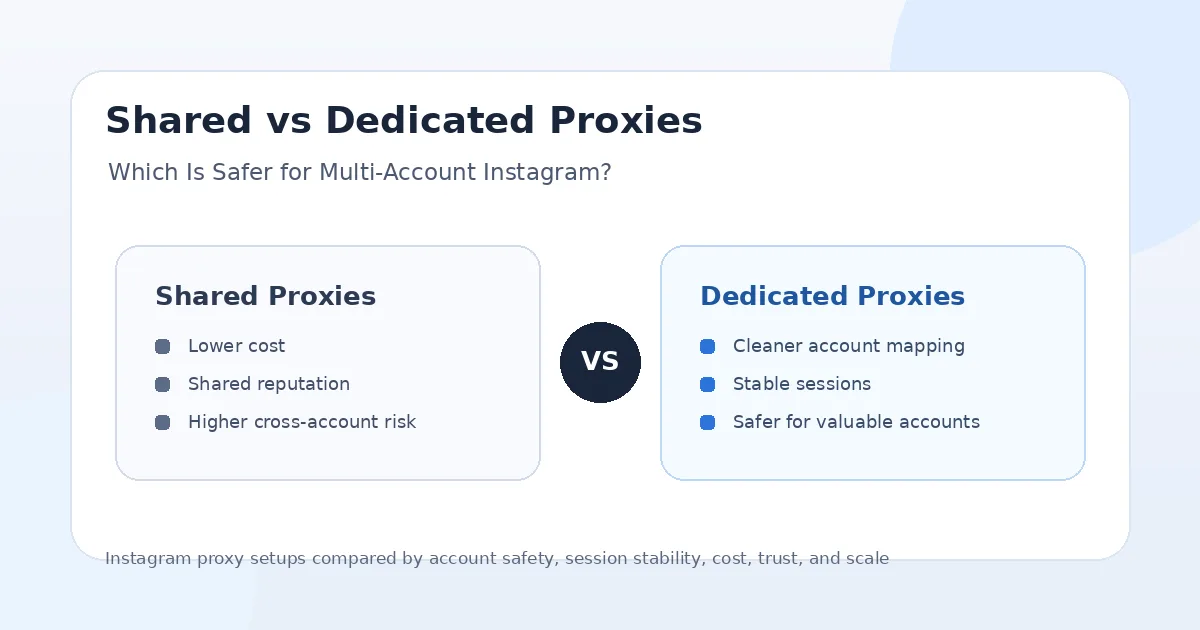
Shared proxies are proxies used by multiple users or multiple accounts at the same time. Instead of one IP being reserved only for you, it may be part of a shared pool that other customers also access. This makes shared proxies cheaper and easier to buy in bulk.
For beginners, shared proxies look attractive because the cost is low. If someone is testing an Instagram bot, checking basic workflows, or running low-value accounts, a shared proxy may feel like a practical starting point. It reduces the upfront cost of building a multi-account setup.
The problem is reputation. You may use the proxy carefully, but another user on the same IP may spam, scrape, create accounts, mass DM, or trigger platform abuse signals. If the IP gets flagged because of someone else’s behavior, your Instagram accounts may suffer even if your own workflow is clean.
What Are Dedicated Proxies?
Dedicated proxies are reserved for one user or one controlled setup. In a strong Instagram automation system, a dedicated proxy may be mapped to one account, one device, or one small account group depending on the operator’s risk tolerance.
The main advantage is control. You are not sharing IP reputation with random users. Your account activity is easier to isolate, monitor, and manage. If something goes wrong, it is easier to understand whether the issue came from your bot behavior, account quality, device setup, or proxy choice.
Dedicated proxies are more expensive than shared proxies, but they usually make more sense for serious multi-account Instagram work. When an Instagram account has value, paying more for a cleaner and more stable proxy environment is often cheaper than losing the account.
Shared vs Dedicated Proxies: The Main Difference
The main difference is reputation control. With shared proxies, your Instagram accounts inherit risk from other users in the same proxy pool. With dedicated proxies, the IP environment is much more controlled because you are not sharing it with unknown activity.
This matters because Instagram does not only evaluate account behavior. It can also evaluate login environments, network history, device consistency, location patterns, and whether multiple accounts appear connected. A proxy with poor history can create friction before the bot even starts running.
Shared proxies are better for low-cost testing. Dedicated proxies are better for account safety, session consistency, and long-term multi-account operations. If the account matters, dedicated is usually the safer choice.
Which Proxy Type Is Safer for Instagram?
Dedicated proxies are safer for Instagram because they reduce unknown reputation risk. You control the usage pattern, account mapping, and session behavior more closely. That makes it easier to keep each account’s environment consistent.
Shared proxies are riskier because they may already be used by other bot operators, scrapers, spammers, or account farmers. Even if the proxy provider claims the pool is clean, you still have less control over the activity connected to that IP.
The safest setup is usually not just “dedicated proxy.” It is a dedicated mobile or high-quality residential proxy paired with a stable device, realistic action limits, warmed account history, and natural session behavior. Appilot supports this kind of workflow by letting users run Instagram bots on real Android devices and emulators remotely, so the proxy environment and device environment can stay more consistent.
Why Shared Proxies Are Risky for Multi-Account Instagram
Shared proxies create risk because multiple accounts or users may appear under the same IP history. If the same proxy is used for unrelated Instagram accounts, different automation styles, spammy behavior, or repeated login attempts, Instagram may treat the environment as suspicious.
The bigger problem is that shared proxy risk is often invisible. You may not know whether the IP was used for mass DMs, account creation, scraping, or banned accounts before you received it. You only see the result when your login gets challenged, your account gets action-blocked, or your automation starts failing.
Shared proxies also make troubleshooting harder. If an account gets restricted, you may not know whether the issue came from your bot, the account age, the device, the action limits, the proxy pool, or another user who abused the same IP. Dedicated proxies make diagnosis much cleaner.
Why Dedicated Proxies Are Better for Account Mapping
Multi-account Instagram automation works best when every account has a stable identity. That means the same account should use a consistent device, consistent proxy region, consistent behavior pattern, and consistent session history.
Dedicated proxies make this easier. You can map one Instagram account to one proxy, or one small group of related accounts to one controlled proxy setup. This gives the account a more believable environment over time.
Shared proxies make this harder because you cannot fully control who else uses the same IP or how often the IP reputation changes. For accounts that need to survive long term, account-to-proxy mapping is one of the most important safety practices.
Static Sessions vs Rotating Sessions
Dedicated proxies are usually better when paired with sticky or static sessions. A logged-in Instagram account should not look like it is jumping between many IPs during normal activity. Real users usually have stable network patterns, even when they switch between Wi-Fi and mobile data.
Shared rotating proxies may be useful for scraping or public browsing, but they are not ideal for logged-in Instagram account activity. If an account uses a new IP too often, especially across different regions, Instagram may see the pattern as suspicious.
For multi-account bots, stable sessions matter more than frequent rotation. A sticky dedicated mobile or residential proxy is usually safer than a shared rotating proxy for real Instagram accounts.
Mobile Dedicated Proxies vs Residential Dedicated Proxies
Mobile dedicated proxies are usually the strongest option for Instagram automation because Instagram is heavily mobile-first. A real Android device or emulator running through a stable mobile proxy creates a more believable environment than a desktop-style setup using a cheap proxy.
Residential dedicated proxies can also work well, especially when the workflow is lighter or the account has a normal-looking location history. They are often cheaper than mobile proxies and can be a good balance between cost and trust.
The right choice depends on account value. High-value accounts, agency accounts, and phone farm accounts usually deserve mobile dedicated proxies. Lower-risk accounts may work fine with strong residential dedicated proxies.
Are Shared Mobile Proxies Safe?
Shared mobile proxies can be better than shared datacenter proxies, but they still carry shared reputation risk. The mobile network itself may look more natural, but the IP pool may still be used by many unknown users.
Because mobile carrier IPs are often shared by real users, shared mobile proxies can sometimes survive better than shared residential or datacenter proxies. But for serious Instagram automation, the unknown usage pattern is still a concern.
If you use shared mobile proxies, use them for lower-risk workflows, testing, or accounts that are not critical. For important Instagram accounts, dedicated mobile proxies are usually worth the extra cost.
Are Shared Residential Proxies Safe?
Shared residential proxies can work for some Instagram tasks, but they are not ideal for valuable logged-in accounts. The main risk is that residential IP pools can vary widely in quality. Some are clean and stable, while others are slow, abused, overloaded, or unreliable.
For browsing, light account warm-up, or low-risk research, shared residential proxies may be acceptable. For follow/unfollow automation, DM workflows, comment automation, or multi-account account operations, dedicated residential proxies are safer.
If a shared residential proxy rotates too often or has poor location control, it can create more problems than it solves. Instagram accounts need stability, not just an IP that looks residential.
Are Shared Datacenter Proxies Safe?
Shared datacenter proxies are usually the weakest option for Instagram automation. Datacenter IPs already carry more suspicion because they come from hosting providers and server environments. When they are shared, the risk becomes even higher.
These proxies may be useful for testing, public checks, low-value scraping, or development workflows, but they are not a good choice for serious Instagram accounts. A shared datacenter proxy may be fast and cheap, but it can create login challenges, action blocks, or early trust issues.
For multi-account Instagram bots, shared datacenter proxies should generally be avoided unless the workflow is low-risk and the accounts do not matter.
Cost vs Safety
Shared proxies win on cost. Dedicated proxies win on safety. The question is whether the money saved on proxies is worth the account risk. For serious Instagram operators, the answer is usually no.
If a proxy costs less but causes restrictions, verifications, lost accounts, or unstable bot performance, it is not actually cheaper. The real cost includes account recovery time, lost campaign performance, lower success rates, and damaged account trust.
A good rule is simple: use shared proxies only for testing or low-value workflows, and use dedicated proxies for accounts that matter. The more valuable the account, the more the proxy should be treated like infrastructure, not a disposable expense.
Best Proxy Setup for One Instagram Account
For one Instagram account, the safest setup is a dedicated mobile proxy or a high-quality dedicated residential proxy. The account should keep a stable IP region, consistent device environment, and realistic activity limits.
A shared proxy may work if the account is low-value or only used for testing, but it adds unnecessary risk. If the account is personal, client-owned, or revenue-generating, dedicated is the better choice.
When using Appilot, the same principle applies. Running the account on a real Android device or emulator through a stable dedicated proxy creates a cleaner environment than constantly rotating or sharing IPs across many accounts.
Best Proxy Setup for Multiple Instagram Accounts
For multiple Instagram accounts, each account should ideally have its own dedicated proxy or a carefully managed proxy-to-account mapping. The goal is to avoid making many accounts look connected through the same network pattern.
If cost is a concern, some operators may group related low-risk accounts under a small dedicated proxy pool, but this should be done carefully. High-value accounts should not share the same proxy with unrelated accounts.
Appilot’s remote dashboard can make multi-account workflows easier because users can manage Android devices and emulators from one place while keeping accounts mapped to stable environments. The proxy setup still needs to be planned properly, but the workflow becomes easier to control.
Best Proxy Setup for Phone Farms
Phone farms should use dedicated mobile proxies whenever possible. A real Android phone paired with a stable mobile proxy creates one of the strongest environments for Instagram automation. It looks closer to normal mobile use than an emulator running through a shared datacenter IP.
If using residential proxies, dedicated residential sessions are better than shared rotating pools. The key is account consistency. Each phone and account should have a predictable network identity.
Shared proxies are not ideal for phone farms because phone farms usually manage accounts that need to survive over time. The more accounts you manage, the more important clean mapping becomes.
Best Proxy Setup for Agencies
Agencies should avoid shared proxies for client accounts. Client accounts are valuable, and a cheap proxy setup can create expensive problems. If an account gets restricted, the agency may lose time, trust, and campaign performance.
A good agency setup uses dedicated mobile or residential proxies, stable device environments, clear account mapping, action limits, logs, and careful monitoring. This is especially important for Instagram growth, DM workflows, influencer outreach, lead generation, or any automation that touches real customer accounts.
Appilot is useful for agencies because it lets teams run bots on real Android devices and emulators without ADB or laptop dependency. When paired with dedicated proxies, it gives agencies a cleaner foundation for managing Instagram and other social workflows professionally.
Best Proxy Setup for Testing
For testing, shared proxies can be acceptable. If you are testing a bot script, checking UI behavior, or running low-value trial accounts, shared proxies can reduce cost. Just do not assume test results from shared proxies will match production performance.
Testing should eventually move to dedicated proxies before important accounts are involved. A workflow that passes on a shared proxy may still fail in production if account quality, proxy consistency, or device mapping changes.
For Appilot users, emulators and lower-cost proxies can be useful for early tests, while real devices and dedicated proxies are better for serious Instagram automation.
Common Mistakes With Shared Proxies
One common mistake is using the same shared proxy across multiple unrelated Instagram accounts. This makes account linking more likely and can cause problems if one account behaves badly or gets flagged.
Another mistake is using shared rotating proxies for logged-in sessions. Rotation may be useful for scraping, but Instagram accounts usually need stable sessions. Too many IP changes can make the account look suspicious.
A third mistake is trusting the word “premium” without checking session stability, proxy history, location control, and real performance. A premium shared proxy is still shared, and shared reputation is still a risk.
Common Mistakes With Dedicated Proxies
Dedicated proxies are safer, but they can still be misused. One mistake is switching dedicated proxies too often. Even if every proxy is clean, sudden changes in account location or network identity can create trust issues.
Another mistake is using one dedicated proxy for too many accounts. Dedicated means you control the proxy, but it does not mean you should overload it with unrelated accounts. Account separation still matters.
A third mistake is pairing a strong dedicated proxy with aggressive bot behavior. A clean proxy cannot protect an account from spammy DMs, mass follows, repetitive comments, or unnatural action timing.
Final Verdict
Dedicated proxies are safer than shared proxies for multi-account Instagram automation. They give bot operators more control over IP reputation, session stability, account mapping, and troubleshooting. For valuable accounts, agencies, phone farms, and long-term Instagram workflows, dedicated mobile or dedicated residential proxies are usually the better investment.
Shared proxies are cheaper, but they carry unknown reputation risk. They can work for testing, low-value accounts, scraping, or early experiments, but they are not ideal for serious Instagram account operations. The risk is not only what you do on the proxy. It is also what other users have done or are doing on the same IP pool.
The safest multi-account setup uses stable dedicated proxies, realistic action limits, warmed accounts, consistent device environments, and careful account-to-proxy mapping. Appilot fits naturally into that setup by helping users run Instagram bots on real Android devices and emulators remotely without ADB or laptop dependency. You can explore Appilot’s bot store and real-device workflows at appilot.app.
FAQs
Q1: Are dedicated proxies safer than shared proxies for Instagram?
Yes, dedicated proxies are usually safer because you control the IP usage and reputation more closely. Shared proxies carry unknown risk from other users.
Q2: Can shared proxies work for Instagram bots?
Shared proxies can work for testing or low-value accounts, but they are riskier for serious Instagram automation. Dedicated proxies are better for valuable accounts.
Q3: Should each Instagram account have its own proxy?
Ideally, yes. Each important Instagram account should have its own stable proxy or carefully managed proxy mapping to reduce account-linking risk.
Q4: Are shared mobile proxies better than shared datacenter proxies?
Yes, shared mobile proxies usually have a stronger trust profile than shared datacenter proxies. Still, dedicated mobile proxies are safer for serious Instagram workflows.
Q5: Does Appilot work with dedicated proxies?
Yes, Appilot can support workflows using dedicated mobile or residential proxies. This works best when each account has a stable device and proxy environment.