Sticky Sessions vs Rotating Proxies: Use Cases

When working with proxies in browser automation, one of the most important decisions is whether to keep the same IP for a session or rotate it frequently. This choice directly affects how websites perceive your activity and whether your sessions remain stable or get flagged.
Understanding the difference between sticky sessions and rotating proxies is important because each approach serves a different purpose. Choosing the wrong one can lead to broken sessions or increased detection risk. This guide explains both concepts and when to use each.
What Are Sticky Sessions?
Sticky sessions refer to maintaining the same proxy IP for a continuous period of time. During this session, all requests are routed through the same IP, creating a consistent network identity.
This approach closely mimics real user behavior, where a user typically remains on the same network while browsing.
Sticky sessions are often configured with a time window, such as a few minutes or hours, after which the IP may change.
The Core Principle Behind Sticky Sessions
The core principle behind sticky sessions is consistency. Websites expect users to maintain a stable connection during a session.
By keeping the same IP, sticky sessions help preserve session data, login states, and behavioral continuity.
This reduces the likelihood of triggering security checks related to sudden identity changes.
What Are Rotating Proxies?
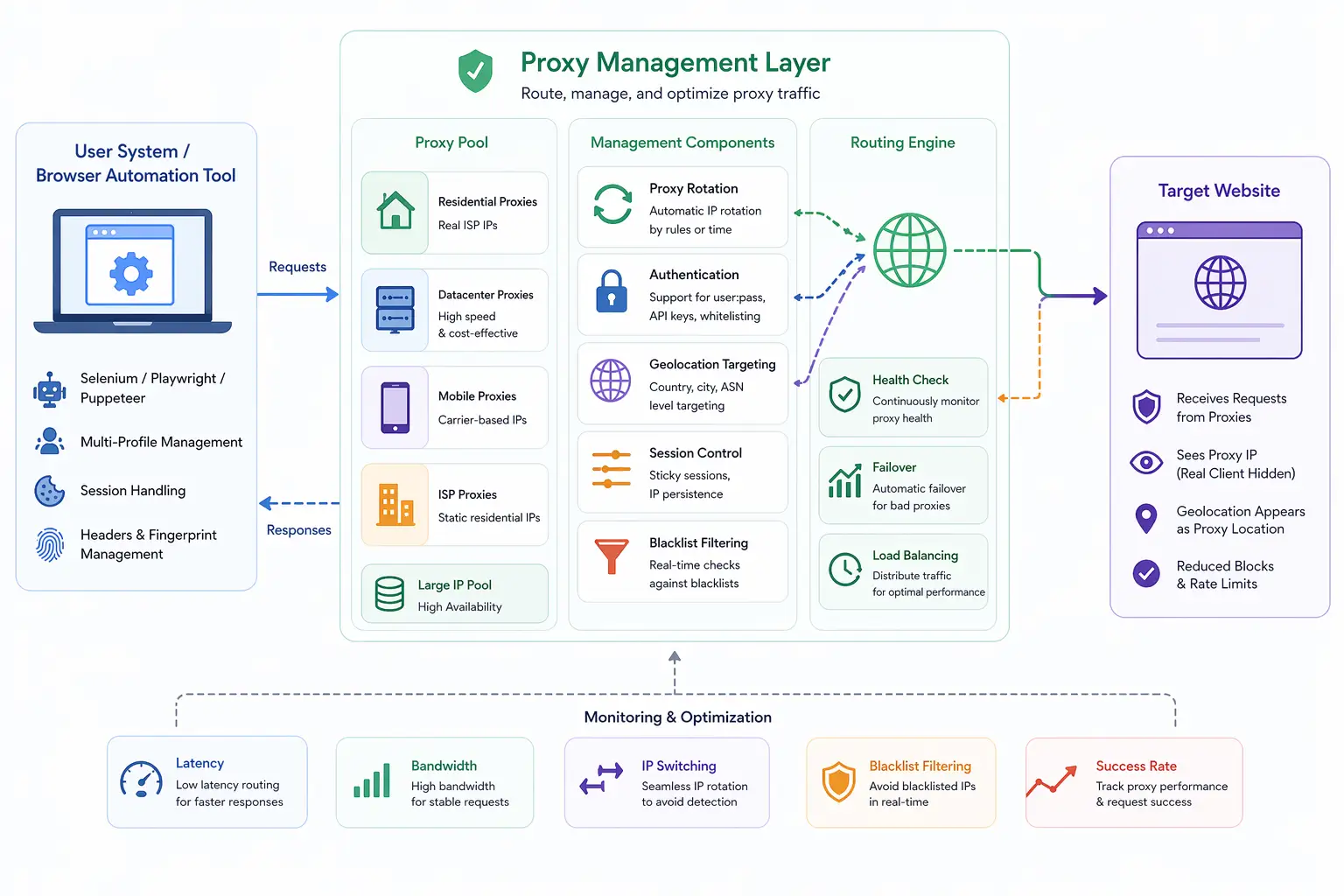
Rotating proxies involve changing the IP address at regular intervals or per request. Instead of maintaining a single identity, the system cycles through multiple IPs from a proxy pool.
This approach distributes activity across different IPs, reducing the load on any single proxy.
Rotating proxies are commonly used in large-scale automation and data collection.
The Core Principle Behind Rotating Proxies
The core principle behind rotating proxies is distribution. By spreading requests across multiple IPs, the system avoids patterns that could be associated with a single identity.
This helps reduce rate limits and prevents IP-based blocking.
However, frequent changes can appear unnatural if not managed carefully.
Key Differences Between Sticky Sessions and Rotating Proxies
The main difference between sticky sessions and rotating proxies lies in stability versus variability.
Sticky sessions maintain a consistent IP, which supports session continuity and realistic behavior. Rotating proxies change IPs frequently, which helps distribute traffic and reduce detection at the IP level.
Sticky sessions are better suited for workflows that require persistence, while rotating proxies are ideal for high-volume tasks.
Understanding this difference is essential for choosing the right approach.
When to Use Sticky Sessions
Sticky sessions are best used in scenarios where maintaining a consistent identity is critical.
This includes account logins, session-based workflows, and interactions that require continuity. For example, logging into an account and performing multiple actions within the same session requires a stable IP.
Changing IPs during such interactions can trigger security checks or logouts.
Sticky sessions help preserve stability and reduce disruptions.
When to Use Rotating Proxies
Rotating proxies are most useful in scenarios that involve large volumes of requests.
They are commonly used in data collection, scraping, and automation tasks where distributing traffic is necessary.
By rotating IPs, the system avoids overloading a single proxy and reduces the risk of being blocked.
However, rotation should be implemented carefully to avoid unnatural patterns.
Sticky Sessions vs Rotating in Detection Context
From a detection perspective, both approaches have advantages and risks.
Sticky sessions provide consistency, which aligns with real user behavior. However, excessive activity from a single IP can still be flagged.
Rotating proxies reduce IP-based detection but can introduce inconsistencies if IP changes are too frequent or do not align with other signals.
Detection systems analyze both stability and variability, so the choice must be balanced.
Common Mistakes
One common mistake is using rotating proxies for session-based tasks. This can break sessions and trigger security checks.
Another mistake is using sticky sessions for high-volume tasks, which can lead to rate limits and IP bans.
There is also the issue of misalignment. Changing IPs without updating related signals such as location or timezone can create inconsistencies.
Avoiding these mistakes is key to effective proxy usage.
Sticky Sessions and Fingerprinting
Sticky sessions and rotating proxies both operate at the network level. They do not affect browser fingerprinting signals.
If multiple sessions share the same fingerprint, they can still be linked even when using different IPs.
This highlights the importance of aligning network identity with browser and device-level signals.
Sticky Sessions vs Real-Device Environments
A key distinction in modern automation is the difference between managing IP behavior and managing full environments.
Sticky sessions and rotating proxies control how IPs are used, but they do not change how the browser or device behaves.
Real-device approaches operate on actual hardware where network, browser, and device signals naturally align. Tools like Appilot follow this approach by running automation on real Android devices, where session stability and natural network behavior occur without needing artificial configurations.
This reduces the complexity of choosing between sticky and rotating strategies.
Choosing the Right Approach
Choosing between sticky sessions and rotating proxies depends on the specific requirements of the workflow.
If the task requires stability and continuity, sticky sessions are the better choice. If the task requires scalability and distribution, rotating proxies are more suitable.
In many cases, a combination of both approaches is used to balance stability and variability.
Understanding the context is essential for making the right decision.
Frequently Asked Questions
Q: What is a sticky session?
It is a session where the same IP address is used continuously for a period of time.
Q: What are rotating proxies?
They are proxies that change IP addresses regularly or per request.
Q: Which is better, sticky or rotating?
It depends on the use case. Sticky is better for sessions, rotating is better for scale.
Q: Can rotating proxies break sessions?
Yes, frequent IP changes can disrupt session continuity.
Q: Do these methods prevent fingerprinting?
No, they only manage IP behavior. Fingerprinting must be handled separately.
Q: How do real-device solutions compare?
Real-device solutions like Appilot naturally align network and device behavior, reducing the need for manual proxy strategies.
Key Takeaways
Sticky sessions maintain a consistent IP for a period of time, supporting stable and realistic interactions, while rotating proxies change IPs frequently to distribute activity and reduce detection risk. Each approach serves a different purpose, and choosing the right one depends on whether stability or scalability is required. Proper alignment with browser and device-level signals is essential for both methods to be effective.