STUN/TURN Servers: How WebRTC Discovers Your IP
WebRTC enables direct, real-time communication between devices, but to do this effectively, it needs to discover how each device is connected to the internet. This is where STUN and TURN servers come into play. These components are essential for establishing connections, but they also expose network information that can reveal your real IP address.
Understanding STUN and TURN is important because they are at the core of how WebRTC gathers and shares network data. This guide explains how these servers work and how they contribute to IP discovery.
What Are STUN and TURN Servers?
STUN and TURN are protocols used by WebRTC to establish connections between devices, especially when they are behind firewalls or network address translation.
STUN, or Session Traversal Utilities for NAT, helps a device discover its public IP address.
TURN, or Traversal Using Relays around NAT, acts as a relay server when direct peer-to-peer communication is not possible.
Both play critical roles in enabling WebRTC connections.
The Core Purpose of STUN and TURN
The main purpose of STUN and TURN is to ensure that devices can communicate regardless of network restrictions.
STUN identifies how a device appears externally, while TURN provides a fallback path when direct connections fail.
Together, they enable reliable communication across different network environments.
How STUN Servers Discover Your IP
STUN servers are responsible for revealing your public IP address.
Public IP Discovery
When your browser connects to a STUN server, it sends a request asking how it appears on the internet.
The STUN server responds with the public IP address and port it sees.
This information is then used to establish connections.
ICE Candidate Generation
The browser collects this public IP as part of its ICE candidates.
These candidates represent possible connection paths and are shared during the WebRTC setup process.
This is how your real IP can become exposed.
Bypassing Proxies and VPNs
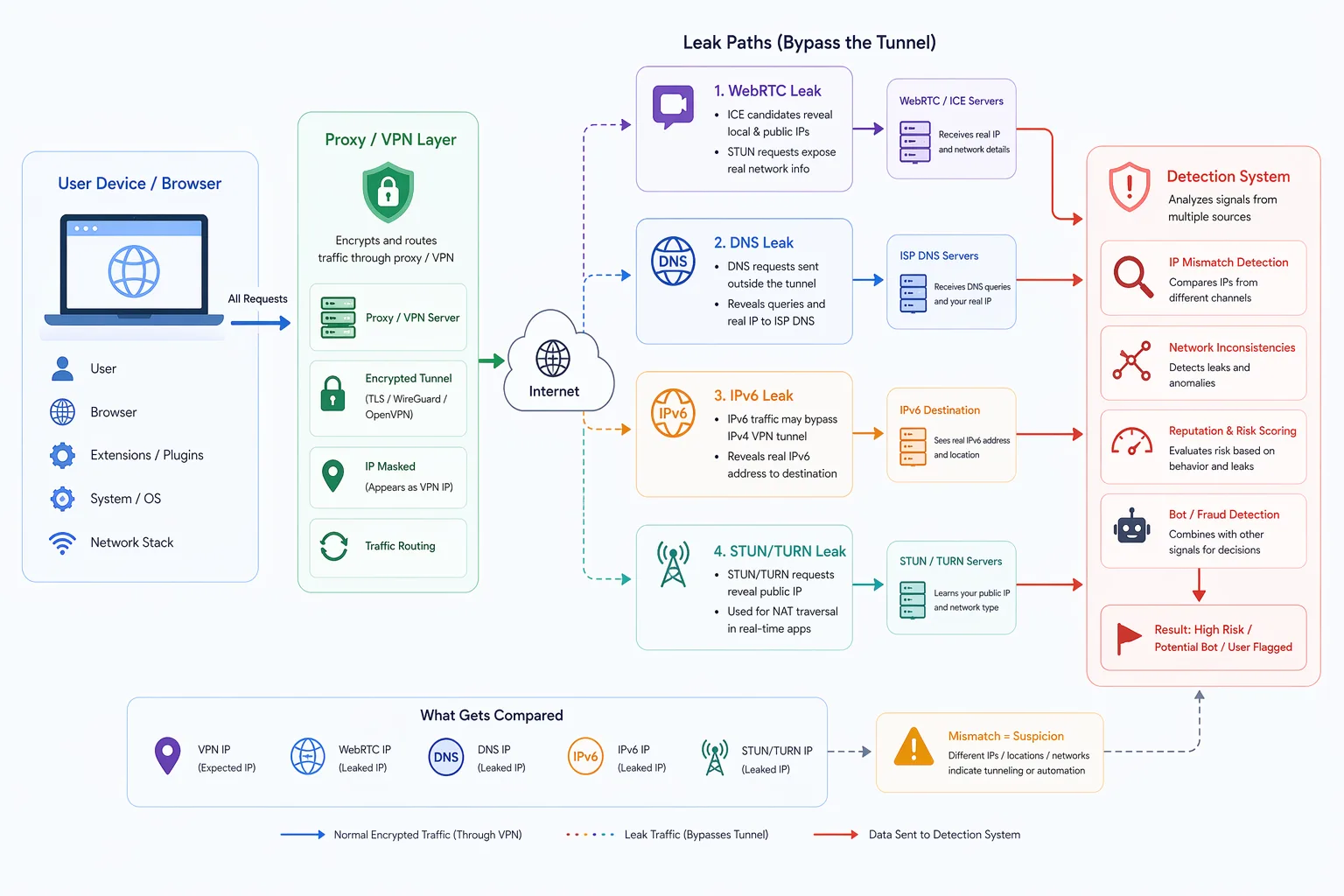
STUN requests may bypass proxies or VPNs, depending on configuration.
This means the IP returned by the STUN server may be your actual network IP rather than the masked one.
This creates a WebRTC leak.
How TURN Servers Work
TURN servers are used when direct connections cannot be established.
Relay-Based Communication
Instead of connecting directly, devices send data through the TURN server.
The TURN server acts as an intermediary, relaying traffic between peers.
IP Exposure During Setup
Even when TURN is used, the initial connection setup may still involve STUN-based discovery.
This means IP information can still be exposed before the relay is established.
Reliability Over Efficiency
TURN prioritizes reliability over performance.
While it adds latency, it ensures communication can occur even in restrictive network environments.
Why STUN/TURN Matter for IP Exposure
STUN and TURN matter because they are fundamental to how WebRTC operates.
STUN directly reveals your public IP, while TURN ensures connectivity but does not eliminate exposure during setup.
This makes them key components in understanding WebRTC leaks.
Their behavior is built into the protocol and cannot be avoided without modifying how WebRTC is used.
STUN/TURN and Network Fingerprinting
The data collected through STUN and TURN contributes to network fingerprinting.
By analyzing IP addresses, ports, and connection behavior, websites can build a profile of your network environment.
This information can be used to track users and detect inconsistencies.
It adds another layer to fingerprinting beyond traditional methods.
STUN/TURN vs Proxies and VPNs
Proxies and VPNs are designed to mask your IP address, but STUN and TURN operate at the browser level.
This allows them to gather network information independently of the main traffic route.
As a result, they can expose your real IP even when other protections are in place.
This creates a gap between expected and actual network behavior.
How Websites Use STUN/TURN Data
Websites can access WebRTC APIs to retrieve ICE candidates.
These candidates include IP addresses discovered through STUN and TURN.
By comparing this data with the request IP, websites can detect mismatches.
This is commonly used in bot detection and fraud prevention.
Limitations of STUN/TURN-Based Detection
While STUN and TURN provide valuable data, they have limitations.
Some browsers restrict access to certain IP information.
Users can disable WebRTC or configure it to limit exposure.
Additionally, not all environments produce consistent results.
These limitations mean STUN/TURN data is often combined with other signals.
STUN/TURN vs Real-Device Environments
A key distinction in modern detection is the difference between simulated setups and real-device environments.
STUN and TURN can reveal inconsistencies in environments where network routing is artificially modified.
Real-device approaches operate on actual hardware and network conditions where IP discovery and routing behave naturally. Tools like Appilot follow this approach by running automation on real Android devices, where STUN/TURN interactions, IP exposure, and network behavior align with real-world usage.
This reduces mismatches that detection systems rely on.
When STUN/TURN Exposure Is Most Critical
STUN/TURN exposure is most critical in scenarios where IP consistency is important.
This includes authentication systems, geo-restricted platforms, and high-security environments.
In these contexts, mismatched IP data can trigger detection or restrictions.
Understanding this helps in managing risk.
Frequently Asked Questions
Q: What is a STUN server?
It is a server that helps discover your public IP address.
Q: What is a TURN server?
It is a relay server used when direct connections are not possible.
Q: Why does STUN reveal my IP?
Because it reports how your device appears on the internet.
Q: Can TURN prevent IP exposure?
Not entirely, as discovery still occurs during setup.
Q: Are STUN/TURN used together?
Yes, they work together in WebRTC connection setup.
Q: How do real-device solutions compare?
Real-device solutions like Appilot maintain consistent network behavior, reducing mismatches caused by STUN/TURN exposure.
Key Takeaways
STUN and TURN servers are essential components of WebRTC that enable devices to discover network paths and establish connections. STUN reveals public IP addresses, while TURN provides relay-based communication when direct connections are not possible. Together, they expose network information that can be used for fingerprinting and detection. Understanding how they work is key to managing WebRTC-related privacy risks.