TCP/IP Fingerprinting: Network-Level Identification

Most tracking discussions focus on browsers and devices, but identification can also happen at the network level. Even before a website analyzes your browser behavior, your connection itself reveals patterns about your system. This method is known as TCP/IP fingerprinting.
Understanding TCP/IP fingerprinting is important because it shows how tracking extends beyond the browser into the underlying network stack. It also explains why simply changing browser settings or clearing cookies does not fully prevent identification. This guide explains TCP/IP fingerprinting, how it works, and why it matters in real-world scenarios.
What Is TCP/IP Fingerprinting?
TCP/IP fingerprinting is a technique used to identify devices based on how their network stack behaves during communication. It analyzes characteristics of TCP and IP packets, such as timing, structure, and configuration, to infer details about the operating system and device.
Every operating system implements the TCP/IP protocol slightly differently. These differences include how packets are structured, how initial connections are established, and how certain fields are set. By observing these variations, systems can create a fingerprint of the device.
Unlike browser-based fingerprinting, TCP/IP fingerprinting operates at a lower level, making it independent of browser settings and harder to manipulate.
The Core Principle Behind TCP/IP Fingerprinting
The core principle behind TCP/IP fingerprinting is that network behavior varies across operating systems and devices. Even when devices follow the same protocol standards, implementation differences create identifiable patterns.
For example, variations in packet size, time-to-live values, window size, and sequence number generation can all reveal information about the system. These characteristics form a signature that can be used to identify the device.
Because these patterns are tied to the operating system and network stack, they are relatively stable and difficult to change without advanced configuration.
How TCP/IP Fingerprinting Differs from Browser Fingerprinting
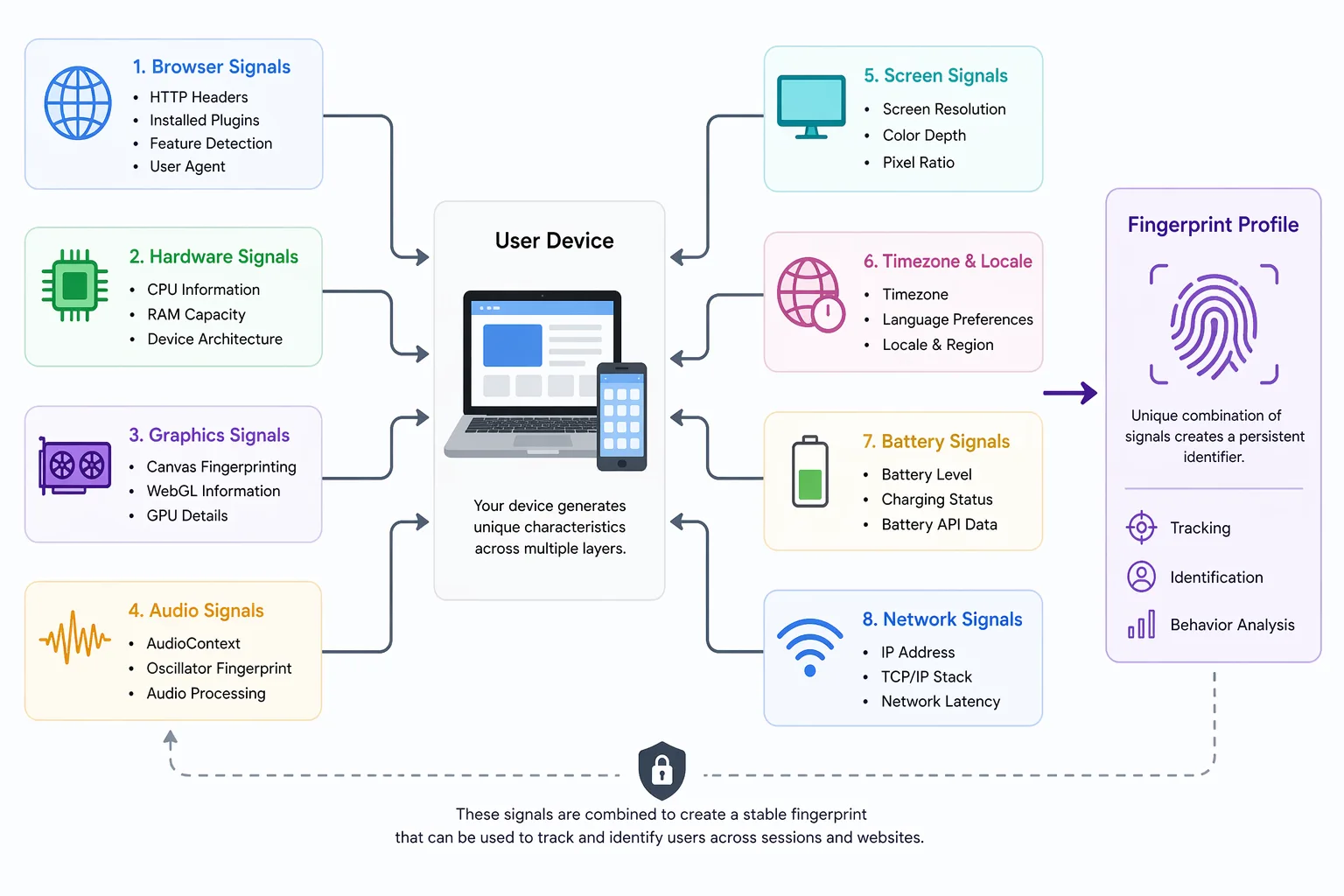
TCP/IP fingerprinting differs from browser fingerprinting in both scope and depth. Browser fingerprinting focuses on software-level signals within the browser, while TCP/IP fingerprinting analyzes the underlying network behavior.
A useful way to understand this is to think of browser fingerprinting as identifying the application layer, while TCP/IP fingerprinting identifies the network layer. Because it operates outside the browser, it is less affected by browser-level privacy tools.
Why TCP/IP Fingerprinting Matters
TCP/IP fingerprinting matters because it provides a foundational layer of identification that is difficult to bypass. It is often used as an initial signal before deeper analysis is performed.
In fraud detection systems, TCP/IP fingerprinting helps identify suspicious activity by analyzing network patterns. For example, if multiple accounts share similar network characteristics, it can indicate coordinated behavior.
From a privacy perspective, TCP/IP fingerprinting is significant because it operates at a level that users rarely control. Unlike cookies or browser settings, network stack behavior is not easily modified.
For developers building automation systems, network consistency is critical. If the network behavior does not match other signals, detection systems can flag the activity. This is why realistic environments must account for both browser and network-level signals.
How TCP/IP Fingerprinting Works in Practice
TCP/IP fingerprinting works by capturing network packets, analyzing their characteristics, and building a profile of the device.
Capturing Network Packets
When a device communicates with a server, it sends TCP/IP packets that contain various fields. These packets can be captured and analyzed by the server or intermediate systems.
The captured data includes information such as packet headers, timing, and connection parameters.
Analyzing Packet Characteristics
The collected packets are analyzed to identify patterns in how the device handles network communication. This includes examining fields such as time-to-live values, window sizes, and sequence numbers.
These patterns can reveal details about the operating system and network configuration.
Building the Network Fingerprint
The analyzed data is combined into a fingerprint that represents the device’s network behavior. This fingerprint can be compared across sessions to identify returning users or detect suspicious activity.
Because network characteristics are relatively stable, this fingerprint can persist over time.
Common Misconceptions About TCP/IP Fingerprinting
There are several misconceptions about TCP/IP fingerprinting that can lead to confusion about its effectiveness.
One common belief is that changing your IP address prevents tracking, but while this changes your network identity, it does not alter the underlying behavior of the network stack.
Another misconception is that TCP/IP fingerprinting is only used for security purposes, but it is also used in tracking and analytics systems.
There is also a belief that this method provides perfect identification, but like other fingerprinting techniques, it is probabilistic. While it provides strong signals, it is not always definitive on its own.
Real-World Examples of TCP/IP Fingerprinting
TCP/IP fingerprinting is widely used in systems that require accurate identification and detection.
In financial platforms, it helps detect fraudulent behavior by identifying unusual network patterns. This allows systems to flag suspicious activity even when other signals appear normal.
In social media environments, TCP/IP fingerprinting contributes to detecting automated behavior. Platforms analyze network-level signals alongside other attributes to identify bots. Tools like Appilot help address this challenge by running automation on real Android devices and networks, where system behavior aligns naturally instead of relying on synthetic configurations.
In network security systems, TCP/IP fingerprinting is used to identify devices and monitor traffic for anomalies.
The Technical Side of TCP/IP Fingerprinting
From a technical perspective, TCP/IP fingerprinting relies on moderate entropy. While individual packet characteristics may not be unique, their combination creates a distinctive profile.
The process involves capturing packet data, analyzing patterns, and integrating the results into a broader fingerprint. This allows systems to efficiently track and identify devices across sessions.
Understanding these technical details helps explain why TCP/IP fingerprinting remains an important component of modern tracking systems.
When TCP/IP Fingerprinting Applies
TCP/IP fingerprinting becomes especially relevant in scenarios where network-level identification is required.
It is important in fraud detection systems, where identifying unusual network behavior can help detect suspicious activity. It is also critical in automation systems, where maintaining realistic network characteristics is necessary to avoid detection. In security applications, understanding this technique helps detect unauthorized or malicious devices.
Frequently Asked Questions
Q: How does TCP/IP fingerprinting work?
It works by analyzing network packet characteristics such as structure, timing, and configuration to identify device behavior.
Q: What is TCP/IP fingerprinting used for?
It is used for fraud detection, network security, and tracking devices across sessions.
Q: Can you block TCP/IP fingerprinting?
It is difficult to fully block because it relies on underlying network behavior, but you can reduce its effectiveness with advanced tools.
Q: Is TCP/IP fingerprinting accurate?
It is moderately effective and becomes more powerful when combined with other fingerprinting methods.
Q: Does changing IP address stop fingerprinting?
No, changing your IP address does not alter the network stack behavior used in fingerprinting.
Q: How does TCP/IP fingerprinting affect automation tools?
It can expose automation systems if network behavior appears inconsistent. Tools that use real-device environments, such as Appilot, tend to produce more reliable results because they maintain natural system behavior.
Key Takeaways
TCP/IP fingerprinting is a technique that identifies devices based on their network behavior, and it plays a foundational role in modern tracking and detection systems. By analyzing how devices send and handle network packets, systems can create a profile that persists across sessions. While it operates at a lower level than browser fingerprinting, it complements other methods to provide a more complete picture of user identity.