Team Members Keep Making Mistakes? Here's Why
When a team starts making repeated mistakes, most people assume the problem is the team itself. They think people are careless, not paying attention, or not following instructions properly. In reality, the issue is usually not the people. The issue is the system.
If browser profiles are poorly named, passwords are stored in different places, proxies are not labeled clearly, and ownership is unclear, even good team members will make mistakes. When people are forced to rely on memory, random spreadsheets, scattered notes, and confusing browser profile lists, mistakes become unavoidable.
For agencies, affiliate marketers, ecommerce teams, social media managers, and outreach teams, repeated team mistakes are often a sign that the operation lacks structure.
The good news is that most mistakes can be reduced significantly once the workflow becomes more organized.
In this guide, you will learn why team members keep making mistakes, what problems usually cause those mistakes, and how to build a system that is easier for everyone to follow.
Time to improve: Usually between one and three days depending on team size. Success rate: High if workflows become more consistent. Cost: Usually low compared to the amount of time and money mistakes waste.
Why Team Members Keep Making Mistakes
Most team mistakes happen because there is too much information to track manually. Team members may need to remember browser profile names, passwords, proxies, recovery emails, client instructions, account notes, and workflow steps all at the same time.
When that information is spread across spreadsheets, browser tabs, chat messages, folders, and bookmarks, it becomes very difficult to stay organized.
Eventually, people start opening the wrong browser profile, using the wrong proxy, sending the wrong message, or logging into the wrong account.
The larger the operation becomes, the more likely these mistakes become.
The Hidden Cost of Team Mistakes
Team mistakes do more than create frustration because they also create expensive problems. A wrong browser profile may get flagged, a client account may get mixed with another project, a password may be lost, or a campaign may be delayed.
These issues become even worse when multiple people are working on the same accounts. Without clear ownership and consistent workflows, it becomes very difficult to know who is responsible for what.
Over time, small mistakes create lost time, lost money, and unnecessary stress.
The Most Common Reasons Teams Make Mistakes
One of the biggest reasons is poor browser profile naming. If profiles are called things like "Profile 12" or "Backup Test," nobody knows what they belong to.
Another common issue is storing information in too many places. Passwords may be in one spreadsheet, recovery emails in another, and client notes somewhere else.
Unclear ownership is another major problem because if nobody knows who is responsible for an account, mistakes are much more likely.
Another common issue is inconsistent workflows. If every team member uses their own system, confusion becomes unavoidable.
How to Reduce Team Mistakes
Step 1: Use Clear Naming Systems
Every browser profile, account, proxy, and folder should follow the same naming structure. The more consistent the naming system becomes, the easier it becomes for people to know what belongs where.
Step 2: Centralize Information
Passwords, recovery emails, phone numbers, proxies, backup codes, notes, and browser profile names should stay in one secure place. The more centralized the information becomes, the fewer mistakes people make.
Step 3: Separate Access by Team Role
Not everyone needs access to everything. Team members should only see the browser profiles, accounts, and credentials they actually need. This reduces confusion and lowers the risk of mistakes.
Step 4: Assign Ownership Clearly
Every browser profile and account should have a clear owner. Even if multiple people work on the same project, there should always be one person responsible for updates, recovery, and account activity.
Step 5: Build Repeatable Workflows
Everyone on the team should follow the same process for browser profile naming, password storage, account setup, proxy assignment, and note management. The more repeatable the workflow becomes, the fewer mistakes people make.
Step 6: Use Search and Filters
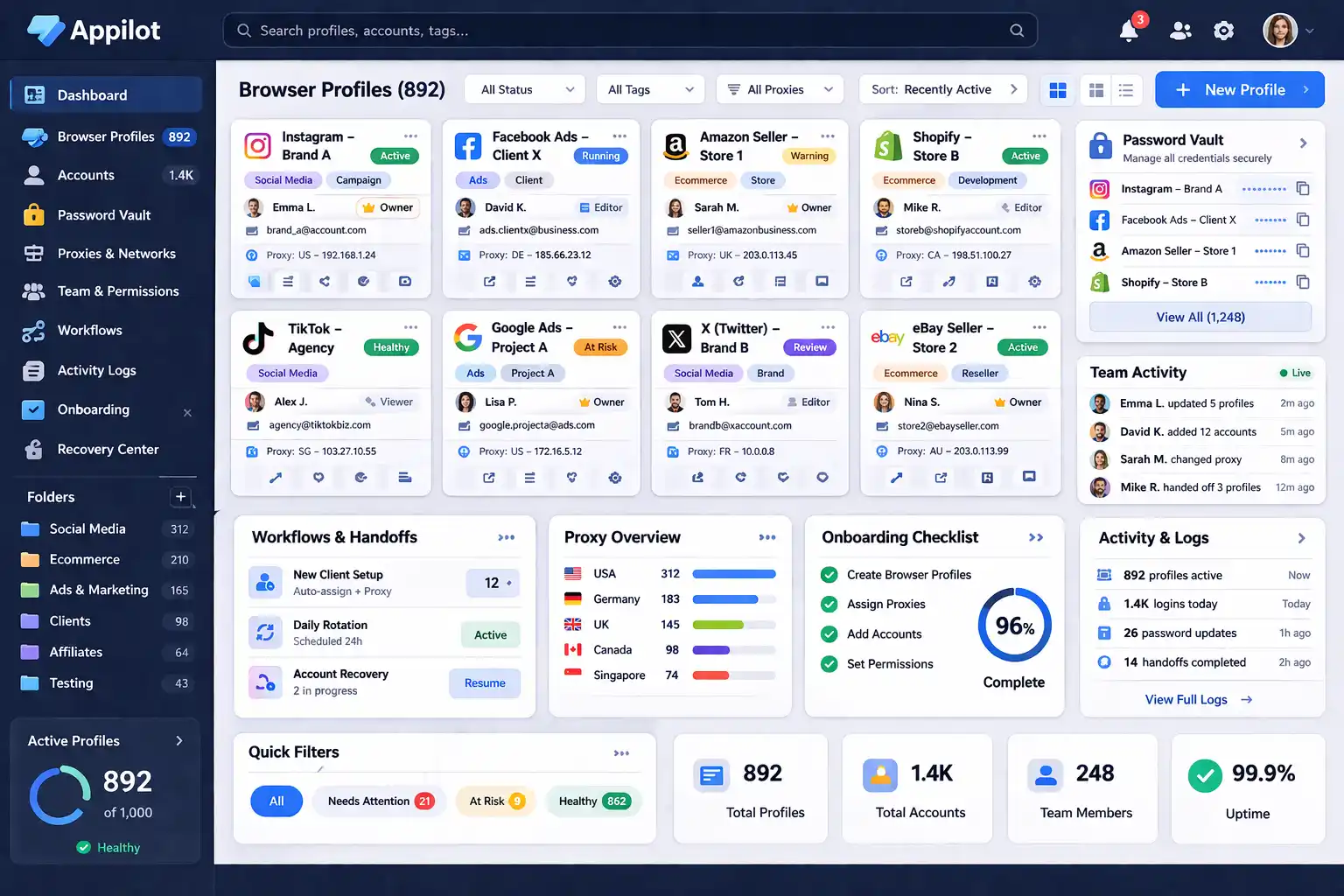
Once you have many browser profiles and accounts, manually searching through long lists becomes very slow. Appilot can help reduce confusion by making browser profiles, credentials, permissions, and account assignments easier to search, filter, and manage.
Step 7: Keep Notes Connected to Accounts
Important notes should stay connected to the account or browser profile they belong to. The more closely notes, passwords, proxies, and ownership details are linked together, the easier it becomes to avoid mistakes.
How to Prevent Team Mistakes in the Future
The best way to reduce mistakes is building structure before the operation becomes too large. Use clear naming systems, centralized credential storage, separate permissions, repeatable workflows, and ownership tracking.
Avoid unclear browser profile names, random spreadsheets, shared passwords, and inconsistent processes. The more organized the system becomes, the easier it becomes for everyone to work without confusion.
Common Mistakes That Make Team Problems Worse
One major mistake is assuming people will remember everything manually. Another mistake is letting every team member use their own naming style and workflow.
People also make the mistake of giving everyone access to everything. Without separate permissions and clear ownership, mistakes become much more likely.
Another common issue is failing to keep notes, credentials, and browser profiles connected together.
Frequently Asked Questions
Q1: Why do team members keep making mistakes?
Because there is often too much information to track manually and not enough structure in the workflow.
Q2: What is the best way to reduce team mistakes?
Use clear naming systems, centralized credential storage, separate permissions, and repeatable workflows.
Q3: Should every browser profile have an owner?
Yes. Clear ownership makes it easier to know who is responsible for updates and account activity.
Q4: How do you stop people from using the wrong account?
Use profile naming systems, organized folders, permissions, and search filters.
Q5: Does Appilot help reduce team mistakes?
Appilot helps make browser profile management, permissions, account assignments, and workflow tracking much easier.
Conclusion
Team mistakes are usually not caused by bad people. They are caused by bad systems.
Once you organize browser profiles properly, centralize information, assign ownership, and create repeatable workflows, teams become much more accurate and productive.
The goal is not just reducing mistakes. The goal is creating a system that makes it easier for everyone to do the right thing.