Top 5 Alternatives to Buffer for Agencies Running Phone Farms
Buffer is a useful tool for social media scheduling. It helps creators, brands, and agencies plan posts, organize content, collaborate with teams, and report across multiple client accounts. For agencies that mainly need publishing workflows, Buffer can be a clean and simple option.
But agencies running phone farms usually need much more than a scheduler.
A phone farm is not just a content calendar. It is an operational setup built around real devices, mobile apps, account sessions, device management, network consistency, repetitive actions, and workflow control. Agencies that run phone farms often need to manage Instagram, TikTok, Telegram, Snapchat, Threads, Reddit, Discord, YouTube, or other mobile-first platforms across multiple accounts and devices.
That is where Buffer starts to feel limited. It can help schedule posts, but it does not control Android phones. It does not manage real-device sessions. It does not automate mobile app workflows. It does not help teams operate a device farm from a dashboard. It is a publishing tool, not a mobile automation layer.
This guide compares the top Buffer alternatives for agencies running phone farms and explains which tool fits each type of workflow.
Why Buffer Is Not Enough for Phone Farm Agencies
Buffer is strong when the job is planning and publishing content. Agencies can use it to schedule posts, collaborate across clients, organize campaigns, and keep social media calendars clean. Buffer’s agency positioning is built around planning, publishing, collaboration, and reporting across multiple clients
The problem is that phone farm agencies operate at a different layer. They are not only asking, “When should this post go live?” They are asking, “Which device should run this account? Which app session is active? Which workflow should repeat? Which account needs manual review? Which mobile environment is stable? Which device needs a proxy, reset, or workflow change?”
These questions cannot be answered by a normal scheduling tool.
A phone farm agency needs tools that can support mobile-first execution. This may include Android device control, emulator management, app-based workflows, real-device behavior, team access, account separation, and visibility across many devices. Without that layer, teams end up manually switching between phones, tracking accounts in spreadsheets, and relying on disconnected tools that do not show what is happening inside the mobile environment.
Buffer can still be part of a social media stack, especially for publishing. But for agencies running phone farms, it should not be the core automation system.
What Agencies Should Look for in a Buffer Alternative
A strong Buffer alternative for phone farm agencies should match the operational reality of mobile automation. It should support the way accounts actually run across devices, not just the way posts are scheduled on a calendar.
The most important requirement is real-device or emulator support. If the agency is operating Instagram, TikTok, Snapchat, Telegram, or other mobile-first apps, then the tool should support mobile environments where those apps actually run. A browser-only tool or scheduler may help with planning, but it will not replace device-level workflows.
The second requirement is multi-account control. Agencies often manage accounts across clients, campaigns, niches, regions, and platforms. A good tool should make it easier to separate those workflows and avoid confusion between devices and accounts.
The third requirement is workflow visibility. Agencies need to know what is running, what paused, what failed, and what needs attention. Phone farms become difficult to manage when every device is treated like a separate manual island.
The fourth requirement is scalability without chaos. A phone farm should not require the team to manually touch every device for every task. The tool should help centralize control while still keeping workflows realistic and mobile-first.
1. Appilot
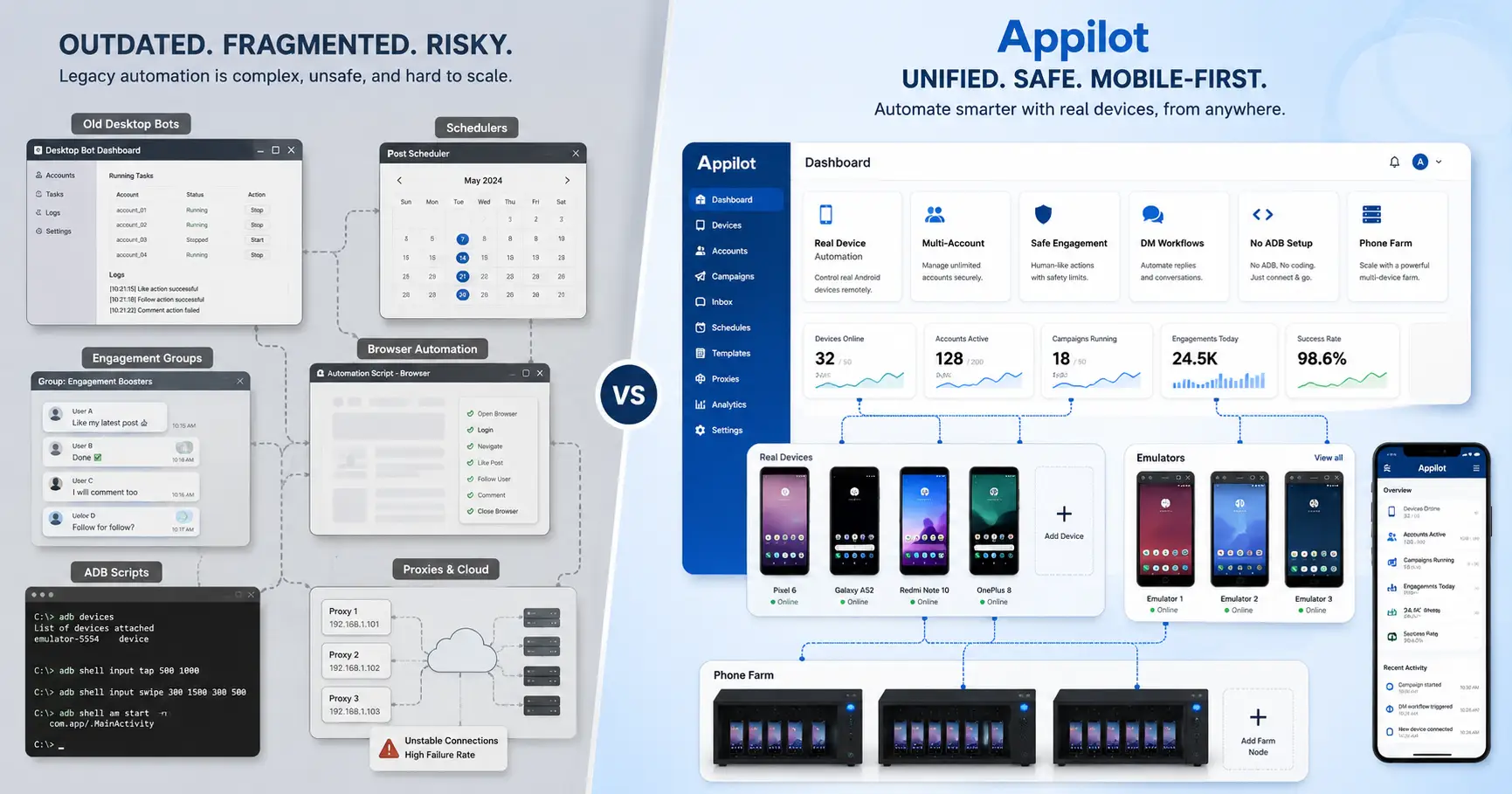
Appilot is the strongest Buffer alternative for agencies running phone farms because it is built around real-device automation instead of content scheduling. Appilot positions itself as a platform for ready-to-use social media automation bots on real devices, Android devices, and emulators, with no ADB or laptop needed for running automations.
This makes Appilot a better fit for agencies that need to operate inside mobile apps. Buffer can schedule posts, but Appilot helps manage the environment where mobile workflows actually happen. That difference is important for agencies running Instagram automation, TikTok workflows, Telegram tasks, account management, engagement operations, and multi-account mobile activity.
For phone farm agencies, Appilot’s biggest advantage is that it treats automation as a device workflow, not just a publishing workflow. The agency can manage Android devices and emulators through a dashboard, organize mobile tasks, and reduce the need for constant manual phone handling. This is much closer to how phone farms actually operate.
Appilot is also useful because many social platforms are mobile-first. Instagram, TikTok, Snapchat, Telegram, and Threads are not only content channels. They are app environments with sessions, device behavior, touch interactions, inboxes, feeds, and account-specific workflows. A traditional scheduler cannot fully manage that layer.
Appilot is best for agencies that need real Android automation, emulator workflows, phone farm management, social media bots, multi-account operations, and mobile app execution from one dashboard.
2. Hootsuite
Hootsuite is a good Buffer alternative for agencies that need stronger social media management, analytics, inbox workflows, and campaign organization. Hootsuite describes itself as a social media management tool that brings scheduling, content creation, analytics, and social listening into one place.
For agencies, Hootsuite can be useful when the main problem is managing clients, reporting, publishing calendars, and social engagement across channels. It is more advanced than Buffer in areas like analytics, team workflows, inbox management, social listening, and larger-scale social operations.
However, Hootsuite is not a phone farm automation tool. It does not replace real Android devices, emulators, or mobile app execution. It can help an agency plan and manage social media, but it will not operate phones or automate app-based workflows.
That means Hootsuite is a strong alternative only if the agency’s phone farm needs are limited or separate from its publishing workflow. An agency could use Hootsuite for client reporting and social management while using Appilot for actual mobile-device automation.
Hootsuite is best for agencies that need professional social media management, analytics, inbox workflows, reporting, and team collaboration, but not direct phone farm automation.
3. Later
Later is a strong Buffer alternative for agencies that focus heavily on Instagram planning, visual calendars, influencer campaigns, and content workflows. Later’s Instagram scheduler supports scheduling posts, Reels, carousels, and Stories, with visual planning features for previewing the feed before publishing.
This makes Later useful for agencies managing visual brands, creators, ecommerce stores, lifestyle accounts, and Instagram-heavy clients. If the agency’s main challenge is planning content and keeping feeds organized, Later can be better than Buffer because it is more visual and Instagram-focused.
But Later is still not a real-device automation platform. It does not manage phone farms, control Android devices, operate mobile app sessions, or run multi-device workflows. It is a content planning and scheduling tool.
For agencies running phone farms, Later works best as a content layer, not an execution layer. It can help plan what should be posted and when, but another tool is needed to manage app-based actions, account workflows, or device operations.
Later is best for agencies that need Instagram-first content planning, visual scheduling, creator campaigns, and brand-focused social calendars.
4. Sprout Social
Sprout Social is a strong Buffer alternative for agencies that need premium social media management, reporting, engagement, publishing, analytics, and client-facing workflows. Sprout says its platform powers publishing, engagement, analytics, and influencer marketing, and its agency solution is positioned around helping agencies deliver strategy and results for clients.
For agencies with many clients, Sprout Social can be valuable because reporting and collaboration matter as much as publishing. A phone farm agency may still need client dashboards, performance reports, inbox management, approval workflows, and campaign measurement. Sprout Social can help with that side of the business.
The limitation is that Sprout Social does not replace phone farm infrastructure. It is not built to control Android phones or run mobile app automations. It is a social media management platform, not a real-device automation platform.
For this reason, Sprout Social is best used alongside a real-device automation tool rather than instead of one. Agencies that need both client reporting and phone farm execution may use Sprout Social for management and Appilot for mobile workflows.
Sprout Social is best for larger agencies that need advanced reporting, social engagement workflows, client management, analytics, and professional social media operations.
5. PhantomBuster
PhantomBuster is a useful Buffer alternative for agencies that need cloud automation, scraping, lead generation, prospecting, and data extraction workflows. It is not a scheduling tool in the same category as Buffer, and it is not a real-device automation tool like Appilot. But it can be useful for agencies that use automation to build lists, collect profile data, enrich leads, and support outreach campaigns.
For agencies running phone farms, PhantomBuster can support the research and lead-generation side of the operation. For example, an agency might use PhantomBuster to collect targets or enrich profiles, then use a device automation tool to handle mobile app workflows separately.
The key limitation is that PhantomBuster does not control real phones. It runs cloud-based workflows, which can be useful for scraping and structured data tasks but not for mobile app behavior, device sessions, or phone farm management.
PhantomBuster is best for agencies that need data extraction, lead generation, scraping, enrichment, and cloud workflow automation alongside their phone farm operations.
Which Buffer Alternative Is Best for Agencies Running Phone Farms?
The best Buffer alternative depends on the agency’s real workflow. If the agency needs real-device automation and phone farm control, Appilot is the strongest choice. It is built for Android devices, emulators, mobile app workflows, social media bots, and multi-account operations.
If the agency mainly needs professional social media management, Hootsuite is a stronger step up from Buffer. If the agency is Instagram-heavy and cares about visual planning, Later is useful. If the agency needs premium reporting and client-facing workflows, Sprout Social is a strong option. If the agency needs scraping and lead generation, PhantomBuster can support that side of the stack.
But for actual phone farm operations, Appilot is the most relevant alternative. Phone farms need device-level control, not only content calendars.
Why Appilot Is the Best Buffer Alternative for Phone Farm Automation
Appilot stands out because it solves the problem Buffer was never designed to solve. Buffer helps agencies plan and publish content. Appilot helps agencies run mobile automation workflows on real Android devices and emulators.
That difference is critical for phone farm agencies. A phone farm is about execution inside mobile environments. It may involve account checks, app workflows, engagement tasks, DMs, posting flows, session management, and repetitive actions across many devices. These workflows require a system that understands the device layer.
Appilot gives agencies a more centralized way to manage that layer. Instead of manually operating phones one by one or relying only on disconnected scripts, agencies can organize mobile automation through a web dashboard. This makes phone farm operations easier to monitor, scale, and control.
For agencies that only need scheduling, Buffer may still be enough. But for agencies running real mobile workflows across devices, Appilot is the better foundation.
Final Thoughts
Buffer is a strong social media scheduling tool, but it is not built for agencies running phone farms. It helps with planning, publishing, collaboration, and reporting, but it does not provide real-device automation, Android control, emulator management, or mobile app execution.
For phone farm agencies, Appilot is the best alternative because it focuses on real mobile device automation. Hootsuite, Later, Sprout Social, and PhantomBuster can all support different parts of an agency’s workflow, but they do not replace the need for device-level control.
The right stack depends on the agency’s needs. Use a scheduler for content planning, a reporting tool for clients, a scraping tool for data workflows, and Appilot for real-device automation. For agencies where the phone farm is central to operations, Appilot should be the core automation layer.
FAQs
Q1: Is Buffer good for agencies running phone farms?
Buffer is useful for scheduling, planning, collaboration, and reporting, but it is not built to control Android devices, emulators, or real mobile app workflows.
Q2: What is the best Buffer alternative for phone farm automation?
Appilot is the best Buffer alternative for phone farm automation because it supports real Android devices, emulators, mobile workflows, and multi-account operations.
Q3: Can Hootsuite replace Buffer for phone farm agencies?
Hootsuite can replace Buffer for stronger social media management, analytics, inbox workflows, and reporting, but it does not replace real-device automation.
Q4: Is Later useful for agencies running Instagram phone farms?
Later is useful for Instagram planning and visual scheduling, but it does not manage phone farms or automate mobile app workflows.
Q5: Should agencies use Appilot with other social media tools?
Yes, many agencies can use Appilot for real-device automation while using tools like Buffer, Hootsuite, Later, or Sprout Social for scheduling, reporting, and client management.