Top ADB-Free Alternatives to UIAutomator2 for Instagram Bots
UIAutomator2 is one of the most common Android automation technologies used by developers, QA engineers, and automation teams. It is powerful because it can interact with Android apps at the UI level, inspect elements, perform actions, and support automated workflows across devices and emulators.
For testing teams, UIAutomator2 can be a strong choice. It works well when the goal is to write structured automation scripts, run test cases, inspect app behavior, and validate Android app flows. But for Instagram bot operators, agencies, phone farm users, growth teams, and non-technical social media managers, UIAutomator2 often creates a different problem.
It is too technical for many real-world Instagram automation workflows.
Most Instagram bot users do not want to manage ADB connections, device drivers, Appium servers, test scripts, selectors, ports, SDK setup, emulator configuration, command-line tools, or unstable local environments. They want to run Instagram workflows, manage multiple accounts, control mobile devices, automate repetitive actions, and reduce manual work without constantly debugging the automation stack.
That is why ADB-free alternatives are becoming more important. The best alternative is not always another developer framework. For Instagram bots, the better option is usually a platform that hides the technical device-control layer and gives users a practical workflow system for real-device automation, mobile app operations, and multi-account management.
This guide compares the top ADB-free alternatives to UIAutomator2 for Instagram bots and explains where each one fits best.
Why Instagram Bot Users Look for ADB-Free Alternatives to UIAutomator2
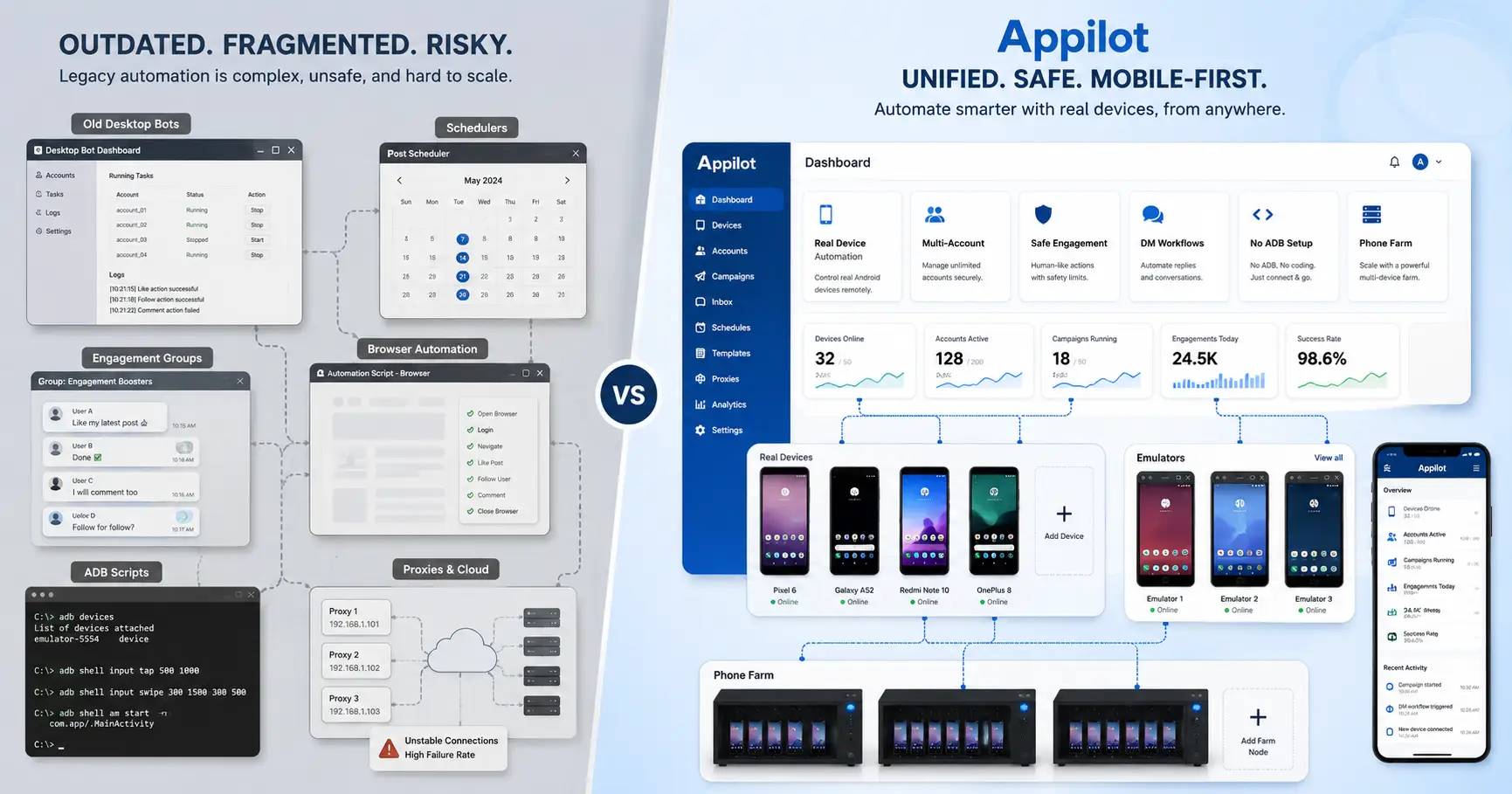
UIAutomator2 is designed for Android UI automation, not specifically for Instagram growth workflows. It can automate interactions, but it usually requires a technical setup. Users often need Appium, Android SDK tools, device debugging, ADB authorization, selectors, scripts, test runners, and ongoing maintenance.
That may be normal for QA engineers, but it is often too much for social media automation teams. An Instagram bot workflow is usually not just one clean test case. It may involve account switching, profile checks, posting, DMs, engagement actions, warming routines, app navigation, session handling, proxy coordination, and multi-account workflows across many devices.
When every device depends on ADB and local setup, the system can become fragile. Devices disconnect. USB authorization fails. Emulators freeze. Selectors change. App updates break flows. Local machines become bottlenecks. Scaling from one device to ten or fifty devices becomes harder than expected.
ADB-free alternatives help reduce this operational burden. Instead of forcing users to build and maintain the whole automation stack, they provide easier control layers for mobile workflows. For Instagram bot users, this can save time, reduce technical complexity, and make multi-account operations easier to manage.
What to Look for in an ADB-Free Instagram Automation Alternative
A good ADB-free alternative should make Instagram automation easier without removing the control that power users need. The tool should support mobile app workflows, account management, device visibility, workflow monitoring, and repeatable automation.
The first thing to look for is real-device or emulator support. Instagram is a mobile-first platform, so automation that runs closer to mobile app behavior is usually more relevant than browser-only automation.
The second thing to look for is no ADB dependency for normal users. If the tool still requires users to manually connect devices through ADB, configure SDK paths, approve debugging prompts, and troubleshoot device bridges, it does not really solve the UIAutomator2 complexity problem.
The third thing to look for is multi-account control. Instagram bot users often manage more than one account, so the tool should make it easier to organize accounts, workflows, devices, and campaigns.
The fourth thing to look for is workflow visibility. A black-box bot is risky because users cannot easily see what is happening. A better platform should let users monitor workflows, pause actions, inspect results, and adjust execution.
The fifth thing to consider is whether the tool is built for social media automation or general app testing. Testing platforms can be useful for QA, but they are not always practical for Instagram growth, phone farms, or social media operations.
1. Appilot
Appilot is the strongest ADB-free alternative to UIAutomator2 for Instagram bots because it is built around real-device social media automation instead of developer-focused test automation. Appilot is designed for users who want to run mobile automation on Android devices and emulators without managing ADB, laptops, or technical test frameworks.
This makes Appilot very different from UIAutomator2. UIAutomator2 is a low-level automation layer that developers can use to build Android automation. Appilot is a workflow platform for people who need practical social media automation on real mobile environments.
For Instagram bot users, this difference matters a lot. Instagram workflows often happen inside the mobile app, where account behavior, sessions, DMs, feeds, profiles, and app navigation all matter. Appilot gives teams a way to manage those mobile workflows from a web dashboard instead of manually controlling every device or building every automation from scratch.
Appilot is especially useful for agencies, phone farm operators, growth teams, and multi-account managers. These users usually need to control many accounts and devices, not just run one test script. Appilot helps centralize the workflow so users can manage Instagram automation more easily without depending on a local ADB setup.
Another advantage is that Appilot is social-media focused. Many general automation frameworks are flexible, but they require users to build everything themselves. Appilot is more practical for users who want ready-to-use automation flows, real-device behavior, emulator support, and mobile workflow control.
Appilot is best for Instagram bot users who need ADB-free Android automation, real-device workflows, emulator support, multi-account management, phone farm operations, and a more user-friendly alternative to UIAutomator2.
2. MacroDroid
MacroDroid is a useful ADB-free alternative for users who want simple Android automation directly on a device. It allows users to create macros based on triggers, actions, and constraints. For example, users can create automations that respond to device events, open apps, tap certain flows, adjust settings, or perform routine phone actions.
For Instagram bot users, MacroDroid can be useful for lightweight device-level automation. It may help with simple repetitive actions, notifications, app launching, timing-based routines, and basic workflow support. It is easier for non-developers than UIAutomator2 because users do not need to write full Appium scripts or manage a testing framework.
However, MacroDroid is not a complete Instagram bot platform. It is a general Android automation app, not a social media automation dashboard. It does not provide the same level of centralized phone farm management, multi-account workflow control, real-device bot orchestration, or agency-level monitoring that Appilot is designed for.
MacroDroid is best for individual users who need simple on-device automation and do not want to write code. It is less suitable for agencies or teams managing many Instagram accounts across many devices.
3. Tasker
Tasker is another Android automation tool that can help users automate device behavior without relying on UIAutomator2 directly. It is powerful, flexible, and widely known among Android power users. Tasker can create advanced automation flows based on triggers, device states, app events, variables, plugins, and custom logic.
For technical users who want more control than MacroDroid but still want to avoid building a full Appium and UIAutomator2 stack, Tasker can be useful. It can support device-level routines, app launching, notification handling, timed actions, and automation logic that helps support Instagram workflows.
The limitation is that Tasker still requires setup thinking. It is easier than writing a full UIAutomator2 framework, but it can become complex when workflows grow. It is also not specifically built for Instagram bots, phone farms, or multi-account social media automation.
Tasker is best for Android power users who want flexible automation on individual devices. It is not the best choice for agencies that need centralized real-device Instagram automation at scale.
4. Automate by LlamaLab
Automate by LlamaLab is an Android automation app that uses flowcharts to build automation logic. Users can create flows that respond to events, perform device actions, interact with apps, manage files, send notifications, or run routines.
For users who dislike coding, the visual flowchart style can be easier than UIAutomator2 scripting. It gives users a more approachable way to think about automation logic without writing full test scripts or managing Appium servers.
For Instagram bot workflows, Automate may help with supporting tasks around app launching, scheduling routines, notifications, and device-level actions. It can be useful for small setups where the user wants more control than a simple macro app but does not want to build a full custom automation stack.
The main limitation is scale. Automate is not built as a dedicated Instagram bot platform or phone farm management system. It does not provide the same centralized dashboard, social media workflow focus, or multi-device orchestration that Appilot offers.
Automate is best for individual Android users and small technical setups that need visual device automation without full UIAutomator2 development.
5. BrowserStack App Automate
BrowserStack App Automate is a strong alternative for teams that need real-device app testing without maintaining their own device lab. It gives QA teams access to real mobile devices in the cloud and supports automated testing workflows.
For users comparing it with UIAutomator2, BrowserStack can reduce local device management problems. Teams do not need to maintain every device physically, and they can run tests across many environments. This is useful for mobile developers and QA teams.
However, BrowserStack is not designed for Instagram bots. It is a testing platform, not a social media automation or phone farm tool. It is useful if your goal is to test an Android app, validate UI flows, or run QA automation. It is not the best fit if your goal is to operate Instagram accounts, run growth workflows, manage DMs, or automate social media actions.
BrowserStack App Automate is best for engineering and QA teams that want cloud-based mobile app testing, not Instagram bot operators.
6. Sauce Labs
Sauce Labs is another mobile testing platform that can reduce the burden of local Android automation setup. It supports automated testing across real and virtual devices and is often used by engineering teams that need reliable QA infrastructure.
Compared with UIAutomator2 on a local machine, Sauce Labs can make testing infrastructure easier to manage. Teams can run automated tests remotely and avoid maintaining every device themselves.
But like BrowserStack, Sauce Labs is not a purpose-built Instagram bot platform. It is designed for test automation, not social media account management. It does not provide Instagram-specific workflows, phone farm operations, account control, or mobile social automation features.
Sauce Labs is best for mobile QA teams and product engineering teams. For Instagram bot users, Appilot is a more relevant option.
7. Kobiton
Kobiton is a real-device testing platform used by teams that need mobile app testing, debugging, and device access. It can help engineering teams test apps across real devices without building an internal device lab.
Kobiton can be useful as an alternative to local UIAutomator2 setups when the goal is app testing. It gives teams access to mobile environments and helps reduce the need for physical device maintenance.
However, Kobiton does not solve the Instagram bot use case directly. It is not built for growth automation, social media account management, Instagram workflows, or multi-account operations. It belongs to the mobile QA category rather than the social media automation category.
Kobiton is best for app developers, QA engineers, and testing teams that need device access and mobile app validation.
8. Katalon
Katalon is a test automation platform that supports web, API, mobile, and desktop testing. It is useful for teams that want a more structured and user-friendly testing environment than building everything from scratch with Appium and UIAutomator2.
For QA teams, Katalon can be easier because it provides a test authoring interface, object repository, test management, and execution features. It can reduce some of the complexity of raw automation scripting.
But Katalon is still mainly a testing platform. It is not built specifically for Instagram bot workflows, phone farms, or multi-account social media automation. It can help test mobile apps, but it does not replace a platform designed for real-device Instagram operations.
Katalon is best for QA teams that need mobile test automation with less raw scripting. It is not the best choice for social media operators who need Instagram bots.
Which ADB-Free Alternative Is Best for Instagram Bots?
The best alternative depends on the user’s goal. If the goal is real Instagram bot automation, mobile app workflows, multi-account management, and phone farm operations, Appilot is the strongest choice. It is the most relevant option because it is designed around social media automation on real Android devices and emulators without requiring users to manage ADB manually.
If the goal is simple personal Android automation, MacroDroid, Tasker, or Automate may be enough. These tools can help with device routines but are not full Instagram bot platforms.
If the goal is mobile app testing, BrowserStack, Sauce Labs, Kobiton, or Katalon may be useful. These tools are strong for QA teams but not ideal for Instagram growth or social media automation.
The key is to avoid comparing tools only by whether they can automate Android. UIAutomator2, Appilot, MacroDroid, BrowserStack, and Katalon all relate to Android automation, but they solve very different problems.
For Instagram bots, Appilot is the best fit because it combines real-device automation, social media workflow focus, emulator support, and an ADB-free user experience.
Why Appilot Is the Best UIAutomator2 Alternative for Instagram Bots
Appilot is the best UIAutomator2 alternative for Instagram bots because it removes the technical friction that makes UIAutomator2 difficult for non-developers. Users do not need to build Appium scripts, configure ADB, manage local device bridges, or maintain a full Android testing stack.
Instead, Appilot gives teams a more practical way to run mobile social media workflows through real Android devices and emulators. This is especially important for Instagram because the platform is mobile-first and many useful workflows happen inside the app.
For agencies, phone farm operators, and growth teams, Appilot also makes scaling easier. Managing one device manually is possible. Managing many devices manually is slow and messy. Appilot helps centralize the device workflow so users can operate more consistently across accounts.
The biggest advantage is that Appilot focuses on social media automation rather than generic testing. UIAutomator2 is powerful, but it is a building block. Appilot is closer to a usable workflow platform for Instagram automation.
Final Thoughts
UIAutomator2 is powerful, but it is not always the right tool for Instagram bot users. It was built for Android UI automation and testing, which means it usually requires technical setup, scripts, ADB, Appium, device configuration, and ongoing maintenance.
For developers and QA engineers, that may be acceptable. For agencies, phone farm operators, and Instagram automation users, it can become a bottleneck.
ADB-free alternatives make mobile automation more practical. MacroDroid, Tasker, and Automate can help with simple Android routines. BrowserStack, Sauce Labs, Kobiton, and Katalon can help with mobile app testing. But for Instagram bots, Appilot is the strongest option because it focuses on real-device social media automation, Android and emulator workflows, multi-account control, and ADB-free execution.
If your goal is to build a testing framework, UIAutomator2 may still be useful. But if your goal is to run Instagram automation without constantly managing technical device setup, Appilot is the better modern alternative.
FAQs
Q1: Is UIAutomator2 good for Instagram bots?
UIAutomator2 can automate Android UI actions, but it is technical and usually better suited for developers or QA teams than non-technical Instagram bot users.
Q2: What is the best ADB-free alternative to UIAutomator2 for Instagram bots?
Appilot is the best ADB-free alternative because it supports real Android devices, emulators, social media automation, and multi-account workflows without requiring users to manage ADB manually.
Q3: Can MacroDroid or Tasker replace UIAutomator2?
MacroDroid and Tasker can replace UIAutomator2 for simple device automation, but they are not full Instagram bot platforms or phone farm management systems.
Q4: Are BrowserStack and Sauce Labs good for Instagram automation?
BrowserStack and Sauce Labs are strong for mobile app testing, but they are not designed for Instagram bots, account workflows, or social media automation.
Q5: Why is Appilot better for Instagram bot workflows?
Appilot is better because it is built for real-device social media automation, Android and emulator workflows, multi-account operations, and ADB-free mobile execution.