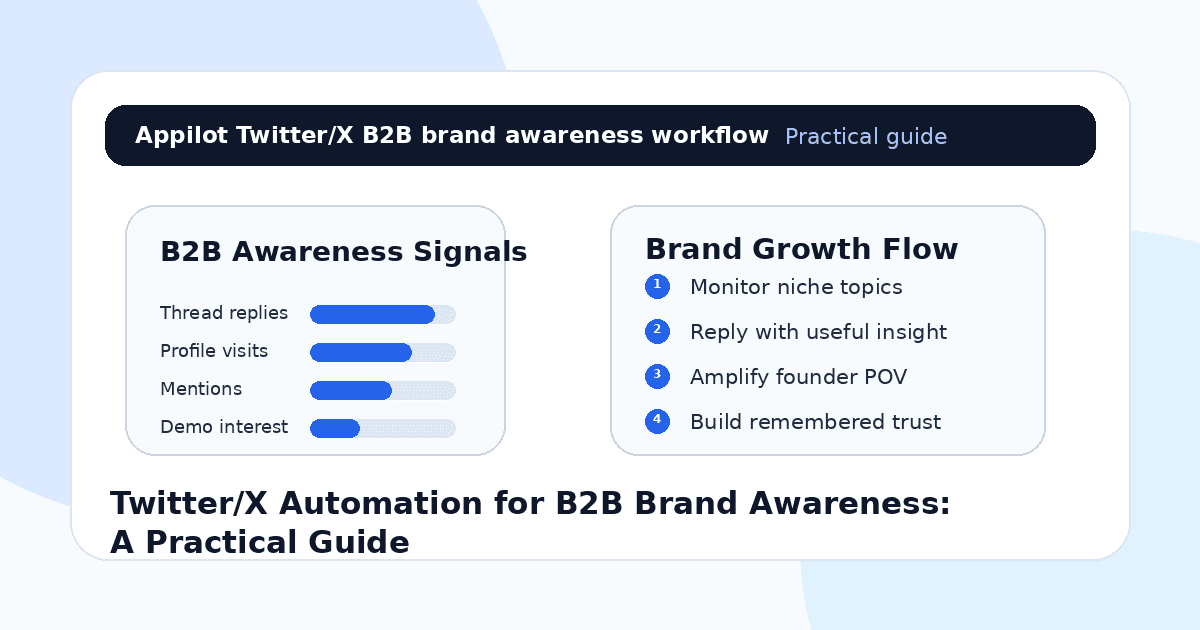
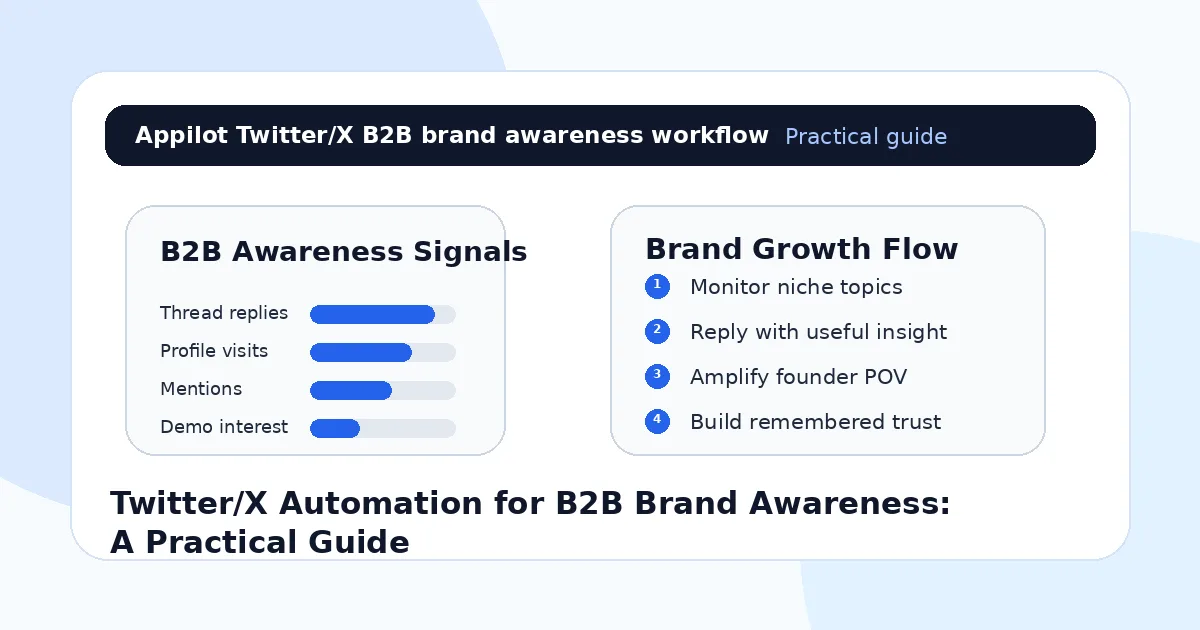
Twitter/X Automation for B2B Brand Awareness: A Practical Guide
You publish a thoughtful post about your industry. It is useful, specific, and tied to a problem your buyers actually care about.
A few people like it. Maybe one customer reposts it. Someone replies with a smart comment. Then the post fades, and by the next day, your brand is back to being invisible to most of the market.
That is the hard part about B2B brand awareness on Twitter/X. One good post rarely changes anything. Awareness comes from repeated appearances in the right conversations, from the right accounts, with a clear point of view people remember.
Twitter/X automation helps B2B teams make that repetition more consistent. Not by blasting generic replies or spamming links, but by helping teams find relevant conversations, engage with the right audience, monitor buyer pain points, and keep the brand active without living inside the platform all day.
Why B2B Brand Awareness Is Hard on Twitter/X
Twitter/X moves quickly. A good post can disappear in hours, and even useful ideas need repetition before the market remembers them.
For B2B companies, the challenge is not just posting more. It is showing up where buyers, operators, founders, marketers, sales leaders, recruiters, developers, creators, or industry experts are already talking.
That takes time.
Someone has to monitor keywords, follow niche conversations, reply to relevant threads, engage with ideal customers, share product lessons, respond to mentions, and keep the company’s point of view visible. Doing that manually can take 45 to 90 minutes a day.
Most B2B teams get Twitter/X wrong because they treat it like a company announcement board. They post feature updates, blog links, and launch news, but rarely join the conversations where awareness is actually built.
The market remembers brands that participate, not brands that only broadcast.
What Twitter/X Automation Means for Brand Awareness
Twitter/X automation means using software to handle repeated discovery and engagement tasks. That can include monitoring keywords, finding relevant accounts, liking useful posts, following niche users, surfacing threads to reply to, supporting DM workflows, and helping teams stay active around specific topics.
For brand awareness, the goal is different from lead generation. You are not trying to push every person toward a demo right away. You are trying to make the right audience repeatedly see your brand associated with a clear problem, category, or belief.
Real-device automation can be useful because it runs workflows through Android devices or emulators instead of relying only on fragile browser scripts or API shortcuts. That gives teams a more mobile-native way to manage repeated social actions.
A platform like Appilot is built around this kind of workflow. It lets B2B teams run Twitter/X automation on Android devices or emulators from a browser dashboard, without coding, ADB setup, or keeping a laptop connected all day. For marketing teams, that means discovery and engagement can run more consistently while humans keep control of voice, positioning, and strategy.
Automation should make your brand more present. It should not make it sound automated.
Step 1: Define What You Want to Be Known For
Before automating anything, decide what your brand should be remembered for.
A B2B brand cannot be known for everything. A sales software company might want to be known for better outbound quality. A recruiting agency might want to be known for faster technical hiring. A cybersecurity SaaS might want to be known for reducing compliance chaos. A marketing agency might want to be known for building demand without wasting ad spend.
This matters because automation will increase your activity. If your message is unclear, more activity only creates more noise.
Choose a few core themes. These should connect your product, buyer pain, market point of view, and customer outcomes. Then build your Twitter/X automation around those themes.
If your brand wants to own “better onboarding for remote teams,” the automation should help you find and engage with conversations around onboarding, remote work, employee activation, HR systems, manager training, and retention.
Awareness starts with clarity.
Step 2: Monitor Buyer Pain Points
Twitter/X is valuable because people complain, debate, ask questions, and share problems in public.
That is useful for B2B teams.
Instead of only tracking brand mentions, monitor the language your buyers use when they describe pain. A founder might post about churn. A sales leader might complain about low reply rates. A developer might rant about flaky tests. A recruiter might talk about candidate drop-off. A marketer might discuss attribution problems.
Automation can help surface these conversations more consistently.
This is where Appilot’s Twitter/X automation can fit naturally. It can help B2B teams run repeated discovery workflows through Android devices or emulators while the team controls the keywords, audience segments, and topics from a dashboard.
The goal is not to jump into every thread with a pitch. The goal is to understand what the market is already saying and show up with useful perspective.
Step 3: Use Replies to Build Recognition
Replies are one of the most underrated awareness channels on Twitter/X.
A company account with 1,000 followers can still get seen by the right buyers if it leaves thoughtful replies under the right posts. This is especially true when founders, operators, influencers, analysts, or category leaders are already discussing a topic your brand understands well.
Good replies are not generic. They add something.
They might share a practical example, correct a misconception, explain a trade-off, give a short framework, or mention what your team sees in the market. The product does not need to appear in every reply.
Automation can help find the right threads, but humans should still shape the best replies. A lazy automated reply like “great insight” does nothing for brand awareness. A useful reply that makes someone pause can create profile visits, follows, and future trust.
The best B2B brands become familiar before they become needed.
Step 4: Publish a Clear Point of View Consistently
Brand awareness is built through repetition.
Your account should not post random thoughts every day. It should repeat a few strong ideas from different angles until the market starts associating you with them.
For example, if you sell customer support software, your themes might include faster response times, AI escalation, support quality, and customer retention. If you sell analytics software, your themes might include cleaner data, attribution, dashboards, and decision-making.
Your posts can include short takes, customer lessons, mini case studies, industry observations, founder opinions, product examples, and mistakes your buyers should avoid.
Automation supports distribution and engagement, but your point of view still needs to come from real experience.
One reason B2B teams use Appilot-style workflows is that automation can help keep engagement around those posts active without manually managing every repeated action. The message stays human. The routine work becomes easier.
Step 5: Avoid Turning Awareness Into Spam
This is where many teams ruin Twitter/X automation.
They automate likes, replies, follows, and DMs too aggressively. They use vague comments. They push links too early. They treat every conversation like a sales opportunity.
That does not build awareness. It builds irritation.
Brand awareness should feel like helpful presence. People should see your account and think, “They understand this problem,” not “They are trying to sell me something again.”
Keep activity targeted. Keep replies useful. Avoid cold DMs unless there is clear intent. Do not reply to every keyword mention with the same message.
A strong automation strategy is controlled and selective.
A weak one is loud.
Step 6: Turn Attention Into Soft Conversion Paths
Awareness does not always convert immediately, but it should have a path.
If someone sees your replies and visits your profile, they should understand what you do within seconds. Your bio should be clear. Your pinned post should explain your strongest idea or offer. Your link should lead to something useful, such as a product page, newsletter, demo page, guide, benchmark report, template, or community.
For B2B brand awareness, soft conversion often works better than pushing a demo too early.
Someone may not be ready to buy today, but they might subscribe to a newsletter, download a checklist, follow your founder, join a webinar, or bookmark a guide. Those touchpoints make future sales easier.
Automation helps create visibility. Your profile and content need to turn that visibility into memory and trust.
Step 7: Measure Awareness With the Right Signals
Brand awareness is harder to measure than direct lead generation, but it is not impossible.
Track profile visits, branded search lift, follower quality, mentions, replies from target buyers, newsletter signups, content saves, link clicks, inbound DMs, demo assists, and how often prospects mention seeing your posts before a sales call.
You should also track which themes create the most useful engagement. A post with fewer likes but more replies from ideal buyers may be more valuable than a viral post that attracts the wrong audience.
The goal is not to become popular with everyone. The goal is to become familiar to the market that can eventually buy from you.
Automation should be judged by whether it increases relevant awareness, not just activity volume.
Common Mistakes B2B Teams Should Avoid
Automating Generic Replies
Replies like “great post” or “love this” do not build awareness. They make the account look automated and forgettable.
Posting Only Company Updates
Launches and blog links are fine, but they should not be the whole strategy. Buyers remember useful ideas and strong opinions more than announcements.
Chasing the Wrong Audience
A big audience is not always a useful audience. Focus on the people who influence, use, buy, or recommend your product.
Sending DMs Too Early
Cold DMs can damage trust if they arrive before context. Build recognition first, then use DMs only when there is clear interest.
Measuring Only Impressions
Impressions can be misleading. Track profile visits, quality replies, mentions, branded search, inbound interest, and assisted pipeline.
Is Twitter/X Automation Right for B2B Brand Awareness?
Twitter/X automation is a good fit if your buyers, users, influencers, or category voices are active on the platform. It works especially well for SaaS, agencies, developer tools, AI products, creator tools, recruiting firms, marketing services, fintech, startup services, and founder-led brands.
It may not be right if your buyers are not active on Twitter/X or your company has no clear point of view. Automation can make you more visible, but it cannot make a vague brand memorable.
Think of it as a consistency layer. It helps your brand show up more often, but your ideas make people remember you.
Final Thoughts
B2B brand awareness on Twitter/X is built through repeated, useful presence in the right conversations.
Automation helps teams monitor topics, find buyers, engage with relevant threads, support founder-led content, and keep activity consistent. But the voice, point of view, and judgment still need to be human.
If you want to run Twitter/X automation without coding, ADB setup, or manual device management, Appilot gives B2B teams a browser-based way to control Android devices, emulators, and ready-to-use bots for Twitter/X, LinkedIn, Instagram, TikTok, and other platforms. You can check it out at appilot.app.
FAQs
Q1: Can Twitter/X automation help B2B brand awareness?
Yes, it can help B2B teams find relevant conversations, engage target audiences, monitor buyer pain points, and stay visible consistently.
Q2: What should B2B brands automate first on Twitter/X?
Start with keyword monitoring, account discovery, relevant thread tracking, light engagement, and surfacing reply opportunities.
Q3: Is Twitter/X automation safe for B2B companies?
It is safer when activity is targeted, gradual, and useful. Generic replies, spam DMs, and aggressive automation can still damage trust.
Q4: Can Appilot help with Twitter/X automation?
Yes, Appilot can run Twitter/X workflows on Android devices or emulators from a browser dashboard without coding or ADB setup.
Q5: Does automation replace brand strategy?
No. Automation supports consistency, but clear positioning, useful content, strong opinions, and human judgment build real brand awareness.