UIAutomator vs Appium vs Accessibility Service: Which Framework Produces the Safest Bots?
Android bot safety is not only about the action the bot performs. It is also about how that action is executed, what system layer the bot uses, whether the device looks natural, how stable the session is, and whether the automation behaves like a real user. That is why UIAutomator, Appium, and Accessibility Service produce very different automation experiences even when they all appear to tap buttons, scroll screens, and interact with apps.
For social media automation, the safest bot is usually not the one with the most technical power. It is the one that creates the most realistic app interaction while avoiding unstable setup, repeated failures, unnatural timing, and excessive device signals. A bot that constantly reconnects through ADB, crashes during sessions, or repeats actions too perfectly can create more risk than a slower workflow that behaves naturally on a real Android device.
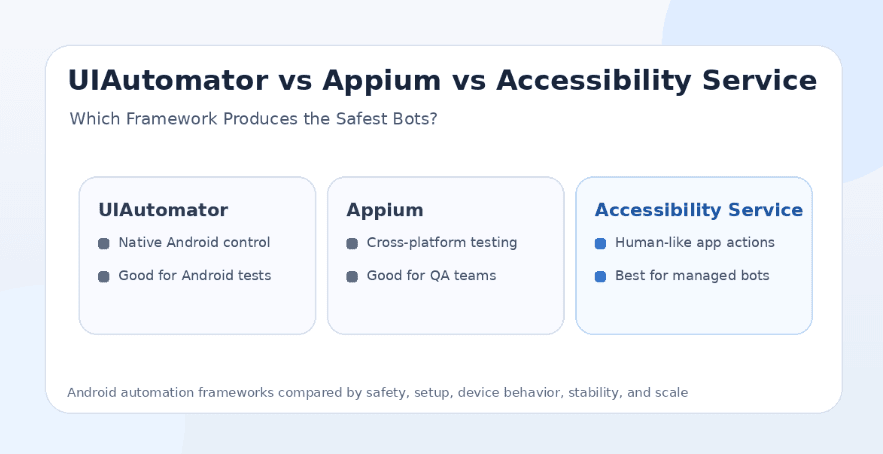
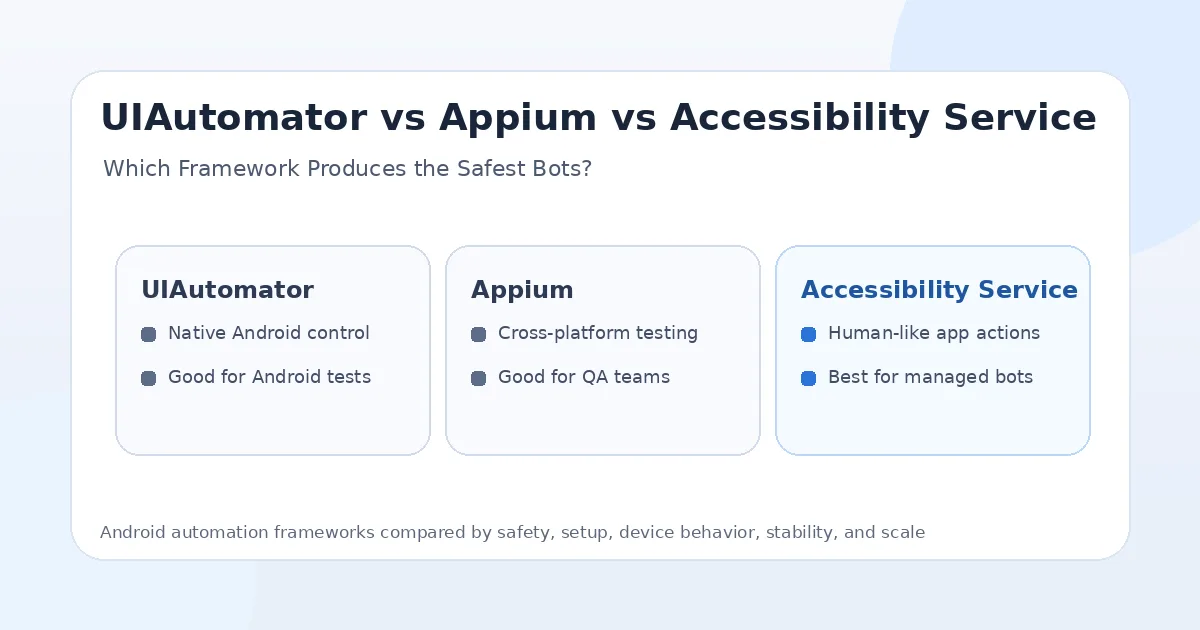
The short answer is that Accessibility Service is often the best framework for long-running social media bots because it can interact with apps in a more user-like way without depending on constant ADB control. UIAutomator is strong for Android testing and native device control. Appium is excellent for QA teams and cross-platform testing, but it is usually heavier than necessary for production social bots.
What Is UIAutomator?
UIAutomator is Android’s native UI testing framework. It allows automation to inspect and interact with Android app screens from outside the app process. Developers and QA engineers use it to write tests that tap buttons, scroll lists, find UI elements, verify screen states, and automate Android app flows.
Its biggest strength is that it is close to Android’s own testing ecosystem. It can work well for native Android app testing, device-level UI validation, and repeatable workflows where the goal is reliability in a controlled test environment.
For bot operators, UIAutomator can be useful because it interacts with real app UI elements rather than only relying on image recognition or blind taps. The limitation is that it is still more of a testing framework than a production bot framework. It usually requires technical setup, Android tooling, device access, and careful handling of selectors, app states, and execution stability.
What Is Appium?
Appium is an open-source mobile automation framework used for testing Android, iOS, mobile web, and hybrid apps. On Android, Appium commonly works through the UIAutomator2 driver, which means it often relies on Android’s UI automation layer while adding a WebDriver-based server and client structure on top.
The biggest advantage of Appium is cross-platform testing. QA teams can write automation scripts in languages like Python, JavaScript, Java, Ruby, or C# and run tests across different devices, apps, and platforms. This makes Appium very useful for companies that need structured mobile test automation.
For social media bots, Appium can work, but it is often heavier than needed. It usually requires Appium server setup, Android SDK tools, capabilities, device connections, drivers, and debugging. That complexity can create friction for long-running bot operations, especially when the goal is not formal testing but stable, repeated app interaction across multiple accounts.
What Is Accessibility Service?
Accessibility Service is an Android system feature originally designed to help users with disabilities interact with apps more easily. It can observe UI changes, read screen elements, perform gestures, tap buttons, scroll, and assist with app navigation. Because it works at the user-interface level, it can be adapted for automation workflows that need to behave closer to real user interaction.
For bots, Accessibility Service can be powerful because it can run directly on the device without needing constant ADB commands or a desktop testing server. This makes it useful for long-running workflows, phone farms, and mobile-first social media automation.
The important detail is that Accessibility Service should be used responsibly. It can reduce setup friction and create smoother app interaction, but it does not make unsafe automation safe. If the bot sends spam DMs, follows aggressively, posts repetitive comments, or scrapes too fast, the account can still get restricted.
UIAutomator vs Appium vs Accessibility Service: The Main Difference
The main difference is the automation layer. UIAutomator is a native Android testing framework. Appium is a broader test automation framework that often uses UIAutomator2 under the hood for Android. Accessibility Service is a device-level interaction layer that can observe and act on UI elements in a way that feels closer to assisted user behavior.
For testing, Appium and UIAutomator are excellent choices. They are built for repeatable validation, QA workflows, and predictable automation in controlled environments. For production bot workflows, Accessibility Service often has the practical advantage because it can run on the device more naturally and does not need the same heavy test stack.
This is why platforms like Appilot use a mobile-first approach around real Android devices and app-level interaction instead of forcing users to manage ADB-heavy local test frameworks. For bot operators, the goal is not just to automate a screen. The goal is to run stable workflows in a believable mobile environment.
Which Framework Produces the Safest Bots?
Accessibility Service usually produces the safest long-running social media bots when used properly, because it can operate closer to normal app interaction and avoid some of the friction of ADB-driven test automation. It is especially useful when the bot needs to run on real Android devices, respond to UI changes, and continue workflows without a laptop constantly controlling the device.
UIAutomator can also produce safe bots when the setup is stable and the workflow is carefully designed. It is strong when selectors are reliable and the device environment is controlled. However, it is still more technical and test-oriented, which can make production bot operations harder to manage.
Appium is safe and reliable for QA testing, but for social media bot operations it is often too heavy. The Appium server, driver setup, ADB dependency, and test-session model can create operational complexity. For one test suite, that is fine. For a phone farm or multi-account bot operation, it can become inefficient.
Safety Is More Than the Framework
The framework alone does not decide account safety. A bot built with Accessibility Service can still be unsafe if it behaves aggressively. A bot built with UIAutomator can still be safe if it uses realistic timing, stable sessions, and careful limits. A bot built with Appium can still work well for testing if the workflow is not spammy.
Platforms like Instagram, TikTok, LinkedIn, Reddit, YouTube, Snapchat, Telegram, and Threads evaluate many signals. They may consider account age, device consistency, IP quality, action speed, message repetition, session timing, login history, and user reports. The automation framework is only one part of that larger picture.
The safest bot combines a believable device environment, clean proxies, realistic action timing, human-like variation, strong account warm-up, and conservative limits. The framework should support those principles instead of fighting them.
Setup Complexity
UIAutomator requires Android development knowledge. Users need to understand Android tooling, selectors, test runners, device connections, and app states. It can be powerful, but it is not the easiest starting point for non-technical bot operators.
Appium is even more setup-heavy because it adds a server layer, drivers, desired capabilities, SDK dependencies, platform configuration, and test client code. It is excellent for QA teams, but the setup can feel excessive for users who simply want stable mobile automation.
Accessibility Service is usually easier for deployed bots because the automation can live on the device and interact with apps through system-level accessibility permissions. Appilot builds around this type of mobile-first workflow so users can run bots on real Android devices and emulators through a web dashboard without manually managing ADB or laptop-based execution.
ADB Dependency
ADB dependency is one of the biggest practical differences. UIAutomator and Appium workflows often depend heavily on Android debugging tools, device connections, drivers, and test sessions. This is fine in a lab or CI environment, but it can be annoying for long-running automation.
ADB can disconnect. Devices can stop responding. USB cables can fail. Laptops can sleep. Drivers can break. When a bot operation depends on that chain staying healthy, reliability becomes harder.
Accessibility Service can reduce that dependency because automation can run on the device itself. This is one reason Appilot’s no-ADB approach is useful for social media operators. It removes a major failure point from phone farm and multi-account workflows.
Stability for Long-Running Bots
Long-running bots need stability more than technical elegance. A framework that works perfectly for a 10-minute QA test may not be ideal for a bot that needs to operate for days across many accounts and devices.
UIAutomator can be stable when selectors are reliable, but it still needs careful handling of app changes, popups, login states, and device conditions. Appium can be stable for structured tests, but long sessions may become heavier because of server connections and driver state.
Accessibility Service is often better suited for long-running workflows because it can continuously observe app states and respond to UI changes on the device. For social media bots that need to scroll, tap, wait, detect popups, and recover from small UI changes, that can be a practical advantage.
Human-Like Behavior
Human-like behavior does not come automatically from any framework. A bot can use Accessibility Service and still act like a machine if it taps at the same interval every time. A bot can use UIAutomator and still look natural if it includes delays, breaks, and varied flows.
That said, Accessibility Service often makes it easier to build workflows that feel closer to assisted user interaction. It can observe UI changes, trigger gestures, scroll, tap, and react on-device. This makes it useful for social app automation where timing and context matter.
Appium and UIAutomator are more test-oriented. They are designed to verify that a flow works, not necessarily to simulate a messy real user over long periods. That is why bot operators need extra behavioral logic if they use those frameworks for social media automation.
App Compatibility
UIAutomator is strong for native Android apps and system-level UI testing. It can interact across apps and handle many Android UI elements, making it useful for test automation.
Appium is more flexible across platforms because it can support Android, iOS, mobile web, and hybrid apps. This makes it attractive for QA teams that need one automation framework across multiple environments.
Accessibility Service is strongest when the automation needs to operate inside Android apps over time. It can work well for social media apps, messaging apps, browser workflows, and device-level actions. This is why it is commonly used in mobile-first automation systems where real user-like app interaction matters.
Maintenance and Updates
All three approaches require maintenance. Social apps change layouts, button labels, popups, login flows, permissions, and anti-abuse checks. A bot that works today may need updates next month.
UIAutomator scripts can break when selectors or UI structures change. Appium scripts can break for the same reason, plus driver and server dependency issues. Accessibility Service workflows can also break if the app UI changes, but on-device observation and flexible fallback logic can make recovery easier when designed well.
For Appilot-style workflows, the benefit is that users do not need to maintain the entire automation infrastructure themselves. The platform handles the remote device and execution layer, while users can focus more on the workflow they want to run.
Performance and Resource Use
UIAutomator is relatively direct because it is native to Android testing. It can be efficient for specific test flows, especially when running on controlled devices or emulators.
Appium is heavier because it adds a server, driver, protocol, and client layers. This is acceptable for QA automation, but it can feel inefficient for large social bot operations where many devices and accounts need lightweight execution.
Accessibility Service can be efficient for deployed device-side automation because it avoids some of the external test orchestration overhead. For phone farms and long-running account workflows, this can make it more practical.
Best Framework for Instagram Bots
For Instagram bots, Accessibility Service is usually the most practical choice because Instagram automation depends heavily on mobile app interaction, timing, UI changes, and long-running sessions. A framework that can operate on-device without constant ADB control has a real advantage.
UIAutomator can work for Instagram testing and controlled automation, but it may require more engineering effort. Appium can also work, especially for QA-style testing, but it is usually too heavy for production growth workflows.
For users managing Instagram accounts through Appilot, the benefit is that workflows run on Android devices and emulators without requiring the user to manage ADB, Appium servers, or local test scripts. That makes the setup more practical for agencies and operators.
Best Framework for TikTok Bots
TikTok bots need smooth app interaction, video playback awareness, scroll timing, and realistic session behavior. Accessibility Service is usually the strongest framework for this kind of mobile-first workflow because it can operate directly on the device and respond to UI changes.
UIAutomator can help test TikTok app flows, but it is more suited to controlled testing than long-running engagement workflows. Appium is useful for QA testing across devices, but it is usually less efficient for bot operations.
The safer TikTok setup still depends on good proxies, slow pacing, account warm-up, and real content strategy. The framework helps execution, but behavior decides risk.
Best Framework for Telegram and Discord Bots
Telegram and Discord workflows can be automated through APIs, desktop clients, browser tools, and Android app workflows. If the automation needs mobile app behavior, Accessibility Service is usually the most practical Android framework.
UIAutomator and Appium can be useful for testing app flows, message screens, login states, and UI behavior. They are less ideal when the goal is always-on messaging workflows across many devices.
For community operations, the safest approach is still opt-in messaging, moderation support, and realistic communication. No framework should be used for spam-style mass messaging.
Best Framework for QA Teams
Appium is usually the best choice for QA teams because it supports structured testing, cross-platform workflows, multiple programming languages, CI/CD integration, and formal test reporting. If the goal is to test Android and iOS apps professionally, Appium is often the most flexible framework.
UIAutomator is strong for Android-only QA, especially when the team wants native Android testing and does not need cross-platform support. It can be more direct than Appium for Android-specific work.
Accessibility Service is less common as a formal QA framework because it is not mainly designed for test suites. It is better for assistive interaction and device-side automation than formal test reporting.
Best Framework for Bot Operators
Accessibility Service is usually the best choice for bot operators because it fits long-running mobile workflows better. It can operate on-device, avoid constant ADB dependency, and support app interactions in a more natural way.
UIAutomator is useful for technical operators who want native Android control and are comfortable maintaining selectors and scripts. Appium is useful when bot operators also need QA-style testing, but it is often heavier than necessary.
For most social media bot operators, the best setup is not raw Appium or raw UIAutomator. It is a managed mobile automation environment like Appilot, where the device control, dashboard, and execution layer are handled without forcing the user to maintain the entire framework stack.
Best Framework for Phone Farms
Phone farms need stability, remote access, account mapping, proxy support, device monitoring, and minimal local dependency. Accessibility Service is usually the best fit because it can run on-device and does not require every action to be driven from a laptop through ADB.
UIAutomator and Appium can work in phone farm testing environments, but they are more fragile for continuous production automation. The more devices you add, the more painful ADB connections and local orchestration become.
Appilot is useful for phone farms because it lets users manage Android devices and emulators remotely through a web dashboard. That makes Accessibility Service-style workflows more practical for scaling without managing cables, drivers, and laptop uptime.
Common Mistakes With UIAutomator
One common mistake is treating UIAutomator as a complete bot platform instead of a testing framework. It can automate Android UI, but operators still need session management, recovery logic, timing variation, and account safety controls.
Another mistake is relying on brittle selectors. If the app UI changes, the bot may fail. Good workflows need fallback logic and error handling.
A third mistake is using UIAutomator for aggressive actions just because it can tap and scroll. The framework can execute actions, but it does not decide whether those actions are safe.
Common Mistakes With Appium
One common mistake is using Appium for production bots when the workflow does not need a full testing stack. Appium is powerful, but it can be overkill for simple social media automation.
Another mistake is underestimating setup complexity. Appium requires server setup, drivers, SDK configuration, device capabilities, and debugging. For non-technical operators, that becomes a barrier.
A third mistake is assuming Appium’s QA reliability equals bot safety. A test can pass perfectly and still create suspicious social media behavior if the action pattern is unnatural.
Common Mistakes With Accessibility Service
One common mistake is assuming Accessibility Service makes bots invisible. It does not. It only changes how the bot interacts with the device. Platforms can still evaluate behavior, account history, IPs, and reports.
Another mistake is creating overly repetitive gesture patterns. If every tap, scroll, and delay happens the same way, the workflow can still look automated.
A third mistake is ignoring user permission and security expectations. Accessibility access is powerful, so any automation system using it should be transparent, controlled, and used only for workflows the user understands.
Final Verdict
If the goal is formal mobile app testing, Appium is usually the best framework because it supports cross-platform QA, multiple languages, structured test execution, and CI/CD workflows. If the goal is Android-only UI testing, UIAutomator is strong because it is native, direct, and built for Android app validation.
If the goal is safer long-running social media bots, Accessibility Service is usually the best fit because it can operate on-device, reduce ADB dependency, and support more natural mobile app interaction. It still needs realistic limits, strong proxies, warmed accounts, stable devices, and careful workflow design.
For bot operators, the safest practical setup is not just picking a framework. It is using a real-device automation environment that keeps devices stable and workflows realistic. Appilot follows that direction by letting users run bots on real Android devices and emulators through a remote dashboard without requiring ADB or laptop-based control. You can explore Appilot’s bot store and real-device workflows at appilot.app.
FAQs
Q1: Which framework is safest for Android bots?
Accessibility Service is usually the safest for long-running social bots because it can run on-device and behave closer to normal app interaction. Safety still depends on limits, proxies, and account behavior.
Q2: Is Appium better than UIAutomator?
Appium is better for cross-platform QA testing, while UIAutomator is better for native Android-only testing. For production social bots, both can be heavier than Accessibility Service.
Q3: Does Accessibility Service make bots undetectable?
No, Accessibility Service does not make bots undetectable. It can improve app interaction, but platforms can still detect spammy behavior, poor proxies, and unnatural account patterns.
Q4: Why do bot operators avoid heavy Appium setups?
Appium often requires servers, drivers, SDK tools, capabilities, and ADB connections. That setup is useful for QA but can be too heavy for long-running multi-account bot operations.
Q5: Does Appilot use a no-ADB workflow?
Yes, Appilot lets users run bots on real Android devices and emulators through a web dashboard without requiring ADB or a laptop-based setup.