Using TikTok Bots to Grow a Wellness Brand from Zero
You post a 20-second TikTok about morning mobility, gut health, meditation, skincare, herbal routines, or nervous system regulation. You check back an hour later and see 83 views, two likes, and no comments.
Then you scroll through another wellness creator’s page and wonder how they seem to be everywhere. Their videos show up often, their comment section is active, and their profile looks like it has momentum even though their advice is not wildly different from yours.
That gap is frustrating, especially when you are starting from zero. Wellness brands do not just need attention. They need trust, repetition, and the right people seeing the content often enough to care.
TikTok bots can help with that early visibility problem, but only when they are used carefully. The goal is not to fake popularity or spam people. The better use is to support discovery, warm up your audience, and reduce the manual work that keeps you glued to the app every day.
The brands that win usually combine automation with useful content, clear positioning, and real human follow-up. That is the difference.
Why Wellness Brands Struggle to Grow on TikTok from Zero
Starting a wellness brand is harder than it looks because the market is crowded and trust is fragile. A fitness coach, nutrition consultant, skincare founder, yoga teacher, supplement brand, or mental wellness creator cannot just post random content and expect people to buy.
People need to believe you.
That means your content has to feel credible, safe, and useful before anyone clicks your link, follows your page, books a call, or buys your product. But when you are starting from zero, TikTok gives you very little room to prove yourself. You might have good content, but without early engagement, the videos often disappear quickly.
Most wellness founders also do not have unlimited time. You may be creating content, answering customers, testing products, handling orders, managing clients, editing videos, and still trying to engage manually for 45 to 90 minutes a day. That gets exhausting fast.
What most people get wrong is thinking TikTok growth is only about posting more. Posting matters, but distribution matters too. If the right people never find your content, even strong videos can stall.
Manual engagement can work, but it does not scale well. Searching hashtags, watching competitor videos, following relevant users, replying to comments, checking profiles, and sending thoughtful DMs can take hours. For a new wellness brand, that time is usually the first thing to break.
What TikTok Bots Actually Do for Wellness Growth
A TikTok bot is software that automates actions you would normally do manually inside TikTok. Depending on how it is built, it may help with actions like viewing profiles, following relevant accounts, liking content, watching videos, saving posts, sending DMs, or tracking engagement patterns.
The important part is how the bot performs those actions.
Old-style bots often rely on browser scripts, unofficial APIs, or desktop automation that does not behave like a real mobile user. That can look suspicious because TikTok is a mobile-first platform. The app expects real device behavior, natural timing, and consistent account sessions.
Real-device automation is different. It means the bot runs through an actual Android device or emulator and interacts with the TikTok app more like a human would. It taps, scrolls, waits, opens profiles, and performs actions through the app interface instead of trying to force activity through hidden API calls.
This is exactly where a platform like Appilot fits naturally. Appilot runs automation on real Android devices or emulators through a web dashboard, so your TikTok workflows can operate without desktop scripts, API shortcuts, or keeping a laptop active all day. You set up the bot, configure the limits, and monitor the activity from your browser.
That does not make automation risk-free. No tool can honestly promise that. But real-device automation is generally a more realistic approach for mobile platforms because it works closer to how the app is actually used.
How Wellness Brands Can Use TikTok Bots in Practice
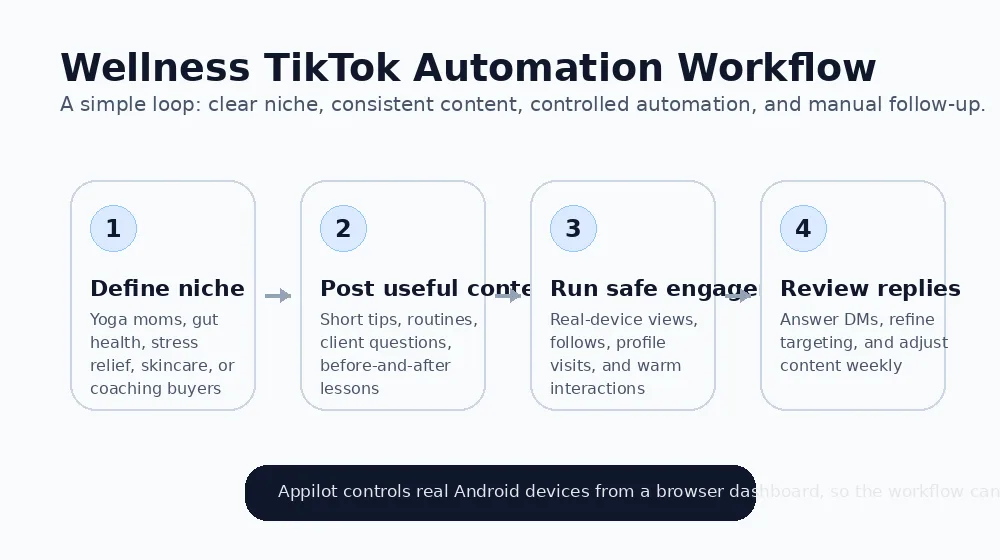
The smartest way to use TikTok bots is not to blast random people. It is to support a focused audience-building workflow that already makes sense manually.
For example, imagine you are building a wellness brand around stress relief for busy professionals. Manually, you would search for creators talking about burnout, breathwork, sleep routines, anxiety management, productivity fatigue, and workplace stress. You would watch videos, follow relevant people, engage with comments, and look for users who seem genuinely interested.
A bot can handle parts of that discovery loop while you focus on creating better content and responding to real conversations.
One practical use case is targeted profile engagement. Instead of manually visiting hundreds of profiles that interact with wellness creators in your niche, automation can help discover and engage with users who already show interest in similar content. That does not guarantee followers, but it increases the number of relevant people who see your brand.
Another use case is competitor audience discovery. If a wellness coach, yoga studio, supplement brand, or skincare creator has an audience similar to yours, their followers can be a useful starting point. A TikTok bot can help interact with that audience gradually, so your account appears in front of people who already care about your category.
Appilot’s TikTok bot can be used for this kind of workflow because it runs through mobile device sessions instead of relying only on desktop-style automation. For a new wellness brand, that means you can configure activity around relevant audiences and let the system run while you work on content, customer support, product development, or coaching calls.
A third use case is warming up a new TikTok account. New accounts should not jump straight into aggressive activity. They need posting consistency, natural watch behavior, gradual engagement, and conservative limits. A controlled bot can help with light activity while the account builds history.
The fourth use case is supporting DM and lead generation workflows. This should be handled carefully. A wellness brand should never send spammy health claims or generic sales messages. But if someone follows you, comments on a video, or asks a relevant question, automation can help organize the follow-up process, while the actual conversation still feels human and specific.
That last part matters. Wellness is personal. Automation can open the door, but trust is still built by real communication.
What Results Should You Realistically Expect?
A TikTok bot will not turn a brand-new wellness page into a massive account overnight. That is not how sustainable growth works.
A realistic early goal is to create consistent account activity, improve discovery, and generate more profile visits from relevant users. For a new wellness brand, seeing a few hundred targeted profile visits or several dozen new followers in the first few weeks can be a useful signal, especially if those people match your niche.
The first two to three weeks are usually about testing. You are learning which content topics get watched, which audience segments respond, and which engagement patterns feel natural. If your content is weak, unclear, or too generic, automation will only expose that problem faster.
The brands that get the best results usually have a clear niche. “Wellness” is too broad. “Five-minute mobility routines for remote workers” is easier to grow. “Gut-friendly meal prep for busy moms” is easier to target. “Simple skincare education for women over 35” gives the bot and the content strategy something specific to work with.
Automation helps distribution. Content still creates trust.
Setting Up a TikTok Bot for a Wellness Brand
The setup should start with the account, not the tool. Before running any automation, your TikTok profile should look trustworthy. That means a clear bio, a recognizable brand name, a profile image, a simple offer, and at least a few useful videos already posted.
Next, decide whether you want to run automation on a real Android device or an emulator. Real devices are often preferred when account trust matters because they create a more natural mobile environment. Emulators can still be useful, especially for testing or lower-risk workflows, but the account setup should be consistent.
You also need to think about proxies. If you are managing one wellness brand account, the setup may be simple. If you are managing multiple accounts, mobile or residential proxies can help keep sessions separated and reduce suspicious overlap. This is especially important for agencies handling multiple wellness creators or product brands.
One reason wellness operators and small teams may prefer Appilot is that the workflow is managed from a browser dashboard. You are not dealing with ADB cables, command lines, driver issues, or custom scripts just to start basic automation. For someone whose real skill is wellness content, coaching, product education, or community building, that simplicity matters.
After the device and account are connected, you should configure targeting carefully. Start with niche hashtags, competitor audiences, creator categories, location filters if relevant, and conservative action limits. A local yoga studio should not target global supplement audiences. A skincare brand should not engage with random fitness hashtags just because they are popular.
The first two weeks should be slow. Watch the activity, check follower quality, review comments, and adjust targeting. Good automation is not “set it and forget it forever.” It is more like a controlled growth system that you tune as you learn.
Common Mistakes Wellness Brands Should Avoid
Targeting Everyone Interested in Wellness
“Wellness” is too broad for useful automation. A person interested in bodybuilding, meditation, skincare, vegan meals, hormone health, and cold plunges may all sit under wellness, but they are not the same buyer.
Your targeting should match the specific audience your brand serves. The narrower the audience, the better your engagement quality usually becomes.
Running Automation Before Posting Enough Content
If someone visits your profile and sees only one vague video, they probably will not follow. Automation can bring people to your page, but your content has to give them a reason to stay.
Before scaling activity, post at least several videos that clearly explain who you help, what you teach, and why your brand is worth following.
Using Aggressive Action Limits Too Early
New accounts should not behave like established accounts. Sudden spikes in follows, likes, profile visits, or DMs can look unnatural.
Start slow, increase gradually, and treat the first few weeks as account conditioning rather than aggressive growth.
Sending Generic Wellness Sales Messages
This is one of the fastest ways to damage trust. A message like “Hey, check out my wellness product” feels cold and careless.
If you use automation around DMs, keep it triggered, relevant, and human-reviewed whenever possible. Wellness buyers need confidence, not pressure.
Ignoring the Content Side
A bot can help more people notice you, but it cannot fix unclear positioning, weak videos, poor hooks, or unsupported claims.
Your content should answer real questions, show expertise, and make your brand feel safe to trust.
Is TikTok Bot Automation Right for Your Wellness Brand?
TikTok bot automation can make sense if you already know your niche, have a clear product or service, and are willing to post consistently. It is especially useful when you are spending too much time manually engaging and want a more structured way to reach relevant users.
It may not be the right move if your account has no content, your offer is unclear, or your industry requires strict compliance review before any public claims are made. Wellness content can touch sensitive topics, so you need to be careful with medical claims, testimonials, and promises.
The best fit is a brand that wants more top-of-funnel attention but still understands that trust, content, and real conversation drive the final result.
Final Thoughts
Growing a wellness brand from zero is not just about getting views. It is about getting the right people to notice you often enough to trust you.
TikTok bots can help with that discovery layer, especially when they run through real-device workflows and conservative limits. But they work best when paired with useful content, clear targeting, and real follow-up.
If you are tired of manually searching hashtags, watching competitor audiences, and trying to engage from scratch every day, Appilot is worth exploring. It offers ready-to-use bots for TikTok, Instagram, LinkedIn, and other platforms through a web dashboard, with no coding required. You can check it out at appilot.app.
FAQs
Q1: Are TikTok bots safe for wellness brands?
TikTok bots carry some risk, especially if used aggressively. Real-device automation with slow limits is generally safer than API-based or spam-style tools.
Q2: Can a TikTok bot grow a wellness brand from zero?
Yes, it can help with discovery and engagement, but content quality still matters. A bot brings attention; your videos and offer convert that attention.
Q3: How fast should a new wellness brand run TikTok automation?
Start slowly for the first two to three weeks. New accounts should use conservative limits and increase activity only after stable posting and engagement.
Q4: What kind of wellness brands can use TikTok bots?
Fitness coaches, yoga studios, skincare brands, supplement companies, nutrition creators, and wellness consultants can use them if targeting is specific and compliant.
Q5: Do I need coding skills to use a TikTok bot?
Not necessarily. Tools like Appilot provide ready-to-use bots through a web dashboard, so you can manage automation without writing code.