VPN Leaks vs Proxy Leaks: Key Differences
When trying to mask your identity online, VPNs and proxies are commonly used tools. However, both can fail in different ways, leading to what are known as leaks. These leaks expose your real network information, creating inconsistencies that websites can detect.
Understanding the difference between VPN leaks and proxy leaks is important because they occur at different layers and require different solutions. This guide explains how each type of leak works and how they compare.
What Is a VPN Leak?
A VPN leak occurs when your device unintentionally sends traffic outside the encrypted VPN tunnel. Instead of routing all data through the VPN server, some requests bypass it and go directly through your internet service provider.
This exposes your real IP address or network information.
VPN leaks can happen due to configuration issues, protocol limitations, or system behavior.
Common Types of VPN Leaks
VPN leaks can occur in multiple forms depending on how traffic is handled.
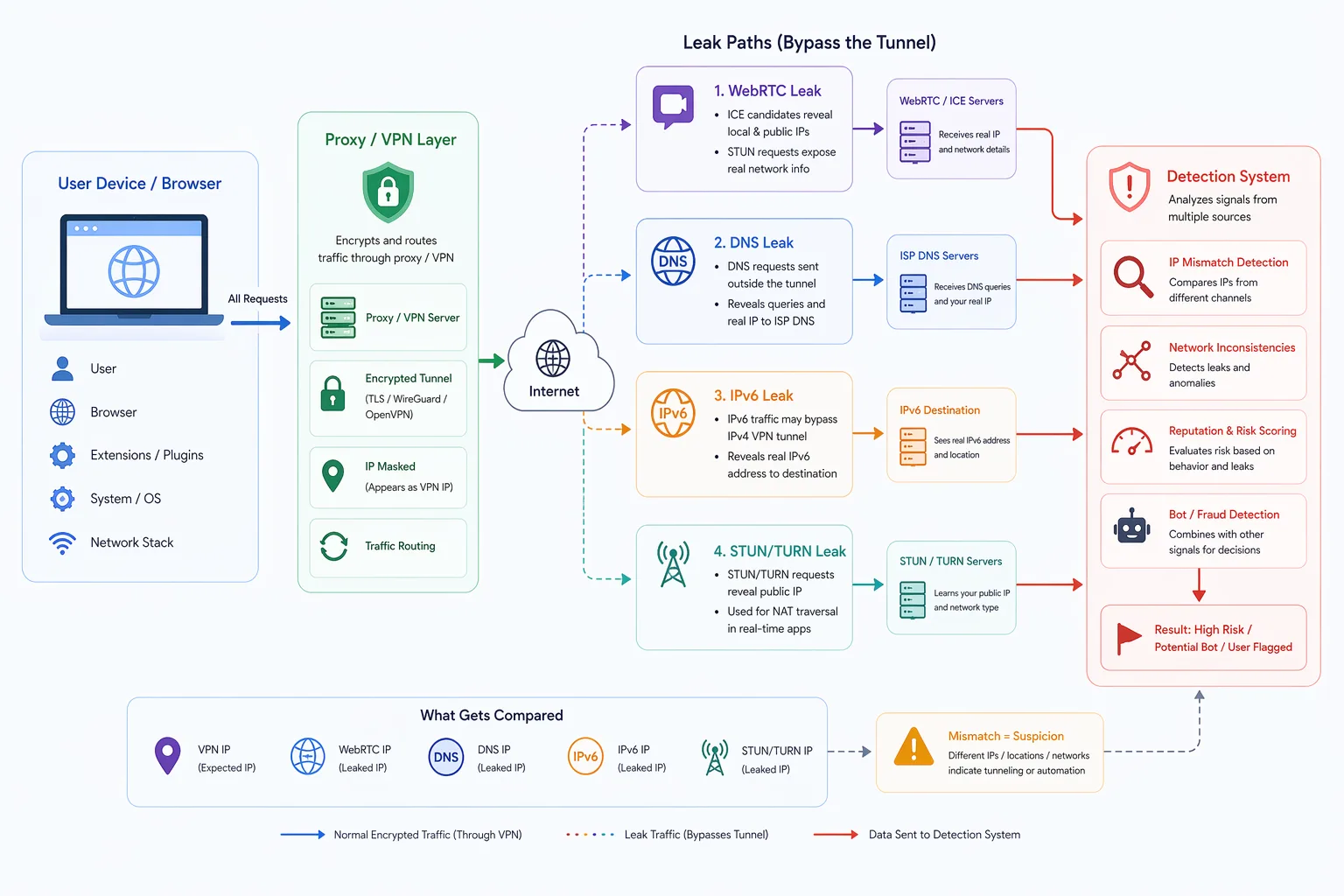
DNS leaks happen when domain resolution requests bypass the VPN and go through the ISP.
WebRTC leaks occur when browser-level communication reveals your real IP.
IPv6 leaks happen when IPv6 traffic is not routed through the VPN.
Each type exposes different aspects of your network.
What Is a Proxy Leak?
A proxy leak occurs when traffic that should pass through a proxy instead bypasses it and connects directly to the internet.
Unlike VPNs, proxies typically operate at the application level rather than encrypting all system traffic.
This makes them more susceptible to partial routing issues.
Proxy leaks can expose your real IP or create inconsistencies between different types of requests.
Common Causes of Proxy Leaks
Proxy leaks often result from incomplete configuration.
Some applications may not be configured to use the proxy.
Certain protocols or requests may bypass the proxy entirely.
Browser features like WebRTC can also reveal real IP information even when a proxy is in use.
Key Differences Between VPN Leaks and Proxy Leaks
The main difference between VPN leaks and proxy leaks lies in how traffic is routed.
VPNs operate at the system or network level, encrypting and routing all traffic through a secure tunnel.
Proxies operate at the application level, handling specific requests rather than all traffic.
Because of this, VPN leaks often involve system-wide issues, while proxy leaks are usually application-specific.
VPN leaks may expose multiple types of data, including DNS and IPv6 traffic. Proxy leaks are more likely to expose inconsistencies between different request paths.
Why These Leaks Matter
Both VPN and proxy leaks matter because they break the consistency of your network identity.
Even if most of your traffic is masked, a single leak can reveal your real IP.
Detection systems look for mismatches between different signals.
These inconsistencies are often used in bot detection and fraud prevention.
VPN Leaks vs Proxy Leaks in Detection Systems
Detection systems analyze multiple layers of network data.
If your HTTP requests show one IP while DNS or WebRTC reveals another, it creates a clear anomaly.
VPN leaks often produce broader inconsistencies across multiple protocols.
Proxy leaks tend to create inconsistencies within specific applications or requests.
Both can be detected when signals do not align.
VPN vs Proxy Reliability
VPNs are generally more reliable because they operate at a lower level in the network stack.
They are designed to route all traffic through a secure tunnel.
Proxies require more careful configuration because they only handle specific traffic.
This makes proxies more flexible but also more prone to leaks.
Limitations of Both Approaches
Neither VPNs nor proxies guarantee complete protection.
Misconfigurations, unsupported protocols, or browser features can still cause leaks.
Detection systems rely on multiple signals, so even minor inconsistencies can be identified.
This means that simply using a VPN or proxy is not sufficient on its own.
VPN/Proxy Leaks vs Real-Device Environments
A key distinction in modern detection is the difference between simulated routing and natural network behavior.
VPN and proxy setups can introduce inconsistencies if not properly configured.
Real-device approaches operate on actual hardware and networks where routing, IP exposure, and protocol behavior align naturally. Tools like Appilot follow this approach by running automation on real Android devices, where network signals remain consistent across all layers.
This reduces mismatches that detection systems rely on.
When VPN and Proxy Leaks Are Most Critical
Leaks are most critical in scenarios where network consistency is essential.
This includes authentication systems, geo-restricted platforms, and high-security environments.
In these contexts, mismatched IP data can trigger detection or restrictions.
Understanding this helps in managing risk.
Frequently Asked Questions
Q: What is a VPN leak?
It is when traffic bypasses the VPN tunnel and exposes real network data.
Q: What is a proxy leak?
It is when traffic bypasses a proxy and connects directly to the internet.
Q: Which is more secure, VPN or proxy?
VPNs are generally more secure due to full traffic routing.
Q: Can both VPNs and proxies leak?
Yes, both can leak if not properly configured.
Q: Why do leaks matter?
They create inconsistencies that can be detected.
Q: How do real-device solutions compare?
Real-device solutions like Appilot maintain consistent network behavior, reducing mismatches caused by leaks.
Key Takeaways
VPN leaks and proxy leaks both expose real network information, but they occur at different layers. VPN leaks affect system-wide traffic and can expose DNS, WebRTC, or IPv6 data, while proxy leaks are typically application-specific and result from incomplete routing. Both create inconsistencies that detection systems can identify. Preventing leaks requires proper configuration and a comprehensive approach to network management.