Understanding WebRTC Leak Detection and Prevention

WebRTC is a powerful browser feature, but it also introduces one of the most commonly overlooked privacy risks: IP leakage. While many users rely on proxies or VPNs to mask their identity, WebRTC can expose real network information at the browser level. Because of this, both detection systems and users actively monitor and manage WebRTC behavior.
Understanding how WebRTC leaks are detected and prevented is essential for maintaining consistency across network signals. This guide explains how detection works and what steps can be taken to reduce exposure.
What Is WebRTC Leak Detection?
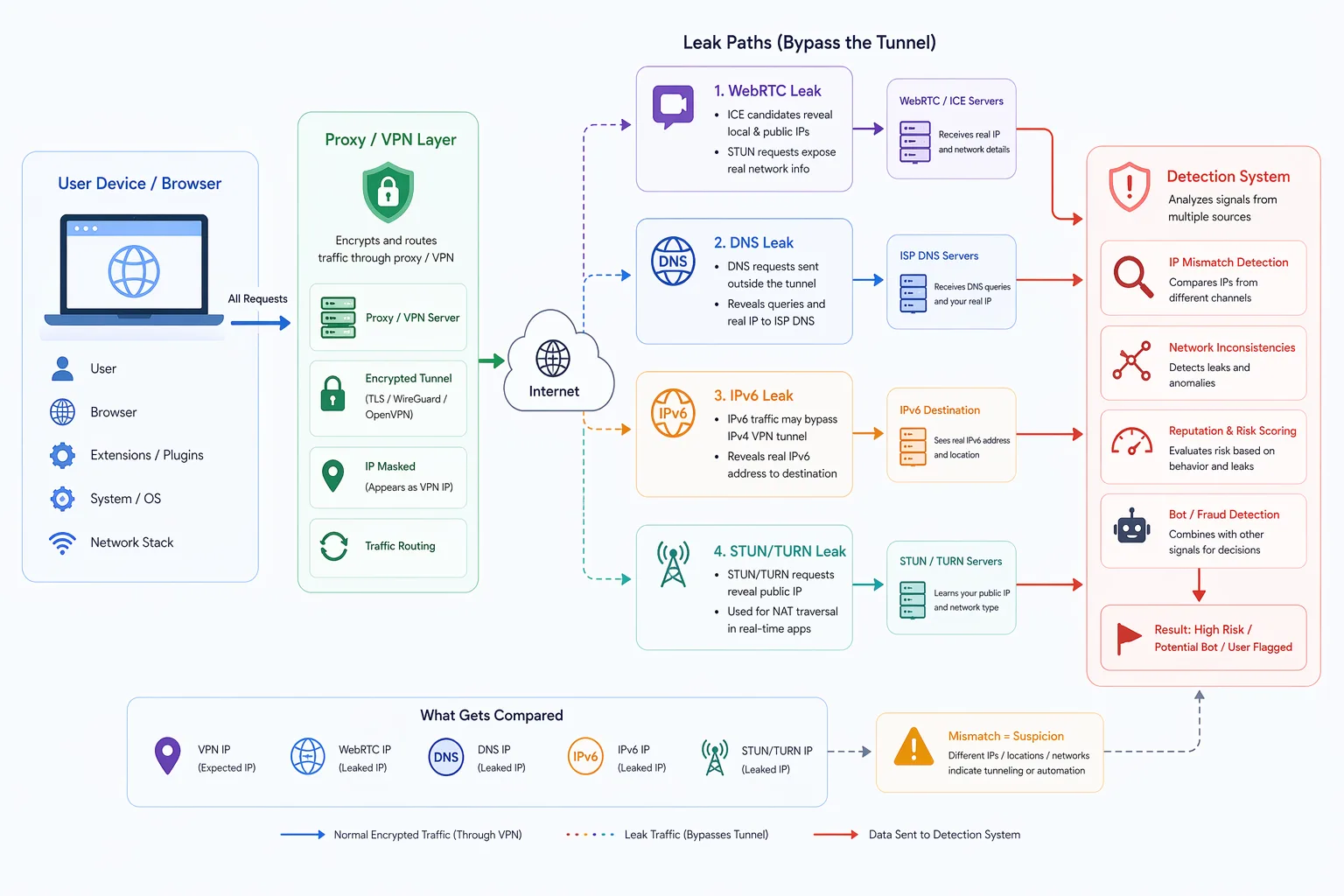
WebRTC leak detection is the process of identifying whether a browser exposes real IP addresses through WebRTC APIs. Websites and security systems use this method to check for inconsistencies between visible network data and actual device information.
Detection systems typically run JavaScript in the browser to gather IP candidates and compare them with the IP address observed from the request.
If multiple IPs are revealed, especially ones that do not match the expected routing, it can indicate a leak.
The Core Principle Behind Leak Detection
The core principle behind WebRTC leak detection is consistency. A legitimate browsing session should present a consistent network identity.
If the browser reports one IP through HTTP requests and a different IP through WebRTC, this mismatch can be flagged.
Detection systems rely on this inconsistency to identify proxies, VPNs, or modified environments.
How WebRTC Leak Detection Works
Detection systems use browser-level scripts to extract network information.
JavaScript IP Enumeration
Websites use JavaScript to access WebRTC APIs and retrieve ICE candidates.
These candidates include local IP addresses, public IP addresses, and sometimes multiple network interfaces.
The script collects this data and sends it back to the server for analysis.
IP Comparison
The detected IPs are compared with the IP address used to make the request.
If the values differ, it indicates that the browser is exposing additional network information.
This mismatch is a strong signal of a WebRTC leak.
Network Consistency Checks
Detection systems also evaluate whether the IPs belong to the same region or network type.
For example, a public IP from one country combined with a local IP from another region can raise suspicion.
These checks help identify anomalies.
Why WebRTC Leak Detection Matters
WebRTC leak detection is important because it exposes inconsistencies that can compromise privacy and reliability.
Even when traffic is routed through a proxy or VPN, a WebRTC leak can reveal the true network identity.
This creates a mismatch that detection systems can easily identify.
In environments where consistency is critical, such leaks can lead to restrictions or blocks.
How to Prevent WebRTC Leaks
Preventing WebRTC leaks involves controlling how the browser handles network information.
Disabling WebRTC
One of the most direct methods is disabling WebRTC in the browser.
This prevents the browser from generating ICE candidates that expose IP addresses.
However, it may also disable features like video calls.
Limiting IP Exposure
Some browsers allow configuration options that limit WebRTC to use only specific interfaces.
This reduces the likelihood of exposing local or real IP addresses.
These settings vary depending on the browser.
Using Browser Extensions
Extensions can modify or restrict WebRTC behavior.
They can block certain API calls or filter out sensitive data before it is exposed.
This provides an additional layer of control.
Consistent Network Configuration
Ensuring that all network signals align is critical.
If WebRTC is enabled, it should reflect the same network path as the main connection.
Inconsistent routing increases detection risk.
WebRTC Leak Prevention vs Detection Systems
Prevention focuses on reducing exposure, while detection systems focus on identifying inconsistencies.
Even when preventive measures are applied, detection systems may still analyze behavior and other signals.
This is why WebRTC management is only one part of a broader strategy.
Combining multiple approaches improves reliability.
Limitations of WebRTC Leak Prevention
Preventing WebRTC leaks is not always straightforward.
Disabling WebRTC may impact functionality in applications that rely on it.
Browser settings and extensions may not fully eliminate all leaks.
Additionally, detection systems use multiple signals, so addressing WebRTC alone is not sufficient.
These limitations highlight the need for a comprehensive approach.
WebRTC Leak Detection vs Other Signals
WebRTC leak detection is often used alongside other detection methods.
It complements fingerprinting, behavioral analysis, and network checks.
While it provides strong evidence of inconsistency, it is rarely used in isolation.
Combining signals improves detection accuracy.
WebRTC vs Real-Device Environments
A key distinction in modern detection is the difference between simulated setups and real-device environments.
WebRTC leaks often create inconsistencies in environments where network routing is artificially modified.
Real-device approaches operate on actual hardware and network conditions where signals naturally align. Tools like Appilot follow this approach by running automation on real Android devices, where IP exposure, browser behavior, and network routing remain consistent.
This reduces mismatches that detection systems rely on.
When WebRTC Leak Detection Is Most Critical
WebRTC leak detection is most critical in scenarios where IP consistency is required.
This includes authentication systems, geo-restricted services, and platforms with strict security measures.
In these contexts, mismatched IP data can trigger detection mechanisms.
Understanding this helps in managing risk.
Frequently Asked Questions
Q: What is WebRTC leak detection?
It is the process of identifying IP exposure through WebRTC APIs.
Q: How do websites detect WebRTC leaks?
By comparing ICE candidate IPs with the request IP.
Q: Can WebRTC leaks be prevented?
They can be reduced through browser settings and extensions.
Q: Does disabling WebRTC solve everything?
No, other detection signals still apply.
Q: Why do mismatched IPs matter?
They indicate inconsistent network routing, which can trigger detection.
Q: How do real-device solutions compare?
Real-device solutions like Appilot maintain consistent network signals, reducing mismatches caused by WebRTC leaks.
Key Takeaways
WebRTC leak detection identifies inconsistencies between browser-reported IP addresses and actual network routing. It works by extracting ICE candidates through WebRTC APIs and comparing them with request IPs. Preventing leaks involves controlling WebRTC behavior through browser settings, extensions, or network configuration. While effective, WebRTC management is only one part of a broader detection landscape. Maintaining consistent signals across all layers is essential for reducing detection risk.